Imagining characters and stories
Students start the year by inventing characters and small story ideas from their own lives. They try out voices, faces, and bodies to bring a pretend person to life.
This is the year theatre shifts from playing pretend to building a scene on purpose. Students invent characters, plan what happens, and rehearse choices instead of just acting on impulse. They also start talking about why a scene works, using their own life and what they have seen to find meaning in a story. By spring, they can shape a short scene with a clear character and explain what it was about.
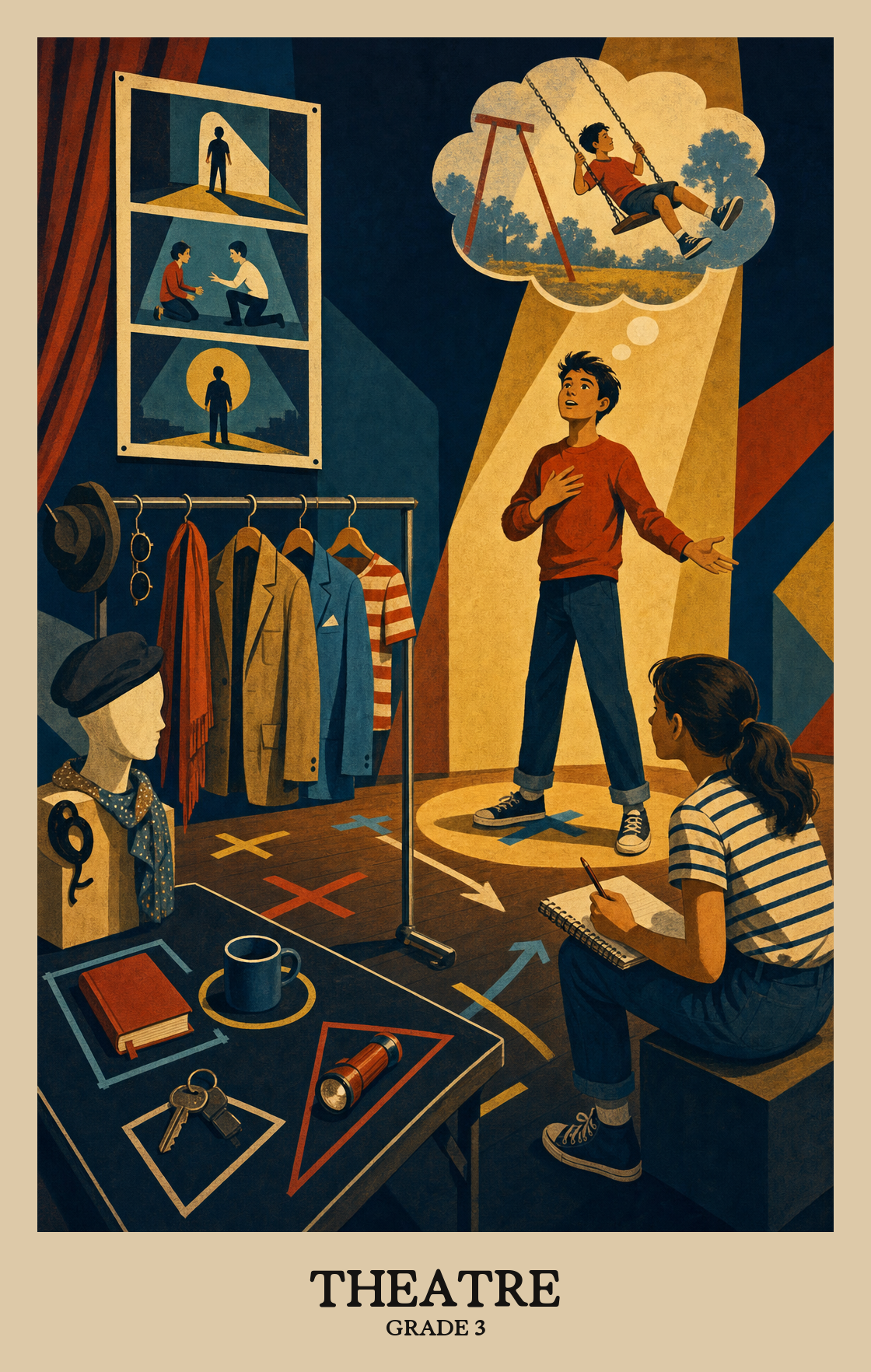
Students start the year by inventing characters and small story ideas from their own lives. They try out voices, faces, and bodies to bring a pretend person to life.
Students work in small groups to shape short scenes with a beginning, middle, and end. They practice listening to classmates and adding their own ideas to the story.
Students rehearse their scenes and make them better with each try. They work on speaking clearly, moving with purpose, and choosing simple costumes or props that help tell the story.
Students share their scenes with classmates or family. They focus on staying in character and making sure the audience understands what is happening.
Students watch plays and classmates' scenes and talk about what worked. They notice how a story connects to their own lives or to the world around them.
Students connect their own memories and experiences to the characters and stories they perform, using what they know from real life to make their acting feel true.
Students look at a play, puppet show, or performance and connect it to where and when it came from. Knowing that context helps them understand why the story was told that way.
| Standard | Definition | Code |
|---|---|---|
| Synthesize and relate knowledge and personal experiences to make art | Students connect their own memories and experiences to the characters and stories they perform, using what they know from real life to make their acting feel true. | TH:Cn10.3 |
| Relate artistic ideas and works with societal, cultural | Students look at a play, puppet show, or performance and connect it to where and when it came from. Knowing that context helps them understand why the story was told that way. | TH:Cn11.3 |
Students brainstorm characters, settings, and simple story ideas to build a short scene or play. The focus is on imagining new possibilities, not polishing a final product.
Students take the characters and scenes they imagined and shape them into a short play, deciding what happens first, next, and last so the story holds together on stage.
Students revisit a scene or character they have been building and make specific changes to improve it, then present the finished piece to the class.
| Standard | Definition | Code |
|---|---|---|
| Generate and conceptualize artistic ideas and work | Students brainstorm characters, settings, and simple story ideas to build a short scene or play. The focus is on imagining new possibilities, not polishing a final product. | TH:Cr1.3 |
| Organize and develop artistic ideas and work | Students take the characters and scenes they imagined and shape them into a short play, deciding what happens first, next, and last so the story holds together on stage. | TH:Cr2.3 |
| Refine and complete artistic work | Students revisit a scene or character they have been building and make specific changes to improve it, then present the finished piece to the class. | TH:Cr3.3 |
Students choose a character or scene to perform and explain why it fits the story they want to tell.
Students practice a scene or monologue more than once, making small adjustments to voice, movement, or timing until the performance is ready to share with an audience.
Students perform a short scene or monologue and make deliberate choices, like tone of voice or movement, to communicate a feeling or idea to the audience.
| Standard | Definition | Code |
|---|---|---|
| Analyze, interpret, and select artistic work for presentation | Students choose a character or scene to perform and explain why it fits the story they want to tell. | TH:Pr4.3 |
| Develop and refine artistic techniques and work for presentation | Students practice a scene or monologue more than once, making small adjustments to voice, movement, or timing until the performance is ready to share with an audience. | TH:Pr5.3 |
| Convey meaning through the presentation of artistic work | Students perform a short scene or monologue and make deliberate choices, like tone of voice or movement, to communicate a feeling or idea to the audience. | TH:Pr6.3 |
Students look closely at a short play or performance and describe what they notice, such as how an actor moves, speaks, or reacts to another character on stage.
Students explain what a scene or character means to them and why the playwright or actor may have made specific choices. They look for clues in the story to back up their thinking.
Students look at a scene or performance and decide what works and what doesn't, using a simple set of criteria like whether the actor spoke clearly or stayed in character.
| Standard | Definition | Code |
|---|---|---|
| Perceive and analyze artistic work | Students look closely at a short play or performance and describe what they notice, such as how an actor moves, speaks, or reacts to another character on stage. | TH:Re7.3 |
| Interpret intent and meaning in artistic work | Students explain what a scene or character means to them and why the playwright or actor may have made specific choices. They look for clues in the story to back up their thinking. | TH:Re8.3 |
| Apply criteria to evaluate artistic work | Students look at a scene or performance and decide what works and what doesn't, using a simple set of criteria like whether the actor spoke clearly or stayed in character. | TH:Re9.3 |
Students make up short scenes, play characters, and act out stories from books or their own lives. They also watch classmates perform and talk about what worked. Most of the year is spent on small group work, not big stage productions.
Read a story together and ask students to act out a scene as one of the characters. Ask why the character did what they did, and how their voice or face might change. Ten minutes of pretend play counts as real practice.
No. Shy students often do well with puppets, voice acting, or playing a character behind a mask. At home, let students perform for a stuffed animal or a pet before a person. Comfort grows with low-pressure practice.
Start with imagination and improv games so students get comfortable making choices in front of peers. Move into building characters and short scenes by mid-year. Save rehearsing and presenting polished work for the last stretch, once trust in the room is solid.
Students can take a story or idea, build a short scene with a clear character and problem, rehearse it, and perform it for classmates. They can also watch a peer's scene and say something specific about what the actor did and what it meant.
Two things tend to lag: giving useful feedback to peers, and refining a scene instead of just running it again. Build short feedback routines with sentence starters, and model what it looks like to change one thing and try the scene a second time.
Not much at this age. Most scenes are improvised or read from a short script. If lines come home to practice, run them a few times at dinner and let students try different voices or feelings rather than drilling word-for-word.
Acting out a story builds reading comprehension, since students have to figure out what a character wants and how they feel. Scenes about history or culture also give students a way into social studies that sticks better than a worksheet.
Students should be able to play a character with a clear voice and body, work with a small group to plan a short scene, and say something thoughtful about a performance they watched. Confidence in front of the class matters more than talent.