Moving with purpose
Students start the year exploring how their bodies move through space. They try different shapes, levels, and speeds, and learn to warm up and move safely with others in the room.
This is the year dance shifts from copying steps to shaping short pieces with a purpose. Students pull ideas from their own lives and from stories they have read, then turn those ideas into movement they can practice and polish. They learn to watch a dance and say what it means, not just whether they liked it. By spring, students can perform a short dance they helped create and explain the idea behind it.
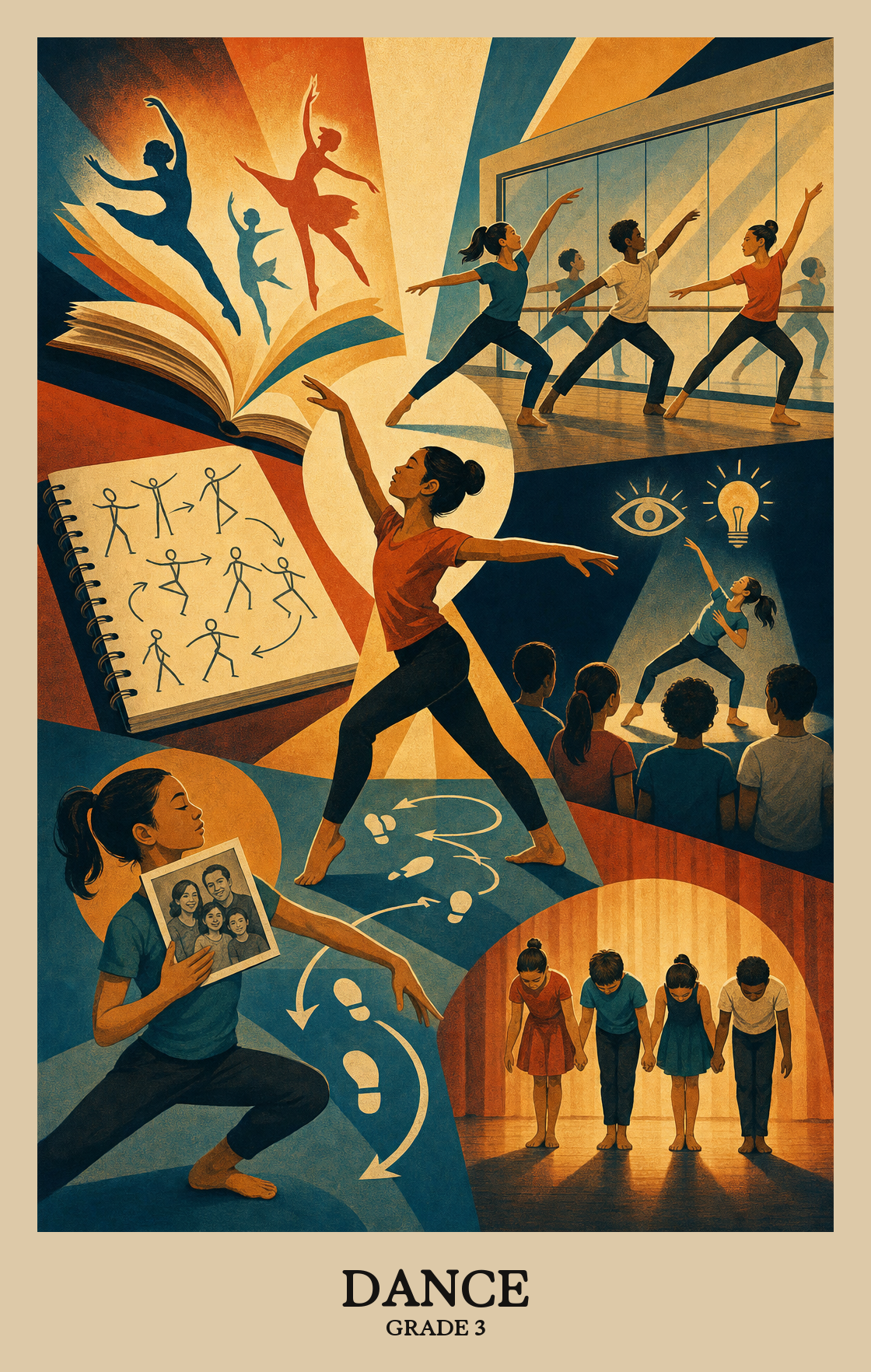
Students start the year exploring how their bodies move through space. They try different shapes, levels, and speeds, and learn to warm up and move safely with others in the room.
Students begin inventing their own short dances. They pull ideas from stories, pictures, and their own lives, then string movements together so the dance has a clear beginning, middle, and end.
Students rehearse their dances and clean up the details. They work on staying in time, hitting their spots, and making each movement clearer so an audience can follow what is happening.
Students show their dances to classmates and talk about what the movement means. They learn to perform with focus and to explain the feeling or idea behind the choices they made.
Students watch dances from their classmates and from other cultures and time periods. They describe what they notice, guess at what the dancer is trying to say, and give kind, specific feedback.
Students connect something from their own life to a dance they create or perform. A memory, a feeling, or something they've noticed in the world becomes part of the movement.
Students look at dances from different times and places to understand what life was like for the people who created them.
| Standard | Definition | Code |
|---|---|---|
| Synthesize and relate knowledge and personal experiences to make art | Students connect something from their own life to a dance they create or perform. A memory, a feeling, or something they've noticed in the world becomes part of the movement. | DA:Cn10.3 |
| Relate artistic ideas and works with societal, cultural | Students look at dances from different times and places to understand what life was like for the people who created them. | DA:Cn11.3 |
Students brainstorm ideas for a dance and start shaping them into movement. They explore what a body can do and make choices about how a piece begins to take form.
Students take their movement ideas and shape them into a short dance, choosing how pieces fit together to make the whole thing work.
Students revisit a dance they made, fix what isn't working, and decide when it's ready to share.
| Standard | Definition | Code |
|---|---|---|
| Generate and conceptualize artistic ideas and work | Students brainstorm ideas for a dance and start shaping them into movement. They explore what a body can do and make choices about how a piece begins to take form. | DA:Cr1.3 |
| Organize and develop artistic ideas and work | Students take their movement ideas and shape them into a short dance, choosing how pieces fit together to make the whole thing work. | DA:Cr2.3 |
| Refine and complete artistic work | Students revisit a dance they made, fix what isn't working, and decide when it's ready to share. | DA:Cr3.3 |
Students choose a dance or movement piece to perform and explain why it fits the audience or occasion.
Students practice and improve a dance piece until it's ready to share with an audience. That means refining movement, staying in control of the body, and making intentional choices about how the dance looks and feels.
Students perform a dance and make deliberate choices, like timing, expression, and spatial design, so the movement communicates a clear idea or feeling to an audience.
| Standard | Definition | Code |
|---|---|---|
| Analyze, interpret, and select artistic work for presentation | Students choose a dance or movement piece to perform and explain why it fits the audience or occasion. | DA:Pr4.3 |
| Develop and refine artistic techniques and work for presentation | Students practice and improve a dance piece until it's ready to share with an audience. That means refining movement, staying in control of the body, and making intentional choices about how the dance looks and feels. | DA:Pr5.3 |
| Convey meaning through the presentation of artistic work | Students perform a dance and make deliberate choices, like timing, expression, and spatial design, so the movement communicates a clear idea or feeling to an audience. | DA:Pr6.3 |
Students watch a dance and describe what they notice, such as how the dancer moves through space or changes speed. Then they start explaining why those choices matter.
Students look at a dance and explain what they think the dancer is trying to say or show. They use what they see in the movement to back up their thinking.
Students use a short checklist or simple questions to judge a dance, explaining what works and what could be stronger.
| Standard | Definition | Code |
|---|---|---|
| Perceive and analyze artistic work | Students watch a dance and describe what they notice, such as how the dancer moves through space or changes speed. Then they start explaining why those choices matter. | DA:Re7.3 |
| Interpret intent and meaning in artistic work | Students look at a dance and explain what they think the dancer is trying to say or show. They use what they see in the movement to back up their thinking. | DA:Re8.3 |
| Apply criteria to evaluate artistic work | Students use a short checklist or simple questions to judge a dance, explaining what works and what could be stronger. | DA:Re9.3 |
Students make up short dances, practice them, perform for classmates, and talk about what they saw. They use ideas from their own lives and from stories or cultures they are learning about. The focus is on creating, performing, and responding to dance, not just following steps.
Put on music and ask students to invent a short movement that shows a feeling or tells part of a story. Watch a dance clip together and ask what the dancers were trying to say. Five minutes of moving and talking about it goes a long way.
Yes. Students are learning to plan ideas, revise their work, perform for an audience, and give thoughtful feedback. Those are the same habits used in writing and science, just expressed through movement.
Start with exploring movement ideas and basic choreography choices, then move into shaping and refining short pieces. Build performance skills in the middle of the year, and save structured peer feedback and cultural context work for later, once students have language for what they see.
Students can generate a movement idea, shape it into a short dance with a clear beginning and end, perform it with focus, and explain what it means. They can also watch a peer's dance and give specific feedback tied to simple criteria.
Refining work is the hardest part. Students often want to call a first draft finished. Plan extra time for revision cycles where students try a section two or three different ways before choosing one.
Give students a short list of things to look for, like shape, energy, or how the dance matches the music. Feedback stays on the dance, not the dancer. Modeling one or two sentence frames early in the year sets the tone for the rest of it.
By spring, students should be comfortable performing in front of peers, taking a movement idea through a draft and a revision, and connecting a dance to a story, culture, or experience. That foundation sets up more complex choreography and analysis next year.