Building the ensemble
Students start the year learning how to work as a theatre group. They try out improv games, share story ideas from their own lives, and get comfortable speaking and moving in front of classmates.
This is the year theatre shifts from playing pretend to building characters on purpose. Students draw on their own lives to shape a role, then rehearse choices about voice, movement, and timing instead of just winging it. They also start watching plays with a critic's eye, asking what the story means and whether it worked. By spring, students can rehearse a short scene, perform it for classmates, and explain the choices behind their character.
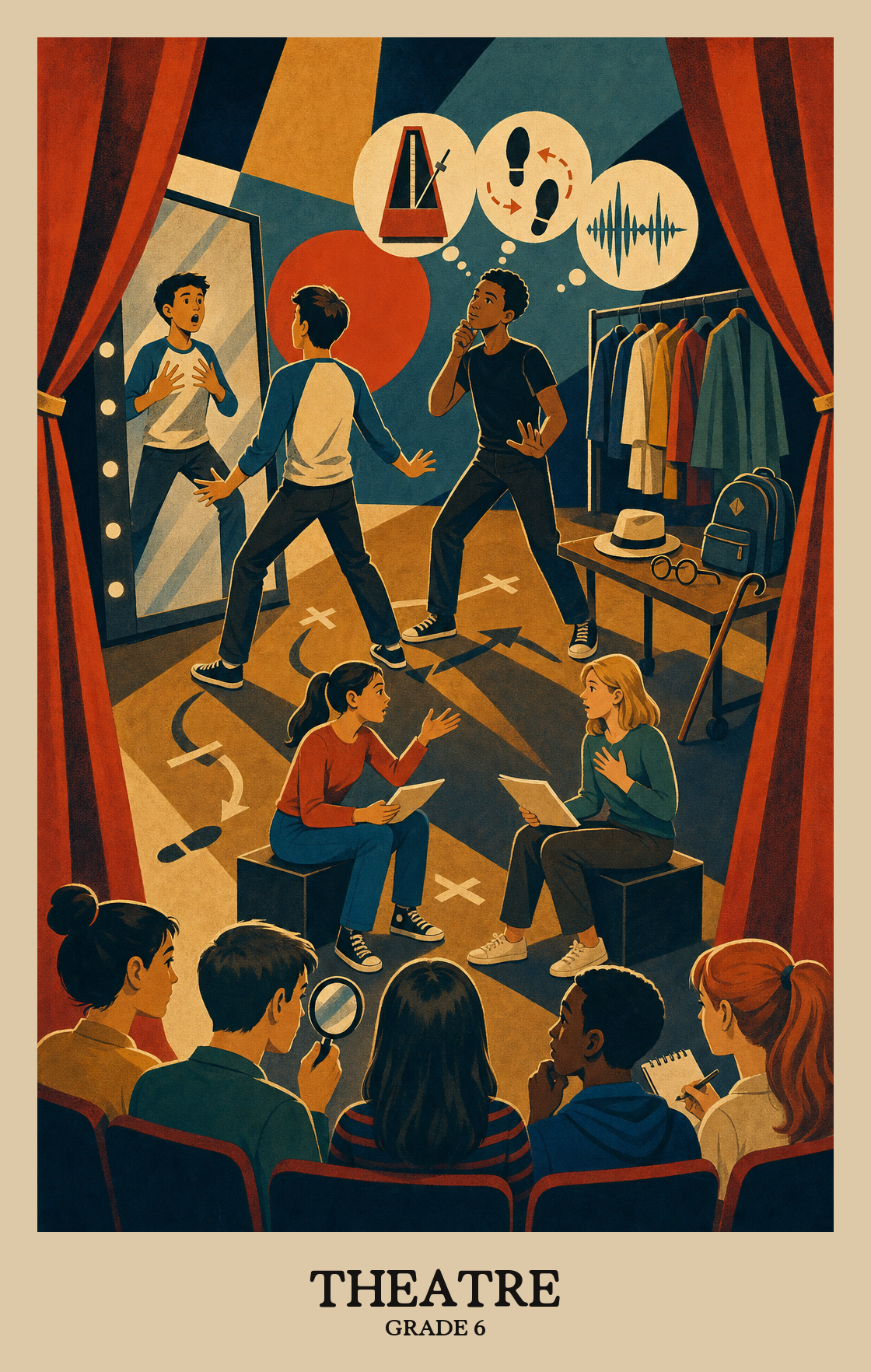
Students start the year learning how to work as a theatre group. They try out improv games, share story ideas from their own lives, and get comfortable speaking and moving in front of classmates.
Students develop short scenes and build characters with clear voices and motivations. They learn to revise their work after feedback and try out different choices before settling on what feels right.
Students pick scenes worth performing and rehearse the craft behind them, including voice, movement, and timing. They work on conveying meaning so an audience understands what the scene is about.
Students watch performances and talk about what worked and why. They learn to back up opinions with specific moments from the show and to connect plays to history, culture, and their own experience.
Students connect their own memories and observations to the characters and stories they perform or create. Personal experience shapes how they interpret a scene or build a role.
Students connect a play or performance to the time and place it came from. Knowing that context helps them understand why the story, characters, or choices matter beyond the stage.
| Standard | Definition | Code |
|---|---|---|
| Synthesize and relate knowledge and personal experiences to make art | Students connect their own memories and observations to the characters and stories they perform or create. Personal experience shapes how they interpret a scene or build a role. | TH:Cn10.6 |
| Relate artistic ideas and works with societal, cultural | Students connect a play or performance to the time and place it came from. Knowing that context helps them understand why the story, characters, or choices matter beyond the stage. | TH:Cn11.6 |
Students brainstorm ideas for characters, scenes, or stories and start shaping those ideas into something that could become a performance.
Students take a rough idea for a scene or character and shape it into something that works on stage, making choices about what to keep, cut, or change.
Students revisit a scene or script they've written and revise it, sharpening dialogue and stage directions until the piece is ready to perform or share.
| Standard | Definition | Code |
|---|---|---|
| Generate and conceptualize artistic ideas and work | Students brainstorm ideas for characters, scenes, or stories and start shaping those ideas into something that could become a performance. | TH:Cr1.6 |
| Organize and develop artistic ideas and work | Students take a rough idea for a scene or character and shape it into something that works on stage, making choices about what to keep, cut, or change. | TH:Cr2.6 |
| Refine and complete artistic work | Students revisit a scene or script they've written and revise it, sharpening dialogue and stage directions until the piece is ready to perform or share. | TH:Cr3.6 |
Students choose a scene or monologue to perform and explain why it fits the moment, the audience, and the story they want to tell.
Students rehearse a scene or monologue, then revise their choices about voice, movement, and timing until the performance is ready to share with an audience.
Students perform a scene or monologue and make deliberate choices, such as tone, movement, or timing, so the audience understands what the piece is really about.
| Standard | Definition | Code |
|---|---|---|
| Analyze, interpret, and select artistic work for presentation | Students choose a scene or monologue to perform and explain why it fits the moment, the audience, and the story they want to tell. | TH:Pr4.6 |
| Develop and refine artistic techniques and work for presentation | Students rehearse a scene or monologue, then revise their choices about voice, movement, and timing until the performance is ready to share with an audience. | TH:Pr5.6 |
| Convey meaning through the presentation of artistic work | Students perform a scene or monologue and make deliberate choices, such as tone, movement, or timing, so the audience understands what the piece is really about. | TH:Pr6.6 |
Students watch a scene or performance and describe what they notice: how the actors move, speak, and use the space to tell the story.
Students explain what a scene, character, or design choice is trying to say and why the creator made it that way.
Students pick a scene or performance and judge it using a clear set of standards. They explain what worked, what didn't, and why, using specific reasons rather than just personal taste.
| Standard | Definition | Code |
|---|---|---|
| Perceive and analyze artistic work | Students watch a scene or performance and describe what they notice: how the actors move, speak, and use the space to tell the story. | TH:Re7.6 |
| Interpret intent and meaning in artistic work | Students explain what a scene, character, or design choice is trying to say and why the creator made it that way. | TH:Re8.6 |
| Apply criteria to evaluate artistic work | Students pick a scene or performance and judge it using a clear set of standards. They explain what worked, what didn't, and why, using specific reasons rather than just personal taste. | TH:Re9.6 |
Students build short scenes, play characters, and talk about what makes a performance work. They move between making theatre, performing it, watching it, and connecting it to real life. Expect more group work and more thinking about why a character behaves a certain way.
Start small. Read a short scene from a book or movie out loud together and take different parts. Ask what the character wants and how their voice should sound. Five minutes of this a few times a week builds confidence faster than pushing for a big performance.
Not usually. Sixth graders work with short scenes and improvised moments more than long memorized speeches. The focus is on making clear choices about a character, not on reciting lines perfectly.
A common arc starts with ensemble and improv work in the fall, moves into scripted scene work in the winter, then ends with a devised or rehearsed piece in the spring. This lets skills in creating, performing, and responding build on each other instead of competing for time.
Giving useful feedback to peers and revising a scene after notes. Students can generate ideas, but applying criteria to their own work and trying a second draft of a scene takes repeated practice across the year.
Ask what character they played this week and what that character wanted. If they can answer, they are doing real work even when it looks like play. The questions show that the thinking behind the scene matters.
By spring, students should be able to make a clear character choice, take a note from a peer or teacher, and try the scene again with that note applied. They should also be able to say what a scene was about and back it up with something they saw or heard.
Students look at where a story comes from and what it meant to the people who first told it. A short scene from a folk tale or a historical moment gives students something to research, perform, and discuss without needing a full production.