Listening with a musician's ear
Students start the year by really listening. They notice things like tempo, mood, and instruments in a song, and begin talking about what the music seems to be saying.
This is the year music shifts from following directions to making real choices. Students come up with their own musical ideas, shape them into short pieces, and then rehearse to perform what they made. They also listen with sharper ears, explaining why a song works and how it connects to a time or place. By spring, students can perform a piece they helped create and talk about the choices behind it.
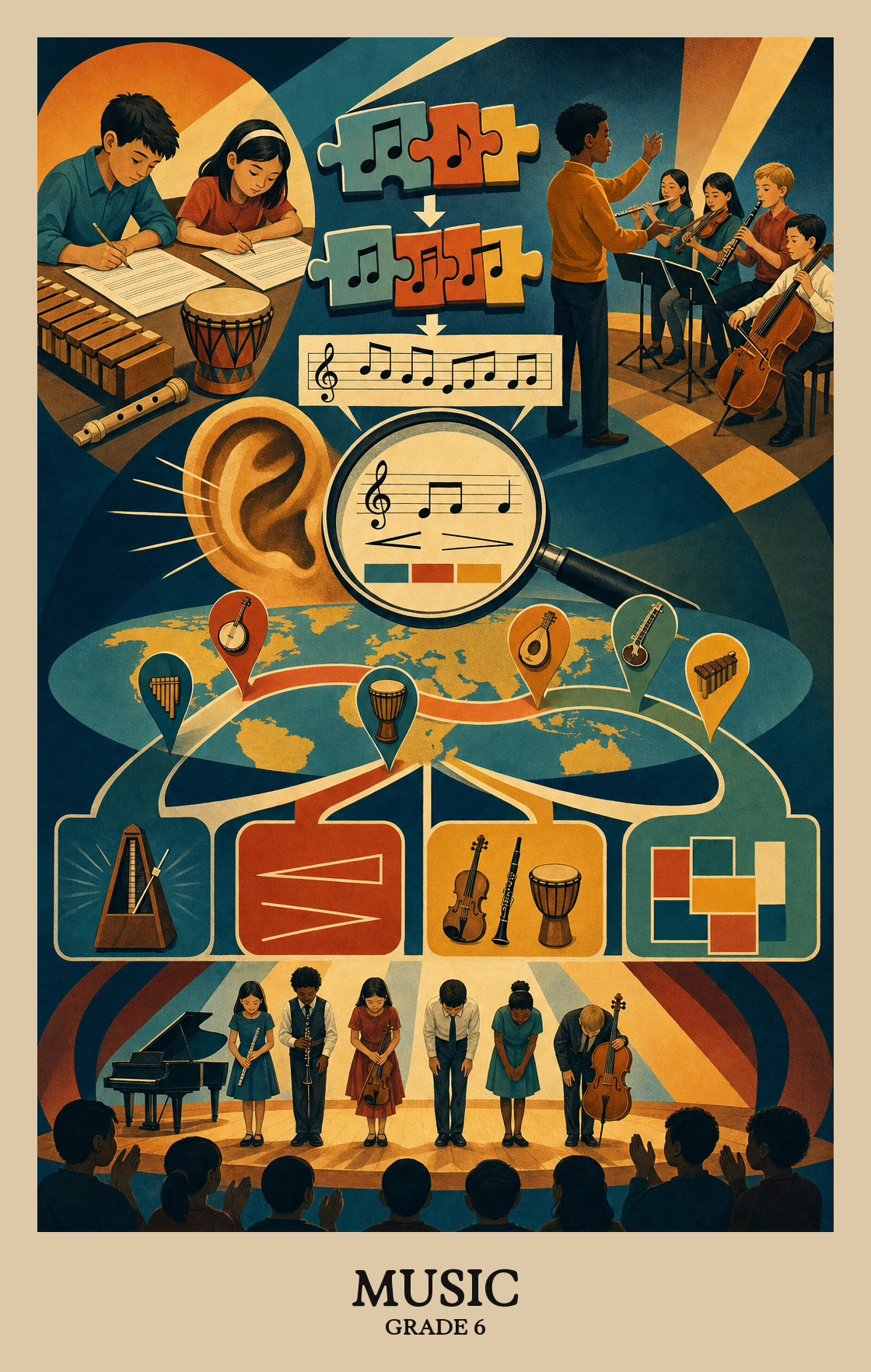
Students start the year by really listening. They notice things like tempo, mood, and instruments in a song, and begin talking about what the music seems to be saying.
Students try writing their own short pieces or melodies. They play with rhythms and patterns, then shape rough ideas into something that sounds finished.
Students pick music to perform and work on the small details that make it sound right. They rehearse, get feedback, and revise until the piece is ready for an audience.
Students connect songs to the people and moments behind them. They look at how a piece fits its culture or history, and how their own experiences shape what they hear.
Students perform for others and use clear criteria to evaluate music, including their own. They explain what worked, what didn't, and what they would change next time.
Students connect what they already know and what they've lived through to the music they create or perform. Personal experiences shape the choices they make as musicians.
Students look at a piece of music alongside the time period and culture it came from, then explain how that background shapes what the music sounds like and what it means.
| Standard | Definition | Code |
|---|---|---|
| Synthesize and relate knowledge and personal experiences to make art | Students connect what they already know and what they've lived through to the music they create or perform. Personal experiences shape the choices they make as musicians. | MU:Cn10.6 |
| Relate artistic ideas and works with societal, cultural | Students look at a piece of music alongside the time period and culture it came from, then explain how that background shapes what the music sounds like and what it means. | MU:Cn11.6 |
Students brainstorm and develop original musical ideas, sketching out melodies, rhythms, or lyrics that could become a finished piece.
Students take a musical idea, shape it into something more complete, and make decisions about structure, sound, and what to keep or cut.
Students revise a piece of music they composed, fixing parts that don't sound right and polishing it until it's ready to share.
| Standard | Definition | Code |
|---|---|---|
| Generate and conceptualize artistic ideas and work | Students brainstorm and develop original musical ideas, sketching out melodies, rhythms, or lyrics that could become a finished piece. | MU:Cr1.6 |
| Organize and develop artistic ideas and work | Students take a musical idea, shape it into something more complete, and make decisions about structure, sound, and what to keep or cut. | MU:Cr2.6 |
| Refine and complete artistic work | Students revise a piece of music they composed, fixing parts that don't sound right and polishing it until it's ready to share. | MU:Cr3.6 |
Students choose a piece of music to perform and explain why it fits their skill level and the audience they're playing for.
Students practice and revise a piece of music until it's ready to perform in front of others. The focus is on improving technique and presentation, not just playing through the song once.
Students perform a piece of music with a clear intent, making choices about dynamics, tempo, or expression to communicate something specific to the audience.
| Standard | Definition | Code |
|---|---|---|
| Analyze, interpret, and select artistic work for presentation | Students choose a piece of music to perform and explain why it fits their skill level and the audience they're playing for. | MU:Pr4.6 |
| Develop and refine artistic techniques and work for presentation | Students practice and revise a piece of music until it's ready to perform in front of others. The focus is on improving technique and presentation, not just playing through the song once. | MU:Pr5.6 |
| Convey meaning through the presentation of artistic work | Students perform a piece of music with a clear intent, making choices about dynamics, tempo, or expression to communicate something specific to the audience. | MU:Pr6.6 |
Students listen to a piece of music and break down what they hear: the rhythm, the melody, the instruments, and how the parts fit together.
Students explain what a piece of music is trying to express, using specific details from the melody, rhythm, or lyrics to back up their thinking.
Students listen to a piece of music and judge it using a specific set of criteria, explaining what works and what doesn't with reasons tied to what they actually heard.
| Standard | Definition | Code |
|---|---|---|
| Perceive and analyze artistic work | Students listen to a piece of music and break down what they hear: the rhythm, the melody, the instruments, and how the parts fit together. | MU:Re7.6 |
| Interpret intent and meaning in artistic work | Students explain what a piece of music is trying to express, using specific details from the melody, rhythm, or lyrics to back up their thinking. | MU:Re8.6 |
| Apply criteria to evaluate artistic work | Students listen to a piece of music and judge it using a specific set of criteria, explaining what works and what doesn't with reasons tied to what they actually heard. | MU:Re9.6 |
Students make their own music, perform pieces for others, and listen carefully to music from different times and places. They write short musical ideas, rehearse them, and talk about why a song sounds the way it does. By the end of the year, students can plan, practice, and share a piece they helped create.
Listening together is the most useful thing. Play a song, then ask what students notice about the beat, the mood, or the instruments. Five minutes of real conversation about a favorite song does more than any worksheet.
No. Class covers singing, playing classroom instruments, and creating short pieces, so there is room for beginners. Students are graded on effort, growth, and thoughtful choices, not on sounding like a trained musician.
Ask what students are creating or performing right now, and what role this student is playing. Sixth graders often want more say in what they play. A small change, like picking the song or the instrument, often turns boredom around.
Most teachers weave creating, performing, responding, and connecting into every unit instead of teaching them in blocks. A useful pattern is to anchor each unit in a piece or style, then build a short composition and a performance from it. Reflection and listening tasks fit naturally at the end of each unit.
Steady beat under changing rhythms, reading basic notation, and giving specific feedback instead of saying a piece was good or bad. Plan to revisit these in short warm-ups across the year rather than in one unit. Composition also stalls without clear limits, so give students a small frame to work inside.
Students can perform a prepared piece with control, create a short original piece with a clear beginning and end, and explain choices using musical words like tempo, dynamics, and form. They can also listen to an unfamiliar piece and say something specific about how it was made and what it might mean.
Look for a student who can keep a steady beat, sing or play a short piece from memory, and talk about music using more than just liked it or did not like it. Comfort working with a small group on a performance is a good sign too. Gaps in any of these are normal and easy to close with practice.
Enough to give every piece a reason for being in the room, but not so much that class turns into a history lecture. A short context conversation before playing or listening usually does the work. Students should be able to say where a piece comes from and why that matters to how it sounds.