Building the actor's toolkit
Students warm up the year with voice, movement, and focus exercises. They try out characters by changing how they stand, speak, and react, and they start brainstorming story ideas drawn from their own lives.
This is the year theatre shifts from playing a part to making deliberate choices behind it. Students build characters from their own experiences and from the world a script comes from, then refine those choices through rehearsal. They also start judging plays with real criteria, not just gut reactions. By spring, students can rehearse a scene, explain why they made the choices they did, and give a classmate useful feedback on a performance.
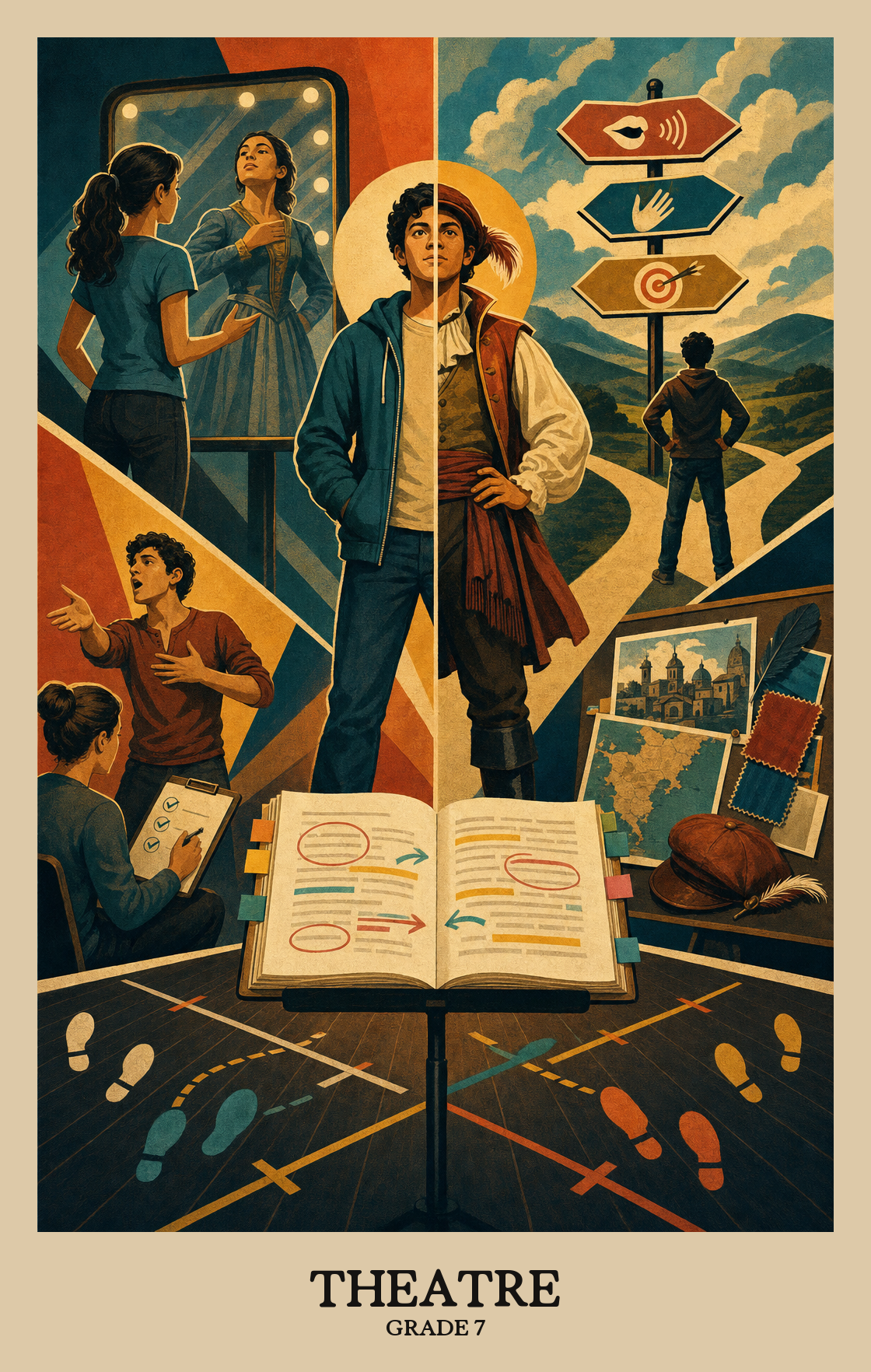
Students warm up the year with voice, movement, and focus exercises. They try out characters by changing how they stand, speak, and react, and they start brainstorming story ideas drawn from their own lives.
Students take rough ideas and build them into short scenes with a clear beginning, middle, and end. They work in small groups to write, block, and rehearse, giving each other notes along the way.
Students pick work to perform and polish it through repeated rehearsal. They sharpen lines, timing, and stage choices so the meaning comes through clearly when family members or classmates watch.
Students look at plays and performances from different times and places, including ones tied to social issues. They talk about what the artists were trying to say and connect it to their own experiences.
Students watch peers and professionals perform and write thoughtful responses. They use agreed-on criteria to explain what worked, what the piece meant, and how a choice on stage changed the message.
Students connect their own memories, interests, and outside knowledge to the theatre work they create and perform. Personal experience shapes the choices they make on stage.
Students look at a play or performance and connect it to the time, place, or culture it came from. That context helps explain why the story was told and what it meant to the people who first saw it.
| Standard | Definition | Code |
|---|---|---|
| Synthesize and relate knowledge and personal experiences to make art | Students connect their own memories, interests, and outside knowledge to the theatre work they create and perform. Personal experience shapes the choices they make on stage. | TH:Cn10.7 |
| Relate artistic ideas and works with societal, cultural | Students look at a play or performance and connect it to the time, place, or culture it came from. That context helps explain why the story was told and what it meant to the people who first saw it. | TH:Cn11.7 |
Students brainstorm original ideas for a scene or performance, then shape those ideas into a plan they can actually put on stage.
Students take a rough theatre idea and shape it into something stageable, making choices about character, dialogue, and action until the scene holds together.
Students revise a scene or script based on feedback, making specific changes until the work is ready to perform or share.
| Standard | Definition | Code |
|---|---|---|
| Generate and conceptualize artistic ideas and work | Students brainstorm original ideas for a scene or performance, then shape those ideas into a plan they can actually put on stage. | TH:Cr1.7 |
| Organize and develop artistic ideas and work | Students take a rough theatre idea and shape it into something stageable, making choices about character, dialogue, and action until the scene holds together. | TH:Cr2.7 |
| Refine and complete artistic work | Students revise a scene or script based on feedback, making specific changes until the work is ready to perform or share. | TH:Cr3.7 |
Students read through a set of scenes or scripts, weigh what each one demands from performers, and choose the piece that best fits the group's skills and the goals of the performance.
Students practice and polish a scene or performance piece until it's ready to share with an audience. Rehearsal, feedback, and revision are all part of the work.
Students perform a scene or monologue with a clear purpose, making choices about voice, movement, and focus so the audience understands what the piece is really about.
| Standard | Definition | Code |
|---|---|---|
| Analyze, interpret, and select artistic work for presentation | Students read through a set of scenes or scripts, weigh what each one demands from performers, and choose the piece that best fits the group's skills and the goals of the performance. | TH:Pr4.7 |
| Develop and refine artistic techniques and work for presentation | Students practice and polish a scene or performance piece until it's ready to share with an audience. Rehearsal, feedback, and revision are all part of the work. | TH:Pr5.7 |
| Convey meaning through the presentation of artistic work | Students perform a scene or monologue with a clear purpose, making choices about voice, movement, and focus so the audience understands what the piece is really about. | TH:Pr6.7 |
Students watch or read a scene and break down how the acting, staging, and story choices work together. They explain what they notice, not just what they like.
Students explain what a scene or performance is really about, looking past the surface to describe what the playwright or actor was trying to say and why those choices matter.
Students judge a piece of theatre against a clear set of criteria, explaining what worked, what didn't, and why using specific details from the performance.
| Standard | Definition | Code |
|---|---|---|
| Perceive and analyze artistic work | Students watch or read a scene and break down how the acting, staging, and story choices work together. They explain what they notice, not just what they like. | TH:Re7.7 |
| Interpret intent and meaning in artistic work | Students explain what a scene or performance is really about, looking past the surface to describe what the playwright or actor was trying to say and why those choices matter. | TH:Re8.7 |
| Apply criteria to evaluate artistic work | Students judge a piece of theatre against a clear set of criteria, explaining what worked, what didn't, and why using specific details from the performance. | TH:Re9.7 |
Students build scenes and short plays, then perform them for classmates. They work on character, voice, and movement, and they learn to give and take feedback. By the end of the year, they can take an idea from brainstorm to performance.
Ask students to tell the story of what their character wants and what gets in the way. Read scenes aloud together and try different choices for the same line. Ten minutes of this kind of talk goes further than memorising lines on their own.
Probably less than expected. A lot of seventh grade theatre is small group work, writing, and rehearsing in pairs before anything is shown. Confidence usually grows over the year as students get used to trying ideas in front of a familiar group.
Many teachers start with ensemble work and short improv, move into scene study and devising, then end with a longer performance project. Building habits of rehearsal and peer feedback early pays off when students take on bigger work in the spring.
Students can generate an original idea, shape it into a scene with a clear beginning and end, and rehearse it with a partner. They can also watch a performance and say what worked, what the artist was going for, and why.
Some, but not as much as parents often expect. Students memorise short monologues and scene partners' cues, not full plays. Running lines for five minutes a few nights a week is plenty.
Specific character choices and giving useful feedback. Students default to playing themselves and to vague comments like "it was good." Short, repeated practice with making a clear choice and naming one specific thing in a peer's work tends to move the needle.
Students look at where a play comes from and what was happening when it was written or set. They also bring their own experiences into the work. Talking at home about a news story or family history can give a student real material to draw on.
They can plan and revise a piece of theatre with a group, rehearse with purpose, and perform with clear choices. They can also write or talk about another performance using specific evidence from what they saw and heard.