Listening with purpose
Students start the year by listening closely to short pieces of music and talking about what they hear. They notice fast and slow, loud and soft, and begin describing how a song makes them feel.
This is the year music shifts from playing along to making real musical choices. Students invent short rhythms and melodies, then revise them with a reason for each change. They sing and play pieces they picked themselves and explain what the music is trying to say. By spring, students can perform a short song for the class and tell you why they chose it.
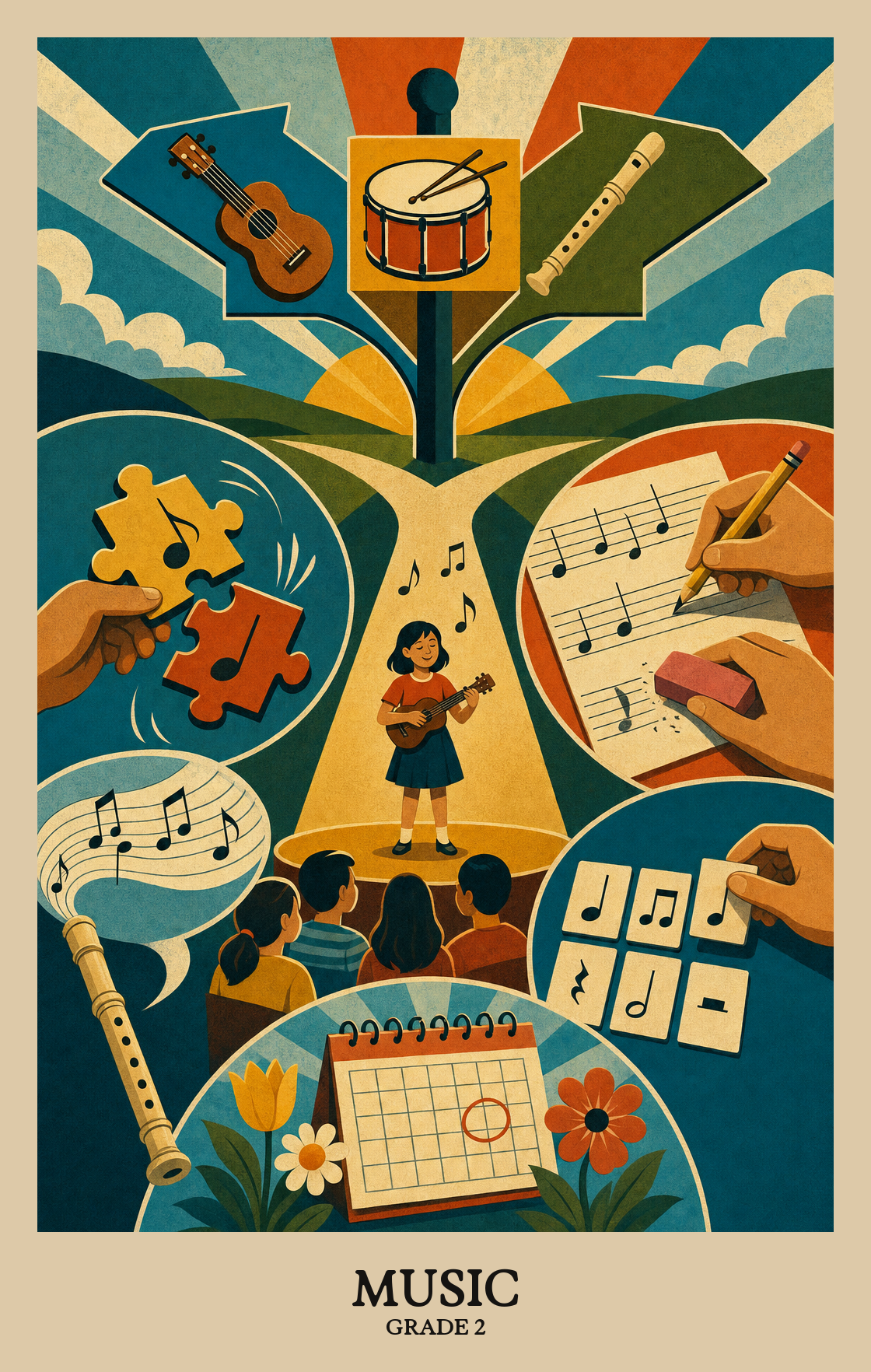
Students start the year by listening closely to short pieces of music and talking about what they hear. They notice fast and slow, loud and soft, and begin describing how a song makes them feel.
Students try out their own rhythms and short tunes using voices, classroom instruments, and simple patterns. They learn that a musical idea can come from a story, a picture, or something from their own life.
Students take a rough musical idea and clean it up. They practice it, change parts that do not work, and get it ready for an audience. Parents may hear the same song at home for weeks.
Students sing and play in front of classmates or families. They think about what the music is supposed to say and try to bring that feeling across when they perform.
Students connect songs to holidays, family traditions, and stories from other places and times. They also use simple words like steady beat or melody to judge what makes a performance work well.
Students connect their own memories and experiences to the music they make or hear, explaining what it reminds them of or how it makes them feel.
Students connect a song or piece of music to where it came from, such as a country, a celebration, or a time in history. That context helps them understand why the music sounds the way it does.
| Standard | Definition | Code |
|---|---|---|
| Synthesize and relate knowledge and personal experiences to make art | Students connect their own memories and experiences to the music they make or hear, explaining what it reminds them of or how it makes them feel. | MU:Cn10.2 |
| Relate artistic ideas and works with societal, cultural | Students connect a song or piece of music to where it came from, such as a country, a celebration, or a time in history. That context helps them understand why the music sounds the way it does. | MU:Cn11.2 |
Students come up with their own musical ideas, like inventing a short melody or rhythm, and start turning those ideas into something they can sing or play.
Students take a musical idea, such as a short melody or rhythm, and work on shaping it into something they could perform or share with the class.
Students revisit a song or rhythm they've been working on, make small improvements, and decide when it's ready to share.
| Standard | Definition | Code |
|---|---|---|
| Generate and conceptualize artistic ideas and work | Students come up with their own musical ideas, like inventing a short melody or rhythm, and start turning those ideas into something they can sing or play. | MU:Cr1.2 |
| Organize and develop artistic ideas and work | Students take a musical idea, such as a short melody or rhythm, and work on shaping it into something they could perform or share with the class. | MU:Cr2.2 |
| Refine and complete artistic work | Students revisit a song or rhythm they've been working on, make small improvements, and decide when it's ready to share. | MU:Cr3.2 |
Students choose a piece of music to perform and explain why they picked it. They think about what the song means and how they want to play or sing it for an audience.
Students practice a song or piece until they can perform it the way they intended. They fix mistakes and make small adjustments before playing or singing for an audience.
Students perform a song or piece of music and make choices, like how loud or soft to play, that express a feeling or idea to the audience.
| Standard | Definition | Code |
|---|---|---|
| Analyze, interpret, and select artistic work for presentation | Students choose a piece of music to perform and explain why they picked it. They think about what the song means and how they want to play or sing it for an audience. | MU:Pr4.2 |
| Develop and refine artistic techniques and work for presentation | Students practice a song or piece until they can perform it the way they intended. They fix mistakes and make small adjustments before playing or singing for an audience. | MU:Pr5.2 |
| Convey meaning through the presentation of artistic work | Students perform a song or piece of music and make choices, like how loud or soft to play, that express a feeling or idea to the audience. | MU:Pr6.2 |
Students listen to a short piece of music and describe what they notice, like changes in speed, loudness, or mood. They start to explain why those choices might have been made.
Students listen to a piece of music and explain what they think the composer or performer was feeling or trying to say. There is no single right answer, but students back up their ideas with what they actually heard.
Students listen to a piece of music and use a simple set of reasons to decide what works well and what doesn't. They back up their opinion with something specific they heard.
| Standard | Definition | Code |
|---|---|---|
| Perceive and analyze artistic work | Students listen to a short piece of music and describe what they notice, like changes in speed, loudness, or mood. They start to explain why those choices might have been made. | MU:Re7.2 |
| Interpret intent and meaning in artistic work | Students listen to a piece of music and explain what they think the composer or performer was feeling or trying to say. There is no single right answer, but students back up their ideas with what they actually heard. | MU:Re8.2 |
| Apply criteria to evaluate artistic work | Students listen to a piece of music and use a simple set of reasons to decide what works well and what doesn't. They back up their opinion with something specific they heard. | MU:Re9.2 |
Students sing, play simple instruments, move to a steady beat, and make up short musical ideas of their own. They also listen to music and talk about what they hear. Most of the year is spent doing music, not reading about it.
Sing in the car, clap along to songs, and ask what students notice in the music, like fast or slow, loud or soft. Five minutes of singing or tapping a beat together is plenty. Students do not need any instruments or training.
Not really. Students start to recognise a steady beat, high and low sounds, and simple patterns, but full music reading comes later. The focus is on hearing and feeling music before reading it on a page.
Start with steady beat, singing voice, and listening habits in the fall. Build into simple rhythm patterns and short composing tasks by winter. Spend spring on small performances and on students giving thoughtful feedback to each other.
Composing here means making up a short rhythm, a four-beat pattern, or a sound story to go with a picture or poem. Students often work in pairs and use body percussion or classroom instruments. The piece can be just a few seconds long.
Keeping a steady beat while singing, and matching pitch in a comfortable range, are the two areas worth revisiting all year. Short daily practice works better than long once-a-week drills. Group singing helps shy students more than solo work.
By the end of the year, students can keep a steady beat, sing a familiar song in tune with the group, and clap back a short rhythm. They can also share one thing they notice about a piece of music and say why they like or dislike it.
At this age, every voice is still developing, and confidence matters more than tone. Sing along with them in a low-pressure way, like during chores or a car ride, and avoid correcting pitch. Most students grow into their singing voice with regular, relaxed practice.