Pretend play and imagination
Students start the year by playing pretend. They act out familiar people like a parent, a doctor, or a pet, and use their bodies and voices to bring an idea to life.
This is the year pretending becomes its own kind of learning. Students step into make-believe roles, act out small stories from their own lives, and try on different voices and faces. They watch classmates perform and start to share what they noticed or liked. By spring, students can act out a familiar story with a costume or prop and talk about what was happening in a friend's pretend play.
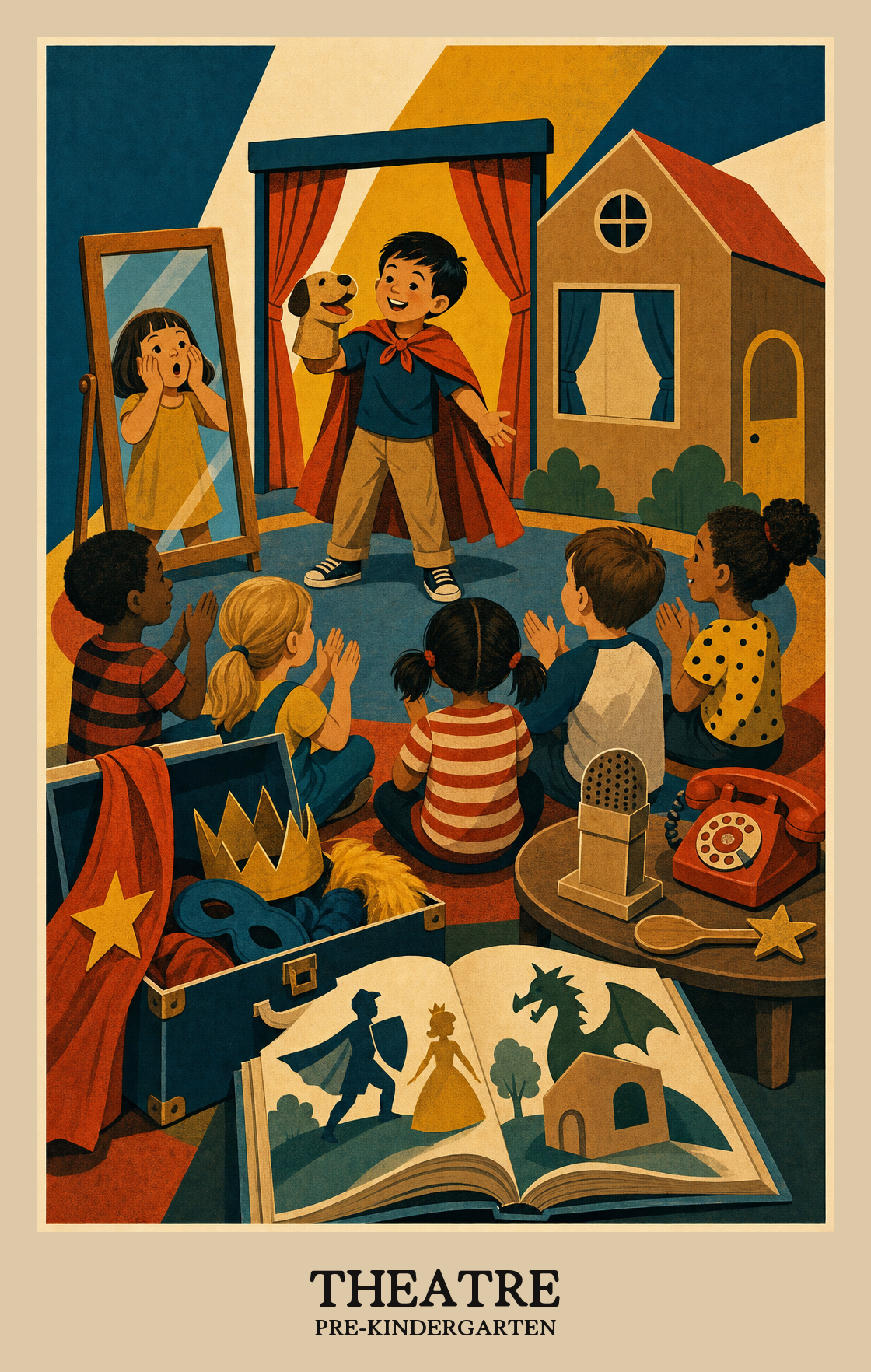
Students start the year by playing pretend. They act out familiar people like a parent, a doctor, or a pet, and use their bodies and voices to bring an idea to life.
Students begin shaping simple stories with a beginning, middle, and end. They add characters, props, and pretend settings, and work with classmates to grow an idea into a short scene.
Students practice showing their work to a small audience. They rehearse a short piece, try it again to make it clearer, and perform for classmates or family.
Students watch stories acted out and talk about what they noticed. They share what a character felt, what part they liked, and connect the story to their own lives at home and school.
Students connect something they know or have done to a story or character they are playing. A familiar feeling or memory helps them make their pretend play more real.
Students connect stories and characters in plays to their own lives and the world around them, noticing how people, places, and feelings show up in theatre just as they do in real life.
| Standard | Definition | Code |
|---|---|---|
| Synthesize and relate knowledge and personal experiences to make art | Students connect something they know or have done to a story or character they are playing. A familiar feeling or memory helps them make their pretend play more real. | TH:Cn10.pk |
| Relate artistic ideas and works with societal, cultural | Students connect stories and characters in plays to their own lives and the world around them, noticing how people, places, and feelings show up in theatre just as they do in real life. | TH:Cn11.pk |
Students practice pretending by making up characters, stories, and simple scenes through play and imagination.
Students use play and imagination to build a simple story or scene, choosing who the characters are and what happens next.
Students finish a short play or story scene by practicing it more than once and making small changes until it feels ready to share.
| Standard | Definition | Code |
|---|---|---|
| Generate and conceptualize artistic ideas and work | Students practice pretending by making up characters, stories, and simple scenes through play and imagination. | TH:Cr1.pk |
| Organize and develop artistic ideas and work | Students use play and imagination to build a simple story or scene, choosing who the characters are and what happens next. | TH:Cr2.pk |
| Refine and complete artistic work | Students finish a short play or story scene by practicing it more than once and making small changes until it feels ready to share. | TH:Cr3.pk |
Students choose a character or story to act out and decide how to play it in front of others.
Students practice a song, movement, or short scene more than once to make it ready to share with others.
Students use simple pretend play, movement, or voice to show an idea or feeling to others. Acting out a story or a character is how they share what something means to them.
| Standard | Definition | Code |
|---|---|---|
| Analyze, interpret, and select artistic work for presentation | Students choose a character or story to act out and decide how to play it in front of others. | TH:Pr4.pk |
| Develop and refine artistic techniques and work for presentation | Students practice a song, movement, or short scene more than once to make it ready to share with others. | TH:Pr5.pk |
| Convey meaning through the presentation of artistic work | Students use simple pretend play, movement, or voice to show an idea or feeling to others. Acting out a story or a character is how they share what something means to them. | TH:Pr6.pk |
Students look at a short play or puppet show and talk about what they noticed, like a character's mood or what happened in a scene.
Students look at a short play or puppet show and say what they think the story is about or how it makes them feel.
Students look at a scene or puppet show and say what they liked and why. They start learning that opinions about art can be explained, not just felt.
| Standard | Definition | Code |
|---|---|---|
| Perceive and analyze artistic work | Students look at a short play or puppet show and talk about what they noticed, like a character's mood or what happened in a scene. | TH:Re7.pk |
| Interpret intent and meaning in artistic work | Students look at a short play or puppet show and say what they think the story is about or how it makes them feel. | TH:Re8.pk |
| Apply criteria to evaluate artistic work | Students look at a scene or puppet show and say what they liked and why. They start learning that opinions about art can be explained, not just felt. | TH:Re9.pk |
At this age, theatre is mostly pretend play with a purpose. Students act out stories, take on roles like a doctor or a bear, and use their voice and body to show feelings. There are no scripts or stages. The work happens on the rug, in the dress-up corner, and during story time.
Pretend play builds the same skills as early theatre. Set out a few props like a hat, a spoon, or a stuffed animal and ask what story they want to tell. Join in as a character and follow their lead. Ten minutes is plenty.
No. Performing at this age means sharing a short pretend moment with a small group or a teacher, not standing on a stage. Shy students often start by watching, then join when they feel ready. That is expected and fine.
Start with imitation and simple character play in the fall, such as acting out familiar stories like The Three Bears. Move into students inventing their own short scenes by winter. By spring, students can plan a scene with a beginning and end, and share it with classmates.
Read picture books with strong characters and clear feelings, then act out a favorite part together. Ask who the character is, where they are, and what they want. Switching roles after each read keeps it fresh and builds the same thinking used in early theatre.
Staying in a role for more than a moment is the hardest part. Students also struggle to listen and respond to a partner instead of talking over them. Short, repeated practice with a clear character and setting helps more than long activities.
Use drama to deepen read-alouds, social studies, and feelings talk. Acting out a community helper, a story problem, or a calm-down moment gives students another way to show what they understand. It also makes the connection to real life that the standards ask for.
By spring, students can take on a clear character, use voice and body to show how that character feels, and act out a short scene with a partner or small group. They can also talk about a classmate's scene and say what they liked or noticed.