How science actually works
Students start the year learning how scientists ask questions, run tests, and weigh evidence. They learn the difference between a hunch, a model, and an idea that has held up to years of checking.
This is the year science stops being a tour of cool facts and starts asking students to act like scientists. They design their own experiments, weigh the evidence, and explain why a claim holds up or falls apart. Across biology, chemistry, physics, and earth science, they connect big ideas like cells, atoms, forces, and ecosystems. By spring, students can read a study or news headline and judge whether the evidence actually supports it.
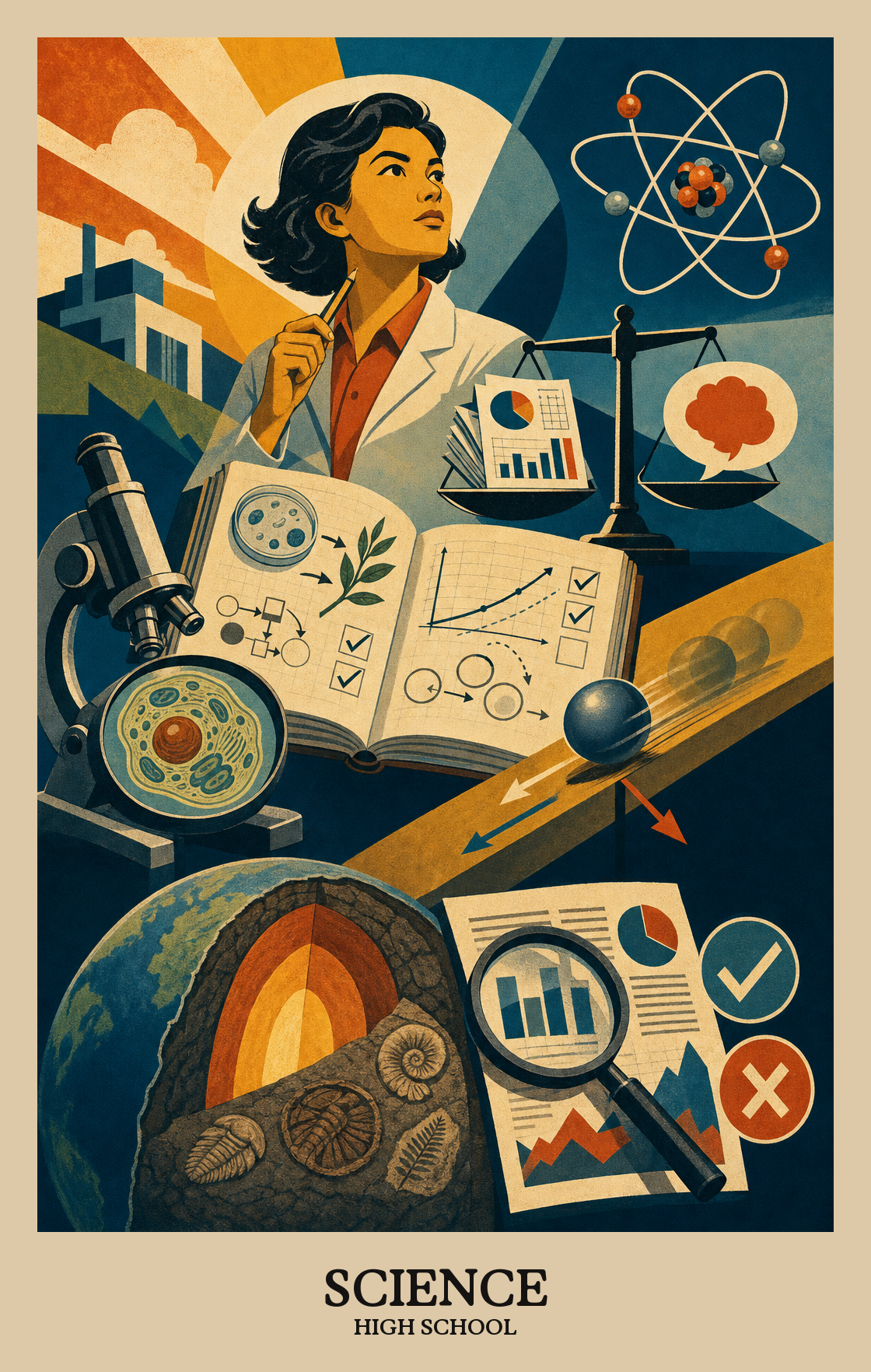
Students start the year learning how scientists ask questions, run tests, and weigh evidence. They learn the difference between a hunch, a model, and an idea that has held up to years of checking.
Students look at where Earth sits in the universe and what shapes the ground, oceans, and air around them. They study why seasons happen and what drives weather and climate.
Students move from single cells to whole organisms. They learn how traits pass from parents to children and how species have changed over long stretches of time.
Students trace how plants, animals, and other living things depend on each other. They follow energy and matter as it moves through food webs and natural cycles.
Students close the year with the physical world. They study what matter is made of, how energy changes form without disappearing, and how forces push and pull things into motion.
Students form a question that can be tested, plan an experiment to test it, collect data, and use what they find to explain what happened.
Science doesn't stay fixed. Students study how scientists test ideas, challenge each other's work, and revise conclusions when new evidence shows a better answer.
Theories explain why something happens, laws describe what consistently happens, and hypotheses are testable predictions. Students learn what each term actually means in science and how scientists use them to understand the natural world.
| Standard | Definition | Code |
|---|---|---|
| The Practice of Science High School | Students form a question that can be tested, plan an experiment to test it, collect data, and use what they find to explain what happened. | FL-SCI.NATURE.9-12.1 |
| The Characteristics of Scientific Knowledge High School | Science doesn't stay fixed. Students study how scientists test ideas, challenge each other's work, and revise conclusions when new evidence shows a better answer. | FL-SCI.NATURE.9-12.2 |
| The Role of Theories, Laws, and Models High School | Theories explain why something happens, laws describe what consistently happens, and hypotheses are testable predictions. Students learn what each term actually means in science and how scientists use them to understand the natural world. | FL-SCI.NATURE.9-12.3 |
Students learn why the sky looks different at night than during the day, why seasons change throughout the year, and where Earth fits within the broader universe. The focus is on patterns that repeat on daily and yearly cycles.
Students learn how Earth is built and how it moves, from the rocky layers underfoot to the oceans and the air above. They study how those systems interact and change over time.
Students learn why some places are hot and dry while others are cold and wet, and why weather follows predictable seasonal patterns. They study how factors like ocean currents, wind, and geography shape the long-term climate of a region.
| Standard | Definition | Code |
|---|---|---|
| Earth in Space and Time High School | Students learn why the sky looks different at night than during the day, why seasons change throughout the year, and where Earth fits within the broader universe. The focus is on patterns that repeat on daily and yearly cycles. | FL-SCI.ESS.9-12.1 |
| Earth's Structures High School | Students learn how Earth is built and how it moves, from the rocky layers underfoot to the oceans and the air above. They study how those systems interact and change over time. | FL-SCI.ESS.9-12.2 |
| Weather and Climate High School | Students learn why some places are hot and dry while others are cold and wet, and why weather follows predictable seasonal patterns. They study how factors like ocean currents, wind, and geography shape the long-term climate of a region. | FL-SCI.ESS.9-12.3 |
Students learn how living things are built from cells up through tissues, organs, and whole organisms. They trace how a single cell can divide and specialize to produce every structure in a living body.
Students learn how living things pass traits to offspring, how a fertilized cell grows into a full organism, and why children resemble their parents but aren't identical to them.
Students study how living things on Earth came to look and behave so differently from one another, and what fossil and genetic evidence tells us about how species have changed across millions of years.
Living things depend on each other, and on their environment, to survive. Students study how energy moves through a food web and how matter like carbon and water cycles through an ecosystem over time.
| Standard | Definition | Code |
|---|---|---|
| Organization and Development High School | Students learn how living things are built from cells up through tissues, organs, and whole organisms. They trace how a single cell can divide and specialize to produce every structure in a living body. | FL-SCI.LS.9-12.1 |
| Heredity and Reproduction High School | Students learn how living things pass traits to offspring, how a fertilized cell grows into a full organism, and why children resemble their parents but aren't identical to them. | FL-SCI.LS.9-12.2 |
| Diversity and Evolution High School | Students study how living things on Earth came to look and behave so differently from one another, and what fossil and genetic evidence tells us about how species have changed across millions of years. | FL-SCI.LS.9-12.3 |
| Interdependence High School | Living things depend on each other, and on their environment, to survive. Students study how energy moves through a food web and how matter like carbon and water cycles through an ecosystem over time. | FL-SCI.LS.9-12.4 |
Students learn what matter is made of at the atomic level and how its properties, like density, state, or reactivity, change under different conditions.
Students learn that energy comes in forms like heat, light, and motion, and that it moves between objects without disappearing. When energy seems to leave one place, it shows up somewhere else.
Students study how forces like gravity and friction cause objects to speed up, slow down, or change direction. They learn to predict motion using Newton's laws and real-world examples like collisions and falling objects.
| Standard | Definition | Code |
|---|---|---|
| Properties of Matter High School | Students learn what matter is made of at the atomic level and how its properties, like density, state, or reactivity, change under different conditions. | FL-SCI.PS.9-12.1 |
| Forms of Energy High School | Students learn that energy comes in forms like heat, light, and motion, and that it moves between objects without disappearing. When energy seems to leave one place, it shows up somewhere else. | FL-SCI.PS.9-12.2 |
| Forces and Motion High School | Students study how forces like gravity and friction cause objects to speed up, slow down, or change direction. They learn to predict motion using Newton's laws and real-world examples like collisions and falling objects. | FL-SCI.PS.9-12.3 |
Federally administered sample-based assessment in reading, mathematics, science, and writing. NAEP results inform state-by-state comparisons rather than individual student or school accountability.
Students work across four big areas: how science itself works, Earth and space, living things, and matter and energy. Expect units on cells, genetics, ecosystems, weather, the structure of matter, energy, and forces. Most schools spread these across biology, chemistry, and earth or physical science courses.
Ask students to explain what they learned in their own words at dinner. Watch a short news clip about weather, space, or a new medical study and ask what evidence backs it up. Five minutes of curious questions does more than trying to reteach the textbook.
Students can read a science article or graph and explain what the evidence shows. They can design a simple investigation, identify variables, and tell the difference between a hypothesis, a theory, and an opinion. They can also connect ideas across units, like how energy moves through both a food web and a circuit.
Start with nature of science so investigation skills carry through every unit. Most teachers anchor the year in one strand (biology, chemistry, or earth science) and weave in the others through labs and current events. Save the most abstract topics, like genetics or atomic structure, for after students have practiced modeling and evidence work.
Genetics with probability, energy transfer across systems, and the difference between theory and hypothesis tend to need a second pass. Students also struggle to read graphs without being told what to notice. Build in short retrieval practice and quick lab write-ups rather than waiting for the unit test.
Most struggle comes from vocabulary and math, not the science itself. Have students keep a running list of terms in their phone or a notebook and quiz each other on definitions. For math-heavy problems, ask them to draw the situation before plugging in numbers.
Some, but understanding matters more than memorizing. Students should know common terms like cell, energy, force, and ecosystem on sight, and recognize a handful of formulas like F equals ma. Most tests provide reference sheets, so practice using formulas in problems instead of reciting them.
Strong lab habits matter more than any single topic. Students should be able to ask a testable question, collect clean data, and write up what they found and why it matters. Encourage one science club, fair project, or summer program to build that experience.
Plan for hands-on investigation in roughly a third of class time. Short labs, data analysis from real datasets, and modeling activities all count. Students need repeated practice with variables, measurement, and writing claims backed by evidence, not just one big project per quarter.