Sketching ideas from life
Students start the year gathering ideas from their own world. They sketch from memory, brainstorm in journals, and try out different ways to plan a picture before picking one to build on.
This is the year art shifts from making pictures to making choices. Students plan their work before they start, try different ways to show an idea, and explain why they kept or changed something. They look closely at art by other people and talk about what it might mean. By spring, students can finish a piece, get it ready to show, and say what they were trying to say.
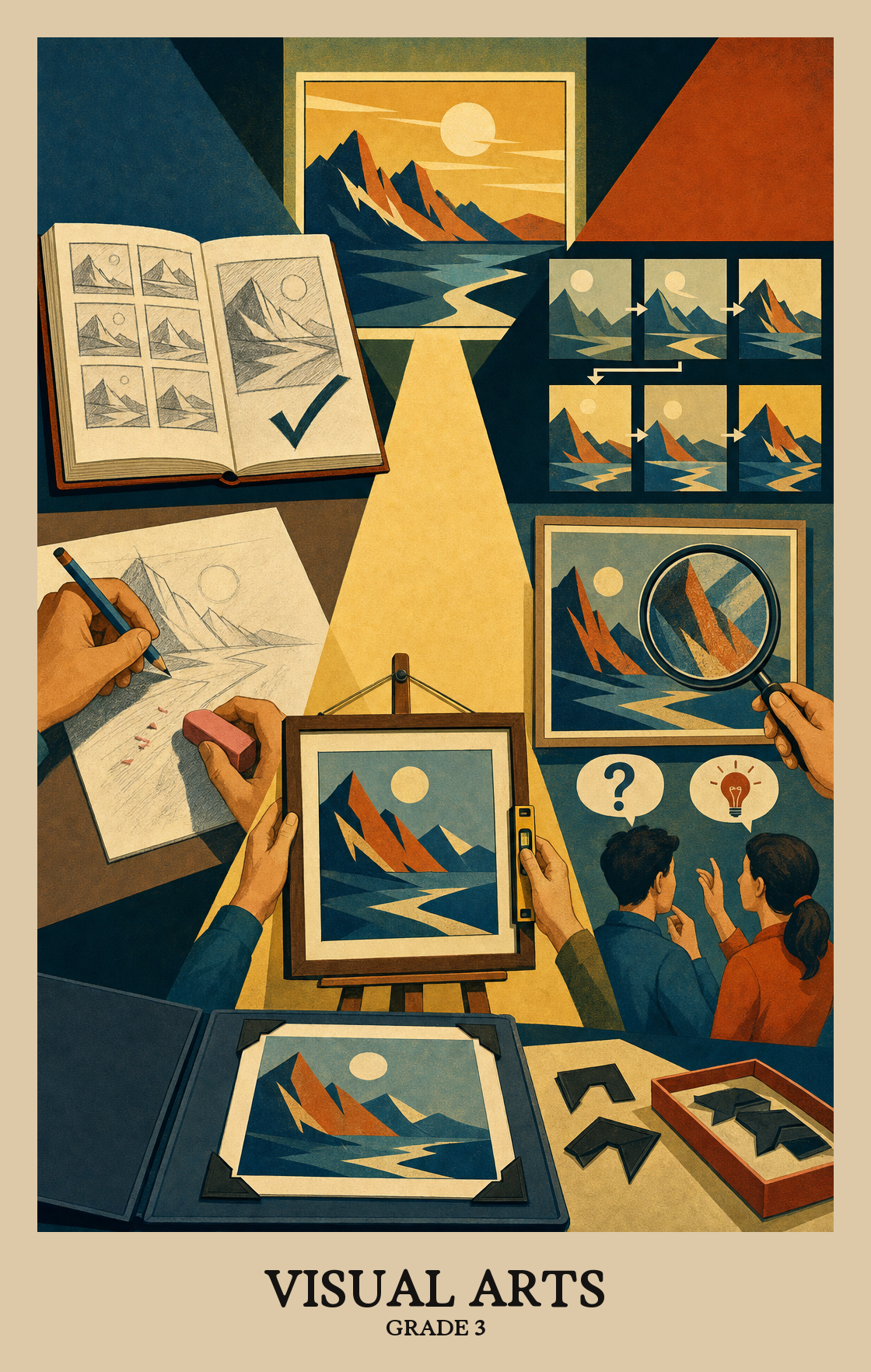
Students start the year gathering ideas from their own world. They sketch from memory, brainstorm in journals, and try out different ways to plan a picture before picking one to build on.
Students move from a rough idea to a finished piece. They choose materials on purpose, practice techniques like shading or cutting, and learn to slow down and fix parts of their work instead of starting over.
Students study artwork by other people, including artists from different places and times. They notice what they see, guess what the artist might have meant, and talk about why someone made the choices they did.
Students pick pieces they want to show and get them ready for an audience. They explain what their art is about, listen to feedback, and use simple rules to judge what makes a piece feel finished.
Students draw on what they know and what they've lived through to make their artwork. A memory, a place, or something learned in class can become the starting point for what they create.
Students look at a painting or sculpture and connect it to the time, place, or community it came from. That context helps them understand why the work looks the way it does and what it meant to the people who made it.
| Standard | Definition | Code |
|---|---|---|
| Synthesize and relate knowledge and personal experiences to make art | Students draw on what they know and what they've lived through to make their artwork. A memory, a place, or something learned in class can become the starting point for what they create. | VA:Cn10.3 |
| Relate artistic ideas and works with societal, cultural | Students look at a painting or sculpture and connect it to the time, place, or community it came from. That context helps them understand why the work looks the way it does and what it meant to the people who made it. | VA:Cn11.3 |
Students brainstorm ideas for art before they start making it. They sketch, think through possibilities, and decide on a direction before picking up a brush or other tool.
Students plan out a piece of artwork before they start, making choices about what to include, how to arrange it, and how to improve it as they go.
Students look at a piece of art they've made, decide what isn't working yet, and make changes until it's finished. The goal is a final piece they feel good about, not just a first attempt.
| Standard | Definition | Code |
|---|---|---|
| Generate and conceptualize artistic ideas and work | Students brainstorm ideas for art before they start making it. They sketch, think through possibilities, and decide on a direction before picking up a brush or other tool. | VA:Cr1.3 |
| Organize and develop artistic ideas and work | Students plan out a piece of artwork before they start, making choices about what to include, how to arrange it, and how to improve it as they go. | VA:Cr2.3 |
| Refine and complete artistic work | Students look at a piece of art they've made, decide what isn't working yet, and make changes until it's finished. The goal is a final piece they feel good about, not just a first attempt. | VA:Cr3.3 |
Students look at their own artwork, talk about what they made and why, and choose which pieces to share with others.
Students practice and improve a piece of artwork until it's ready to share. They learn how small changes, like adding detail or fixing a line, make the finished work stronger.
Students choose how to display their artwork so viewers understand what the piece is about. The arrangement, setting, and display decisions all shape what the artwork communicates.
| Standard | Definition | Code |
|---|---|---|
| Analyze, interpret, and select artistic work for presentation | Students look at their own artwork, talk about what they made and why, and choose which pieces to share with others. | VA:Pr4.3 |
| Develop and refine artistic techniques and work for presentation | Students practice and improve a piece of artwork until it's ready to share. They learn how small changes, like adding detail or fixing a line, make the finished work stronger. | VA:Pr5.3 |
| Convey meaning through the presentation of artistic work | Students choose how to display their artwork so viewers understand what the piece is about. The arrangement, setting, and display decisions all shape what the artwork communicates. | VA:Pr6.3 |
Students look closely at a piece of artwork and describe what they notice: the colors, shapes, lines, and how the parts work together.
Students look at a piece of art and explain what they think the artist meant. They use details in the work to back up their thinking.
Students look at a piece of artwork and use a set of reasons (like color, detail, or how well it fits the assignment) to explain whether it works and why.
| Standard | Definition | Code |
|---|---|---|
| Perceive and analyze artistic work | Students look closely at a piece of artwork and describe what they notice: the colors, shapes, lines, and how the parts work together. | VA:Re7.3 |
| Interpret intent and meaning in artistic work | Students look at a piece of art and explain what they think the artist meant. They use details in the work to back up their thinking. | VA:Re8.3 |
| Apply criteria to evaluate artistic work | Students look at a piece of artwork and use a set of reasons (like color, detail, or how well it fits the assignment) to explain whether it works and why. | VA:Re9.3 |
Students move past just making a picture and start planning their work on purpose. They sketch ideas before they build, try different materials like paint, clay, and collage, and talk about what their art means. They also start looking closely at other artists' work and saying what they notice.
Keep a small notebook for doodles and ideas, and let students draw from things they already care about, like a pet, a memory, or a favorite place. Ask what they were trying to show before you ask if it looks good. The goal is planning, not perfection.
No. The work is about ideas, choices, and effort, not natural talent. Students are graded on how they plan, revise, and explain their art, so a child who sketches three versions of a robot and picks the best one is doing exactly what is expected.
Most teachers start with Creating, since students need confidence making things before they can analyze or present. Layer in Responding early using picture books and museum images, then build toward Presenting in the second half of the year with a small show or class gallery. Connecting threads through every unit.
Refining work. Students at this age often want to call a piece finished the moment it looks recognizable. Build in a planned revision step on most projects, with a specific question like what could you add to show where this happens, so revision feels like part of the process.
Look at one image together, a book illustration, a photo, or a painting online, and ask what students see, what they think is happening, and what makes them say that. This is the same kind of close looking practiced in class, and it builds the vocabulary for talking about art.
By spring, students should be able to plan a piece with a sketch, choose materials for a reason, revise at least once, and explain what their work is about in a few sentences. They should also be able to look at another artist's piece and say what they notice and what it might mean.
Students relate art to history, culture, and their own lives this year, so a unit on community in social studies pairs well with a self-portrait or neighborhood collage. Reading a folktale can lead to illustrating a scene. These crossovers make both subjects stick better.