Listening with a careful ear
Students start the year by really listening to music. They notice fast and slow, loud and soft, and talk about what a song reminds them of or makes them feel.
This is the year music shifts from following along to making real choices. Students invent short musical ideas of their own, then shape and polish them with feedback before performing. They also start explaining why a piece sounds the way it does and what the composer or singer might be trying to say. By spring, students can perform a piece they helped prepare and talk about what makes it work.
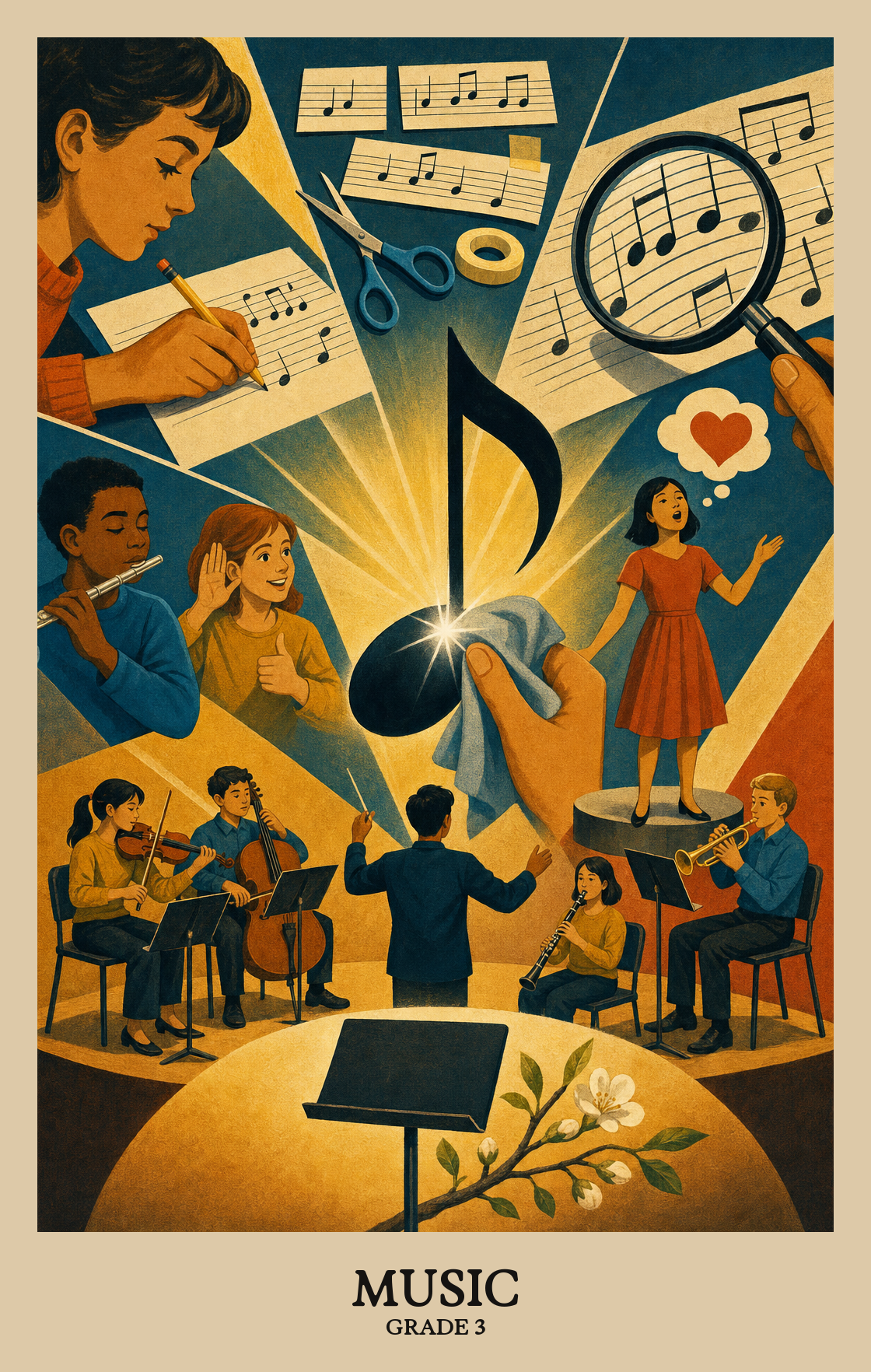
Students start the year by really listening to music. They notice fast and slow, loud and soft, and talk about what a song reminds them of or makes them feel.
Students try out their own rhythms and short tunes. They clap patterns, tap on instruments, and put small ideas together to start building something that sounds like a real piece.
Students take a rough musical idea and clean it up. They practice the tricky spots, decide what to keep, and get a song or rhythm ready for an audience.
Students perform for classmates or families. They think about how to play a song so the feeling comes through, not just the right notes.
Students listen to music from different places and times. They talk about what a song was for, who sang it, and use simple guidelines to say what works well in a piece.
Students connect what they already know and what they've lived through to the music they create or perform. Personal experiences shape the choices they make as young musicians.
Students connect a song or piece of music to the time, place, or culture it came from. That context helps them understand why the music sounds the way it does.
| Standard | Definition | Code |
|---|---|---|
| Synthesize and relate knowledge and personal experiences to make art | Students connect what they already know and what they've lived through to the music they create or perform. Personal experiences shape the choices they make as young musicians. | MU:Cn10.3 |
| Relate artistic ideas and works with societal, cultural | Students connect a song or piece of music to the time, place, or culture it came from. That context helps them understand why the music sounds the way it does. | MU:Cn11.3 |
Students brainstorm and sketch out musical ideas, like making up a short melody or rhythm pattern, before deciding what to keep and shape into a piece.
Students take a musical idea, such as a short melody or rhythm pattern, and shape it into something more complete by arranging the parts and deciding what stays, what changes, and what fits together.
Students listen back to a piece they composed or practiced, make small changes to improve it, and decide when it's ready to share.
| Standard | Definition | Code |
|---|---|---|
| Generate and conceptualize artistic ideas and work | Students brainstorm and sketch out musical ideas, like making up a short melody or rhythm pattern, before deciding what to keep and shape into a piece. | MU:Cr1.3 |
| Organize and develop artistic ideas and work | Students take a musical idea, such as a short melody or rhythm pattern, and shape it into something more complete by arranging the parts and deciding what stays, what changes, and what fits together. | MU:Cr2.3 |
| Refine and complete artistic work | Students listen back to a piece they composed or practiced, make small changes to improve it, and decide when it's ready to share. | MU:Cr3.3 |
Students listen to and compare pieces of music, then choose one to perform based on what they notice about mood, tempo, or difficulty.
Students practice a song or piece of music repeatedly, then make small improvements before performing it for an audience.
Students perform a song or piece with purpose, making choices about how to play or sing so the music expresses a clear feeling or idea to the audience.
| Standard | Definition | Code |
|---|---|---|
| Analyze, interpret, and select artistic work for presentation | Students listen to and compare pieces of music, then choose one to perform based on what they notice about mood, tempo, or difficulty. | MU:Pr4.3 |
| Develop and refine artistic techniques and work for presentation | Students practice a song or piece of music repeatedly, then make small improvements before performing it for an audience. | MU:Pr5.3 |
| Convey meaning through the presentation of artistic work | Students perform a song or piece with purpose, making choices about how to play or sing so the music expresses a clear feeling or idea to the audience. | MU:Pr6.3 |
Students listen to a short piece of music and describe what they notice, like changes in speed, loudness, or mood. Then they explain what those choices do to the sound.
Students listen to a piece of music and explain what feeling or story they think it tells, using what they hear in the rhythm, melody, or tempo to back up their thinking.
Students listen to a piece of music and use specific reasons to explain why it works well or where it falls short. They practice making judgments, not just saying they liked it or didn't.
| Standard | Definition | Code |
|---|---|---|
| Perceive and analyze artistic work | Students listen to a short piece of music and describe what they notice, like changes in speed, loudness, or mood. Then they explain what those choices do to the sound. | MU:Re7.3 |
| Interpret intent and meaning in artistic work | Students listen to a piece of music and explain what feeling or story they think it tells, using what they hear in the rhythm, melody, or tempo to back up their thinking. | MU:Re8.3 |
| Apply criteria to evaluate artistic work | Students listen to a piece of music and use specific reasons to explain why it works well or where it falls short. They practice making judgments, not just saying they liked it or didn't. | MU:Re9.3 |
Students sing, play simple instruments, and start writing short musical ideas of their own. They also listen to music from different times and places, talk about what they hear, and perform for classmates. The focus is doing music, not just learning about it.
Play music while cooking or driving and ask what students notice: fast or slow, happy or sad, what instruments they hear. Clap rhythms back and forth. Singing along to a favorite song counts. Five minutes of this a few times a week builds a strong ear.
No. Voice, hands, and household items work fine. A pot and a wooden spoon can teach steady beat. If a small keyboard, recorder, or ukulele is already around, that is a bonus, but nothing needs to be bought.
Many teachers spend the fall building steady beat, simple rhythms, and singing voice, then move into short composing tasks in the winter once students have a vocabulary to draw from. Spring is a good window for polishing a performance piece and using listening tasks to apply what students now hear.
Students should keep a steady beat, sing in tune with a group, read simple rhythm patterns, and improvise or compose a short musical idea. They should also be able to listen to a piece and say something specific about its rhythm, mood, or instruments.
Steady beat under changing rhythms is the big one, especially when students start playing instruments and lose the pulse. Matching pitch in singing and reading rhythms with rests also tend to need repeated short practice across many lessons rather than one long unit.
Students listen to music from different cultures and time periods and talk about why it was made and who it was for. A song from West Africa, a colonial fiddle tune, and a modern pop chorus all become ways to ask what music does for people.
Ask them to sing a song from class, clap a rhythm, or describe a piece of music in their own words. Progress sounds like steadier beat, more confident singing, and richer descriptions such as naming an instrument or a mood instead of just saying they liked it.
Short performance checks and quick listening prompts work well. Have students perform a four-beat rhythm, sing a phrase back, or write one sentence about a listening example. Brief notes on a class roster across the quarter give a clearer picture than a single graded performance.