Imagining characters and stories
Students start the year by inventing characters and short story ideas from their own lives and imaginations. Parents may hear kids acting out little scenes at home and trying out different voices.
This is the year theatre stops being pure pretend and starts feeling like real storytelling. Students invent characters and short scenes, then rehearse them with choices about voice, face, and body. They also watch classmates perform and say what worked and why, using simple reasons instead of just "I liked it." By spring, students can plan a short scene, perform it for an audience, and explain what the story was trying to show.
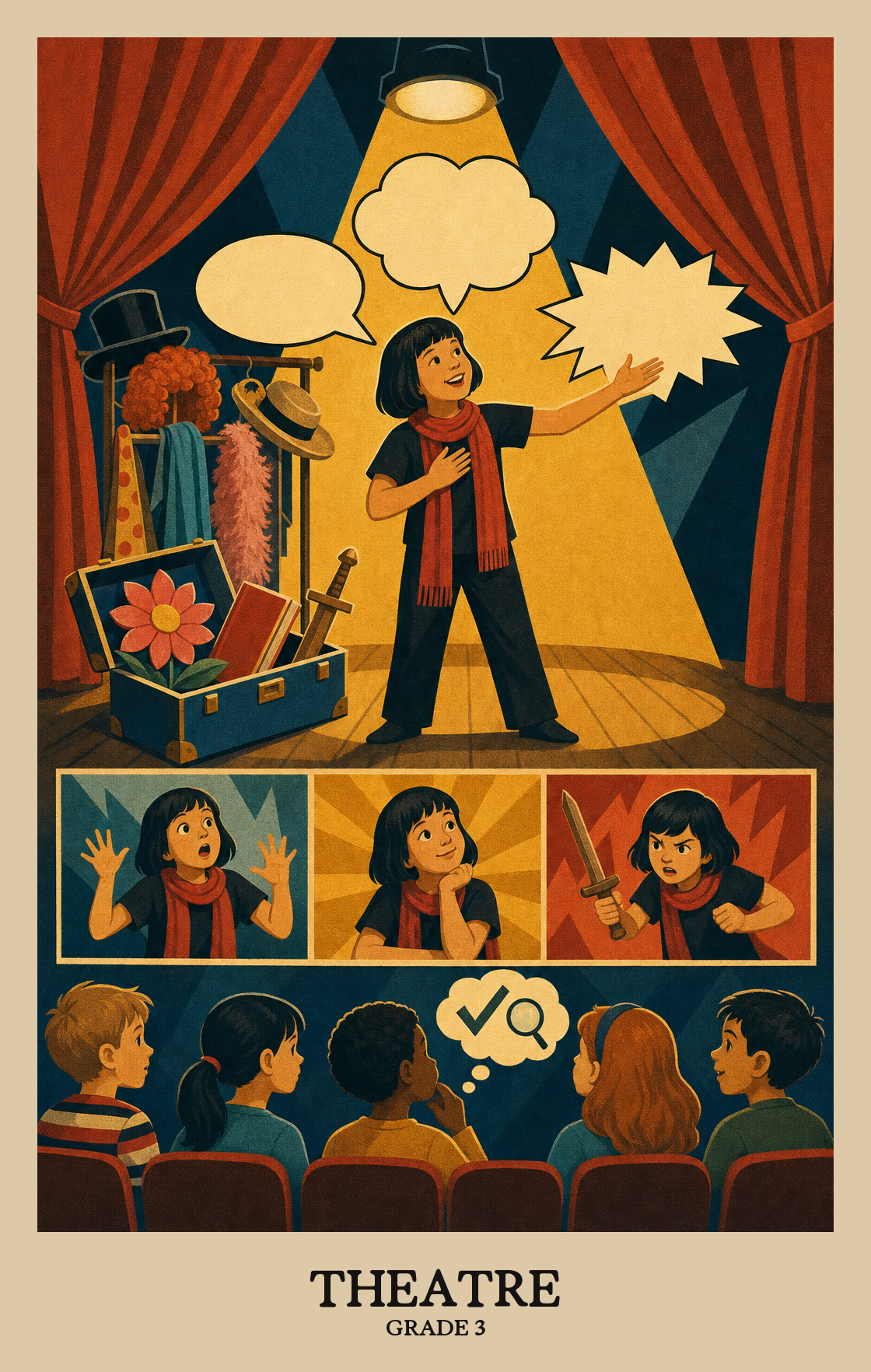
Students start the year by inventing characters and short story ideas from their own lives and imaginations. Parents may hear kids acting out little scenes at home and trying out different voices.
Students work in small groups to shape their ideas into short scenes. They decide what happens, who says what, and how the scene starts and ends.
Students practice using their voice, face, and body to show feeling. They rehearse scenes, take feedback, and try the same moment a few different ways.
Students perform short scenes for classmates and watch other groups perform. They talk about what worked, what the scene meant, and how they would improve it next time.
Students connect plays and stories to their own lives and to other times and places. They notice how a story can mean different things to different people.
Students connect something from their own life to a scene or character they create. A memory, a feeling, or a story from home becomes part of the performance.
Students look at a play or performance and think about when and where it came from. They ask what the story says about the people who made it.
| Standard | Definition | Code |
|---|---|---|
| Synthesize and relate knowledge and personal experiences to make art | Students connect something from their own life to a scene or character they create. A memory, a feeling, or a story from home becomes part of the performance. | TH:Cn10.3 |
| Relate artistic ideas and works with societal, cultural | Students look at a play or performance and think about when and where it came from. They ask what the story says about the people who made it. | TH:Cn11.3 |
Students brainstorm ideas for characters, scenes, or stories and begin shaping them into something that could be performed. This is the starting point where imagination meets planning.
Students take a theatre idea, like a character or a short scene, and shape it into something ready to perform. They make choices about what to say, how to move, and what the story needs.
Students review their drama work, make changes based on feedback, and practice until the scene feels ready to share.
| Standard | Definition | Code |
|---|---|---|
| Generate and conceptualize artistic ideas and work | Students brainstorm ideas for characters, scenes, or stories and begin shaping them into something that could be performed. This is the starting point where imagination meets planning. | TH:Cr1.3 |
| Organize and develop artistic ideas and work | Students take a theatre idea, like a character or a short scene, and shape it into something ready to perform. They make choices about what to say, how to move, and what the story needs. | TH:Cr2.3 |
| Refine and complete artistic work | Students review their drama work, make changes based on feedback, and practice until the scene feels ready to share. | TH:Cr3.3 |
Students choose a short scene or story to perform and explain why it fits their audience. They practice making deliberate choices about what to present and why it matters.
Students practice a scene or short play more than once, fixing small problems each time, so the final performance is clearer and stronger than the first try.
Students perform a short scene or story and make deliberate choices, like how loudly to speak or how to move, so the audience understands what the piece is about.
| Standard | Definition | Code |
|---|---|---|
| Analyze, interpret, and select artistic work for presentation | Students choose a short scene or story to perform and explain why it fits their audience. They practice making deliberate choices about what to present and why it matters. | TH:Pr4.3 |
| Develop and refine artistic techniques and work for presentation | Students practice a scene or short play more than once, fixing small problems each time, so the final performance is clearer and stronger than the first try. | TH:Pr5.3 |
| Convey meaning through the presentation of artistic work | Students perform a short scene or story and make deliberate choices, like how loudly to speak or how to move, so the audience understands what the piece is about. | TH:Pr6.3 |
Students watch a short play or scene and describe what they notice: what the characters want, how they move, and what the story seems to be about.
Students look at a scene or performance and explain what the actor or playwright was trying to say. They back up their thinking with specific details from what they saw or heard.
Students look at a scene or performance and explain what works and what doesn't, using a simple set of questions or rules to back up their opinion.
| Standard | Definition | Code |
|---|---|---|
| Perceive and analyze artistic work | Students watch a short play or scene and describe what they notice: what the characters want, how they move, and what the story seems to be about. | TH:Re7.3 |
| Interpret intent and meaning in artistic work | Students look at a scene or performance and explain what the actor or playwright was trying to say. They back up their thinking with specific details from what they saw or heard. | TH:Re8.3 |
| Apply criteria to evaluate artistic work | Students look at a scene or performance and explain what works and what doesn't, using a simple set of questions or rules to back up their opinion. | TH:Re9.3 |
Students invent characters, build short scenes, and act them out for classmates. They also watch performances and talk about what worked and why. A lot of the work happens in small groups, with students trying ideas, getting feedback, and trying again.
Read a story together and act out a scene with different voices and faces. Ask what a character wants and how their body or voice shows it. Even five minutes of pretend play with a favorite book counts.
No. Most of the work happens in the classroom, in small groups, and in front of classmates. Confidence grows from short, low-pressure scenes, not big productions.
Start with imagination and character work, then move into building short scenes with a clear beginning, middle, and end. Save polished performance and peer critique for later in the year, once students have a shared vocabulary for voice, body, and intent.
Staying in character through a whole short scene is hard at this age, and so is giving feedback that points to something specific instead of just liking or disliking a scene. Plan to revisit both several times across the year.
Students act out scenes tied to stories, cultures, and time periods studied in reading and social studies. Pairing a scene with a book or a history unit makes the connection concrete and gives the acting a reason to exist.
Students can take an idea or a story, shape it into a short scene with a clear character and purpose, and perform it for classmates. They can also watch another group's scene and say what the actors were trying to show and how it landed.
Listen for students talking about characters as people with feelings and reasons, not just costumes. At home, students might narrate stuffed animals, change voices for different characters, or ask to act out a book. Those are real signs of growth.