Thinking and working like scientists
Students start the year learning how science actually gets done. They ask testable questions, design experiments, and back up their claims with evidence instead of opinion.
This is the year science stops being a tour of facts and starts asking students to back up their thinking with evidence. Students dig into how atoms build matter, how energy moves, how traits pass from parents to children, and how human choices shape the planet. They also design and test solutions to real problems, the way engineers do. By spring, students can read a science claim, weigh the data behind it, and explain whether they buy it.
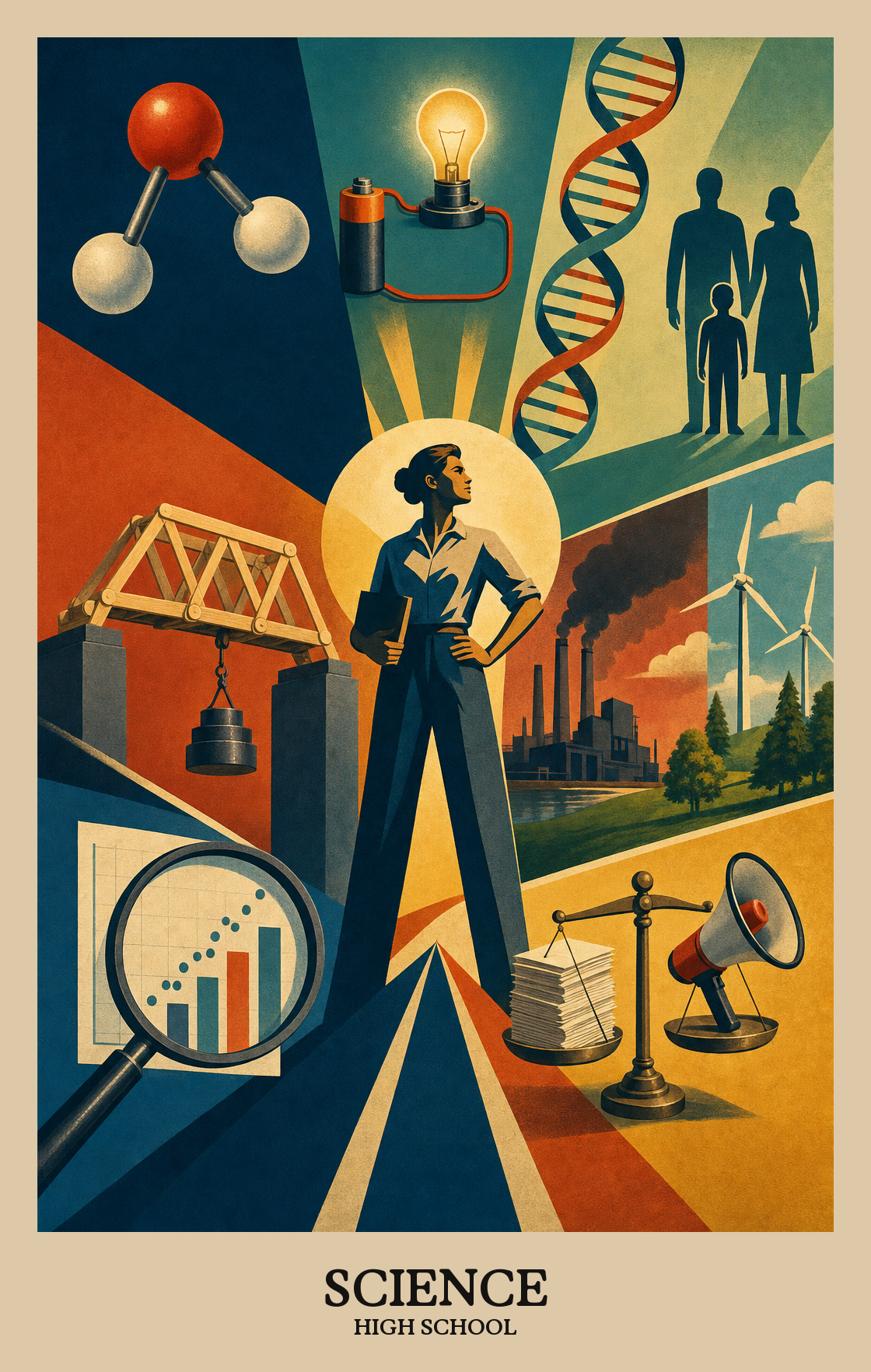
Students start the year learning how science actually gets done. They ask testable questions, design experiments, and back up their claims with evidence instead of opinion.
Students dig into the physical world. They study what matter is made of, how forces move objects, and how energy shifts from one form to another, like heat into motion or light into electricity.
Students look at how waves carry energy and information, from sound and light to the signals behind phones and Wi-Fi.
Students turn to living things. They study how cells keep a body running, how energy moves through a food web, and how traits like eye color pass from parents to children.
Students examine why living things share so much in common and why they also look so different. They trace how species change across long stretches of time.
Students zoom out to the planet and beyond. They study how Earth's land, water, and air interact, how the solar system moves, and how human choices shape the climate and the land.
Students learn to frame a question or problem precisely enough that it can actually be tested in a lab or solved with a design. The goal is to separate questions science can answer from ones it cannot.
Students build diagrams, simulations, or physical models to show how a system or process works, then use those models to explain what they observe or predict what happens next.
Students design and run experiments to collect real data and find out whether their ideas hold up. That means choosing what to measure, deciding how to set up the test, and recording what actually happens.
Reading data from charts, graphs, or experiments, students look for patterns and explain what those patterns actually mean, not just what the numbers say.
Students use math, data, and calculations to back up scientific claims. That might mean graphing results, running numbers, or checking whether the data actually supports what the experiment suggested.
Students build written or spoken explanations for why something happens in nature, then back each claim with data or observations from their own work or from established science.
Students look at two or more scientific explanations or proposed solutions, weigh the evidence behind each, and argue for the one that holds up best. The goal is to show why one answer is stronger, not just to pick a side.
Students read scientific sources, judge how reliable they are, and share what they find in writing, diagrams, or presentations. The focus is on understanding real research and explaining it clearly to others.
| Standard | Definition | Code |
|---|---|---|
| Asking Questions and Defining Problems High School | Students learn to frame a question or problem precisely enough that it can actually be tested in a lab or solved with a design. The goal is to separate questions science can answer from ones it cannot. | DC-SCI.SEP.9-12.1 |
| Developing and Using Models High School | Students build diagrams, simulations, or physical models to show how a system or process works, then use those models to explain what they observe or predict what happens next. | DC-SCI.SEP.9-12.2 |
| Planning and Carrying Out Investigations High School | Students design and run experiments to collect real data and find out whether their ideas hold up. That means choosing what to measure, deciding how to set up the test, and recording what actually happens. | DC-SCI.SEP.9-12.3 |
| Analyzing and Interpreting Data High School | Reading data from charts, graphs, or experiments, students look for patterns and explain what those patterns actually mean, not just what the numbers say. | DC-SCI.SEP.9-12.4 |
| Mathematics and Computational Thinking High School | Students use math, data, and calculations to back up scientific claims. That might mean graphing results, running numbers, or checking whether the data actually supports what the experiment suggested. | DC-SCI.SEP.9-12.5 |
| Constructing Explanations High School | Students build written or spoken explanations for why something happens in nature, then back each claim with data or observations from their own work or from established science. | DC-SCI.SEP.9-12.6 |
| Engaging in Argument from Evidence High School | Students look at two or more scientific explanations or proposed solutions, weigh the evidence behind each, and argue for the one that holds up best. The goal is to show why one answer is stronger, not just to pick a side. | DC-SCI.SEP.9-12.7 |
| Communicating Information High School | Students read scientific sources, judge how reliable they are, and share what they find in writing, diagrams, or presentations. The focus is on understanding real research and explaining it clearly to others. | DC-SCI.SEP.9-12.8 |
Students investigate how atoms and molecules are arranged and how they interact to explain physical phenomena like dissolving, burning, or changes in state.
Students study how forces change the way objects move, using Newton's laws and the idea that energy and momentum stay constant in a closed system. They apply these rules to real situations, like collisions or objects in free fall.
Students trace how energy changes form and moves from one object to another, then show that the total amount stays the same. Think heat leaving a hot pan, electricity lighting a bulb, or a ball rolling downhill.
Students study how waves move energy and information from one place to another. They look at real applications like radio signals, medical imaging, and fiber optics to see how wave behavior makes modern communication possible.
| Standard | Definition | Code |
|---|---|---|
| Matter and Interactions High School | Students investigate how atoms and molecules are arranged and how they interact to explain physical phenomena like dissolving, burning, or changes in state. | DC-SCI.PS.9-12.1 |
| Motion and Stability High School | Students study how forces change the way objects move, using Newton's laws and the idea that energy and momentum stay constant in a closed system. They apply these rules to real situations, like collisions or objects in free fall. | DC-SCI.PS.9-12.2 |
| Energy High School | Students trace how energy changes form and moves from one object to another, then show that the total amount stays the same. Think heat leaving a hot pan, electricity lighting a bulb, or a ball rolling downhill. | DC-SCI.PS.9-12.3 |
| Waves and Information High School | Students study how waves move energy and information from one place to another. They look at real applications like radio signals, medical imaging, and fiber optics to see how wave behavior makes modern communication possible. | DC-SCI.PS.9-12.4 |
Students examine how living things are built and how they work, from the smallest cell up to whole-body systems like digestion or circulation.
Students trace how energy flows through a food web and how matter like carbon and water cycles back through living and nonliving parts of an ecosystem. They also study how organisms compete, cooperate, and depend on each other to survive.
Students examine why offspring resemble but don't perfectly match their parents. They trace how traits like eye color or height are passed down, and why siblings can look different even when they share the same parents.
Students examine how living things share common traits across species while also differing in key ways, then study the processes like natural selection and genetic change that explain how species shift over time.
| Standard | Definition | Code |
|---|---|---|
| Structures and Processes High School | Students examine how living things are built and how they work, from the smallest cell up to whole-body systems like digestion or circulation. | DC-SCI.LS.9-12.1 |
| Ecosystems High School | Students trace how energy flows through a food web and how matter like carbon and water cycles back through living and nonliving parts of an ecosystem. They also study how organisms compete, cooperate, and depend on each other to survive. | DC-SCI.LS.9-12.2 |
| Heredity High School | Students examine why offspring resemble but don't perfectly match their parents. They trace how traits like eye color or height are passed down, and why siblings can look different even when they share the same parents. | DC-SCI.LS.9-12.3 |
| Biological Evolution High School | Students examine how living things share common traits across species while also differing in key ways, then study the processes like natural selection and genetic change that explain how species shift over time. | DC-SCI.LS.9-12.4 |
Students study where Earth sits in the solar system and how it moves, then trace the major events that shaped Earth across billions of years.
Students examine how Earth's land, water, air, and living things connect and affect each other. A volcanic eruption, a rainstorm, or a wildfire shows how one part of Earth can shift what happens in the others.
Students study how things like farming, cities, and energy use change the land, air, and water around us. They also look at how earthquakes, floods, and wildfires shape where and how people live.
| Standard | Definition | Code |
|---|---|---|
| Earth's Place in the Universe High School | Students study where Earth sits in the solar system and how it moves, then trace the major events that shaped Earth across billions of years. | DC-SCI.ESS.9-12.1 |
| Earth's Systems High School | Students examine how Earth's land, water, air, and living things connect and affect each other. A volcanic eruption, a rainstorm, or a wildfire shows how one part of Earth can shift what happens in the others. | DC-SCI.ESS.9-12.2 |
| Earth and Human Activity High School | Students study how things like farming, cities, and energy use change the land, air, and water around us. They also look at how earthquakes, floods, and wildfires shape where and how people live. | DC-SCI.ESS.9-12.3 |
Students identify a real problem, sketch or build possible fixes, then test and refine their best idea until it works better. This is the core loop of engineering design.
Students study how new technologies shape daily life and how the needs of society push engineers to solve new problems. Each one changes the other.
| Standard | Definition | Code |
|---|---|---|
| Engineering Design High School | Students identify a real problem, sketch or build possible fixes, then test and refine their best idea until it works better. This is the core loop of engineering design. | DC-SCI.ETS.9-12.1 |
| Links Among Engineering, Technology, and Society High School | Students study how new technologies shape daily life and how the needs of society push engineers to solve new problems. Each one changes the other. | DC-SCI.ETS.9-12.2 |
DC Biology end-of-course assessment, administered once in high school after a biology course.
Students study three big areas across their high school years: physical science (matter, forces, energy, and waves), life science (cells, ecosystems, genetics, and evolution), and earth and space science (the solar system, Earth's systems, and human impact). They also practice the habits scientists and engineers use, like asking questions, testing ideas, and arguing from evidence.
Ask students to explain the idea in their own words, then ask what evidence makes them think so. That second question is the heart of high school science. A short walk, a news article, or a kitchen experiment can give plenty of material to talk about.
Most schools spend a full year on one area at a time, often biology, then chemistry, then physics or earth science. Inside each year, build from structure to interactions to change over time. Weave the science and engineering practices into every unit instead of teaching them as a separate chapter.
Math helps, but the math used in high school science is mostly algebra, ratios, graphs, and units. Students who struggle with math can still do well if they practice reading graphs and checking whether an answer makes sense. A weak math year does not have to mean a weak science year.
Plan extra time for energy conservation, the difference between heredity and evolution, and reading graphs of real data. Students often memorize definitions for these without understanding the underlying model. Short formative checks with a diagram or a graph tend to expose the gaps faster than a multiple-choice quiz.
Students define a real problem, sketch possible solutions, build or model one, test it, and improve it. It does not require a fancy lab. A paper bridge, a water filter, or a coded simulation all count as long as students collect data and use it to make the design better.
By the end of high school, students should be able to read an unfamiliar article or graph, explain what claim is being made, and judge whether the evidence supports it. They should also be able to design a simple investigation and write up what they found. Recall of facts matters less than this kind of reasoning.
Watch the news together and ask which claims are backed by data and which are not. Cook, garden, fix something broken, or track the weather for a week. These small habits build the same reasoning students use in class, and they take ten minutes.