Getting ideas and looking closely
Students start the year by gathering ideas from their own lives and from art they see. They learn to slow down, notice details in a picture, and talk about what they see before they make their own.
This is the year art-making becomes more deliberate. Students plan a piece before they start, try out ideas in a sketchbook, and revise their work instead of calling the first try done. They also start talking about art with real reasons, explaining what a piece means and why they think so. By spring, students can pick a finished piece, prepare it for display, and explain the choices behind it.
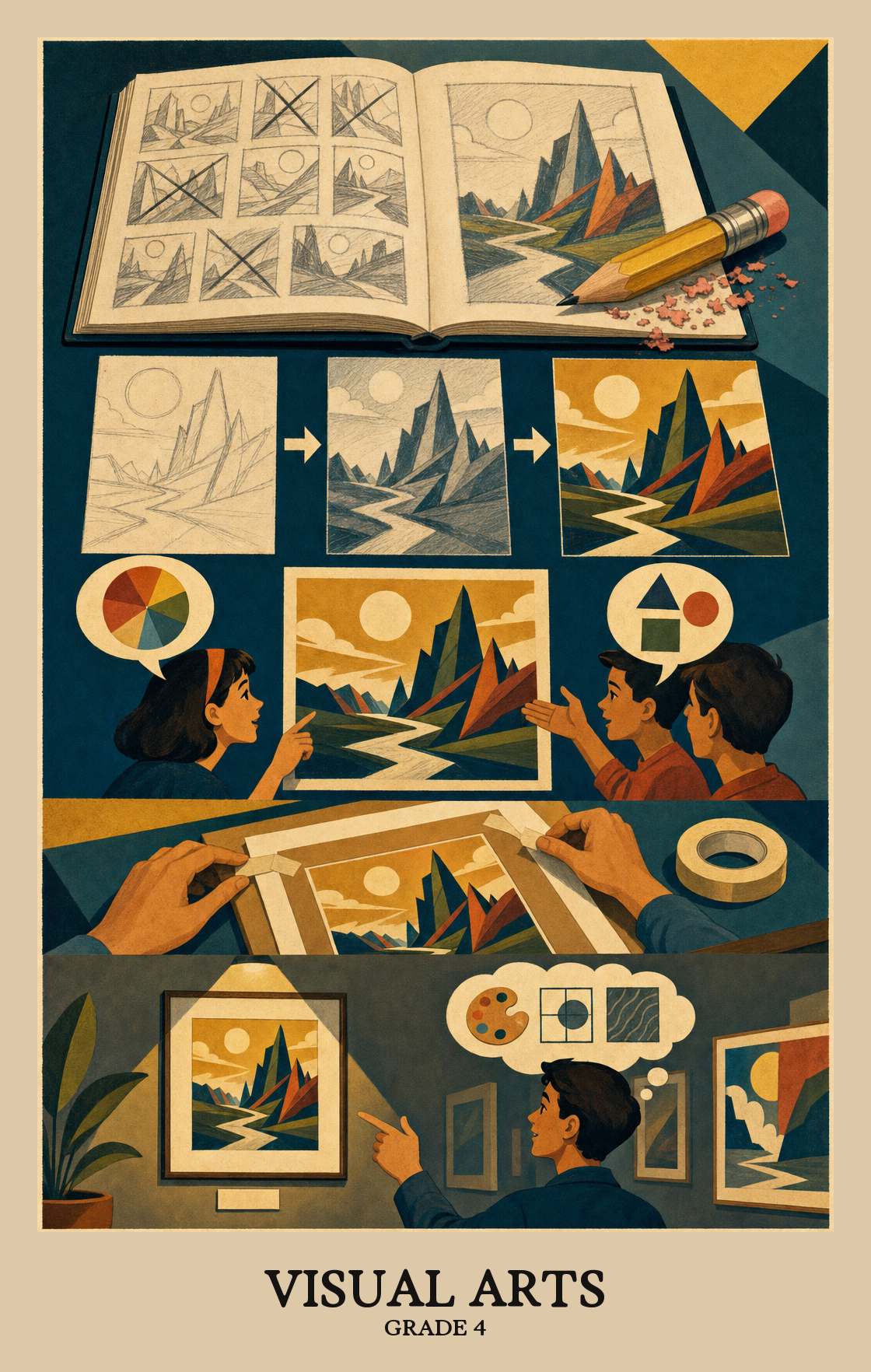
Students start the year by gathering ideas from their own lives and from art they see. They learn to slow down, notice details in a picture, and talk about what they see before they make their own.
Students sketch, try out materials, and build artwork from a plan. They learn that a first try is rarely the final piece, and that changing course mid-project is part of the work.
Students return to pieces they started and push them further. They practice specific techniques, fix what is not working, and decide when a piece is actually done.
Students look at art from different cultures and time periods and connect it to their own ideas. They start to understand that artists make choices for reasons tied to where and when they lived.
Students choose pieces to display, explain what the work is about, and use a clear set of reasons to talk about other artists' work. They learn that a thoughtful opinion is more than liking or disliking something.
Students pull from things they already know and moments they have lived through to make artwork that feels personal and specific to them.
Students look at a painting, sculpture, or other artwork and connect it to when and where it was made. Understanding the history or culture behind a piece helps students see what the artist was trying to say.
| Standard | Definition | Code |
|---|---|---|
| Synthesize and relate knowledge and personal experiences to make art | Students pull from things they already know and moments they have lived through to make artwork that feels personal and specific to them. | VA:Cn10.4 |
| Relate artistic ideas and works with societal, cultural | Students look at a painting, sculpture, or other artwork and connect it to when and where it was made. Understanding the history or culture behind a piece helps students see what the artist was trying to say. | VA:Cn11.4 |
Students brainstorm ideas before picking up a brush or pencil, then sketch out a plan for what they want to make. The focus is on thinking through the idea first, not just starting and seeing what happens.
Students plan and refine their artwork before calling it finished. They make choices about composition, color, and detail, then adjust what isn't working.
Students review their own artwork, make changes to improve it, and bring it to a finished state.
| Standard | Definition | Code |
|---|---|---|
| Generate and conceptualize artistic ideas and work | Students brainstorm ideas before picking up a brush or pencil, then sketch out a plan for what they want to make. The focus is on thinking through the idea first, not just starting and seeing what happens. | VA:Cr1.4 |
| Organize and develop artistic ideas and work | Students plan and refine their artwork before calling it finished. They make choices about composition, color, and detail, then adjust what isn't working. | VA:Cr2.4 |
| Refine and complete artistic work | Students review their own artwork, make changes to improve it, and bring it to a finished state. | VA:Cr3.4 |
Students look at several pieces of their own artwork, decide which ones are strongest, and choose what to present or display.
Students practice and improve a piece of artwork before sharing it with others, making deliberate choices about what to change or keep.
Students choose how to display their artwork so viewers understand what it means. Framing, placement, and setting all shape how someone experiences the work.
| Standard | Definition | Code |
|---|---|---|
| Analyze, interpret, and select artistic work for presentation | Students look at several pieces of their own artwork, decide which ones are strongest, and choose what to present or display. | VA:Pr4.4 |
| Develop and refine artistic techniques and work for presentation | Students practice and improve a piece of artwork before sharing it with others, making deliberate choices about what to change or keep. | VA:Pr5.4 |
| Convey meaning through the presentation of artistic work | Students choose how to display their artwork so viewers understand what it means. Framing, placement, and setting all shape how someone experiences the work. | VA:Pr6.4 |
Students look closely at a piece of art and describe what they notice: the colors, shapes, lines, and how the parts work together to create a mood or meaning.
Students look at a piece of art and explain what they think the artist meant, using details from the work itself to back up their thinking.
Students look at a piece of art and judge it against a set of criteria, explaining what works, what doesn't, and why, using specific details from the work itself.
| Standard | Definition | Code |
|---|---|---|
| Perceive and analyze artistic work | Students look closely at a piece of art and describe what they notice: the colors, shapes, lines, and how the parts work together to create a mood or meaning. | VA:Re7.4 |
| Interpret intent and meaning in artistic work | Students look at a piece of art and explain what they think the artist meant, using details from the work itself to back up their thinking. | VA:Re8.4 |
| Apply criteria to evaluate artistic work | Students look at a piece of art and judge it against a set of criteria, explaining what works, what doesn't, and why, using specific details from the work itself. | VA:Re9.4 |
Students plan an idea, make the artwork, then step back and judge how it turned out. They also look closely at other people's art and talk about what the artist might have meant. Sketching, building, and revising all count as real art work this year.
Keep simple supplies handy and let students make things from their own ideas, not just craft kits. Ask what they were trying to show and what they might change next time. Even ten minutes of drawing after dinner builds the habits art class is asking for.
Push back gently on the idea that art is a talent students either have or don't. Praise the choices they made, like the colors or the shapes, not how realistic it looks. Trying, revising, and finishing a piece matter more than getting it perfect.
Students start connecting art to where and when it was made, so a little background helps. Visit a museum if there's one nearby, or look up a few artists online together. Talking about why an artist made something is more useful than memorizing names and dates.
Start with idea generation and sketching so students get comfortable making choices. Build technique pieces in the middle of the year, then move into longer projects where students plan, refine, and present finished work. Save reflection and critique routines for the whole year, not just the end.
Refining work trips students up. Many treat the first draft as the final piece and resist going back in. Build short revision steps into every project so editing feels normal, not like punishment for a bad first try.
Give students a short list of things to look for, like use of color or how the piece fills the page. Have them point to specific parts of the artwork when they comment. Modeling kind, specific language a few times early in the year sets the tone.
Students can come up with an idea, plan it, make it, and explain the choices they made. They can also look at someone else's work and say what it might mean and what is working well. Finished pieces should show real revision, not just a first attempt.