Exploring ideas through movement
Students start the year by turning everyday experiences, stories, and feelings into movement. They try out different ways the body can move and gather ideas that will grow into longer dances later.
This is the year dance becomes a way to tell a story on purpose. Students take an idea, shape it into movement, and clean it up so an audience can follow it. They also start to watch dance with a sharper eye, noticing what the choreographer was trying to say. By spring, students can perform a short dance they helped build and explain what it means.
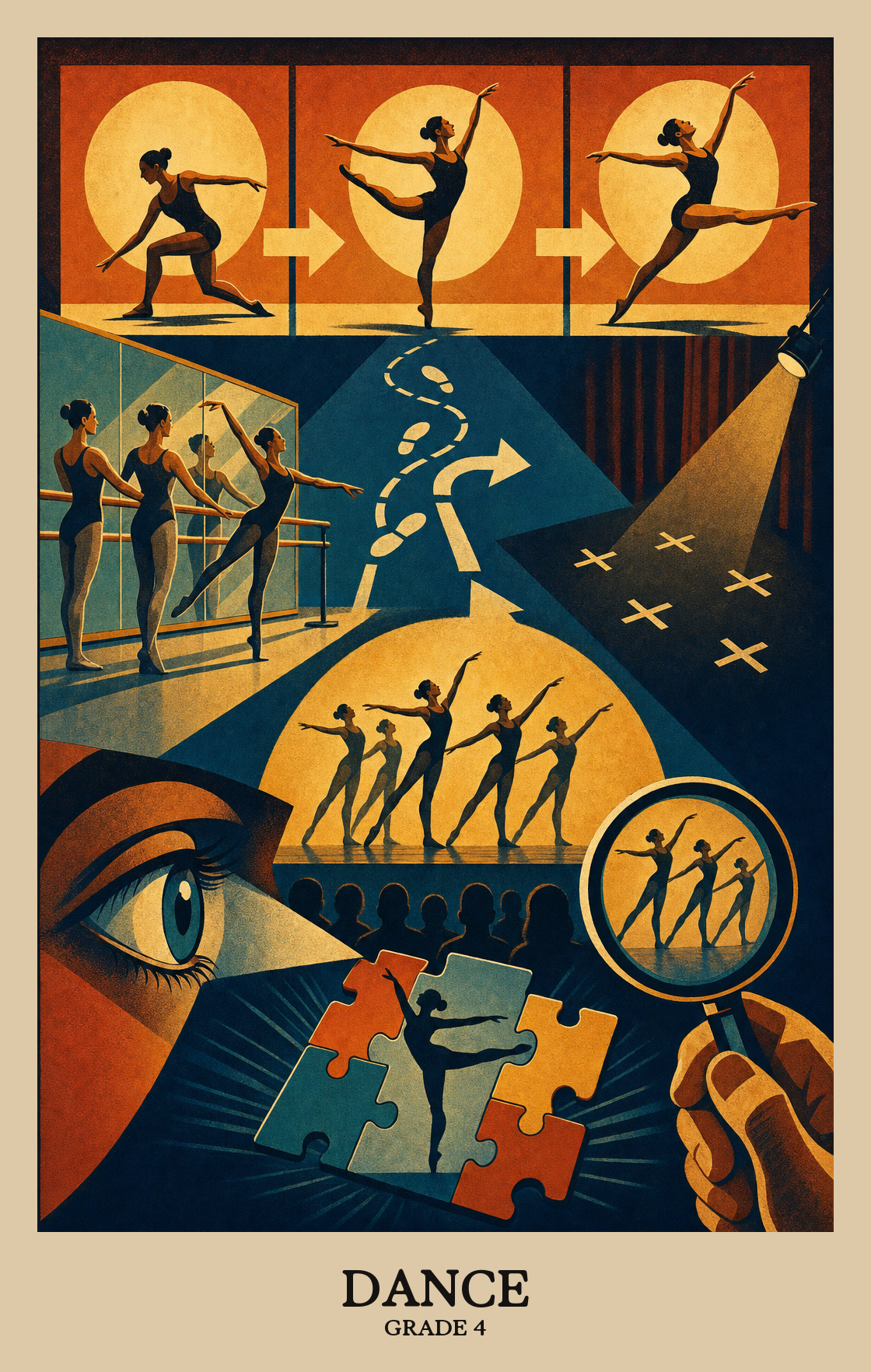
Students start the year by turning everyday experiences, stories, and feelings into movement. They try out different ways the body can move and gather ideas that will grow into longer dances later.
Students take rough ideas and build them into short dances with a clear beginning, middle, and end. They practice choosing movements on purpose so a dance feels organized instead of random.
Students sharpen body control, timing, and balance. They rehearse pieces and learn how small choices in energy or pacing change what an audience feels when watching.
Students watch dances and talk about what they notice. They describe what the movement seems to mean, give reasons for their opinions, and connect dances to the cultures and times they come from.
Students connect something they know or have lived through to the dances they make or watch. A memory, a feeling, or an idea from their own life shapes the movement they create.
Students look at a dance and ask where it came from: what culture created it, when, and why. That context changes how the dance looks and what it means.
| Standard | Definition | Code |
|---|---|---|
| Synthesize and relate knowledge and personal experiences to make art | Students connect something they know or have lived through to the dances they make or watch. A memory, a feeling, or an idea from their own life shapes the movement they create. | DA:Cn10.4 |
| Relate artistic ideas and works with societal, cultural | Students look at a dance and ask where it came from: what culture created it, when, and why. That context changes how the dance looks and what it means. | DA:Cn11.4 |
Students brainstorm and sketch out ideas for a dance before they start moving. They decide what story, feeling, or image they want their dance to express.
Students take a dance idea and shape it into a real sequence, choosing which movements to keep, which to cut, and how to arrange them so the piece feels intentional from start to finish.
Students look back at a dance they've been building and make specific changes to improve it, then practice until the piece feels finished and ready to share.
| Standard | Definition | Code |
|---|---|---|
| Generate and conceptualize artistic ideas and work | Students brainstorm and sketch out ideas for a dance before they start moving. They decide what story, feeling, or image they want their dance to express. | DA:Cr1.4 |
| Organize and develop artistic ideas and work | Students take a dance idea and shape it into a real sequence, choosing which movements to keep, which to cut, and how to arrange them so the piece feels intentional from start to finish. | DA:Cr2.4 |
| Refine and complete artistic work | Students look back at a dance they've been building and make specific changes to improve it, then practice until the piece feels finished and ready to share. | DA:Cr3.4 |
Students choose a dance or movement piece to perform and explain why it fits the occasion or idea they want to share.
Students practice a dance phrase again and again, adjusting timing, body position, and movement quality until the piece is ready to perform for an audience.
Students perform a dance for an audience with a clear purpose in mind, using movement choices to express a specific feeling, story, or idea.
| Standard | Definition | Code |
|---|---|---|
| Analyze, interpret, and select artistic work for presentation | Students choose a dance or movement piece to perform and explain why it fits the occasion or idea they want to share. | DA:Pr4.4 |
| Develop and refine artistic techniques and work for presentation | Students practice a dance phrase again and again, adjusting timing, body position, and movement quality until the piece is ready to perform for an audience. | DA:Pr5.4 |
| Convey meaning through the presentation of artistic work | Students perform a dance for an audience with a clear purpose in mind, using movement choices to express a specific feeling, story, or idea. | DA:Pr6.4 |
Students watch a dance and describe what they notice, from how the dancers move to how the whole piece feels. They start backing up their observations with specific reasons.
Students explain what a dance is trying to say and why the choreographer may have made specific choices, like the speed, direction, or mood of the movement.
Students use a set of criteria, like a checklist of what makes a dance clear or expressive, to judge whether a performance is working and explain why.
| Standard | Definition | Code |
|---|---|---|
| Perceive and analyze artistic work | Students watch a dance and describe what they notice, from how the dancers move to how the whole piece feels. They start backing up their observations with specific reasons. | DA:Re7.4 |
| Interpret intent and meaning in artistic work | Students explain what a dance is trying to say and why the choreographer may have made specific choices, like the speed, direction, or mood of the movement. | DA:Re8.4 |
| Apply criteria to evaluate artistic work | Students use a set of criteria, like a checklist of what makes a dance clear or expressive, to judge whether a performance is working and explain why. | DA:Re9.4 |
Students make up short dances, learn steps from a teacher or video, and perform for classmates. They also watch dances and talk about what the movement might mean. The work moves between creating, performing, and responding to dance.
Give space to move and a few minutes of music a day. Ask students to show a short dance about something real, like a rainy walk or a basketball game, then ask what each move means. Watching dance together and talking about it counts too.
No. The goal is not talent. Students are learning to plan movement, practice it, and explain their choices. A student who can describe why they chose a slow spin instead of a jump is doing the work.
Start with movement vocabulary and short solo studies so students build a personal toolkit. Move into partner and small group work where students shape and refine a piece. End with a presentation cycle that includes performing, watching peers, and giving feedback against shared criteria.
Students can take an idea, such as a poem or a memory, and turn it into a short dance with a clear beginning, middle, and end. They can rehearse it, perform it for an audience, and explain the choices they made. They can also describe what a peer's dance seems to be about.
Refining work is the hardest part. Students often want to call a first draft finished. Build in short revision cycles where students perform a phrase, get one piece of feedback, and try it again the same day. Vocabulary for describing movement also needs steady practice.
Students pull ideas from stories, history, science, and their own lives, then shape those ideas into movement. A dance about the water cycle or a family tradition is fair game. This connection makes dance feel useful and gives students more to draw from.
Students should be able to plan a short dance on their own, rehearse it without giving up, and perform it for others. They should also be able to watch a classmate's dance and say something specific about what worked. Confidence in front of a small audience is a good sign.