Finding ideas worth making
Students start the year by turning their own experiences and questions into art ideas. They keep a sketchbook of rough drawings and notes, and learn that good art usually starts with messy thinking.
This is the year art becomes a way of thinking, not just making. Students start with an idea they care about, then plan, sketch, and revise until the piece says what they meant. They look closely at other artists and ask why a work was made and who it was for. By spring, students can show a finished piece and explain the choices behind it.
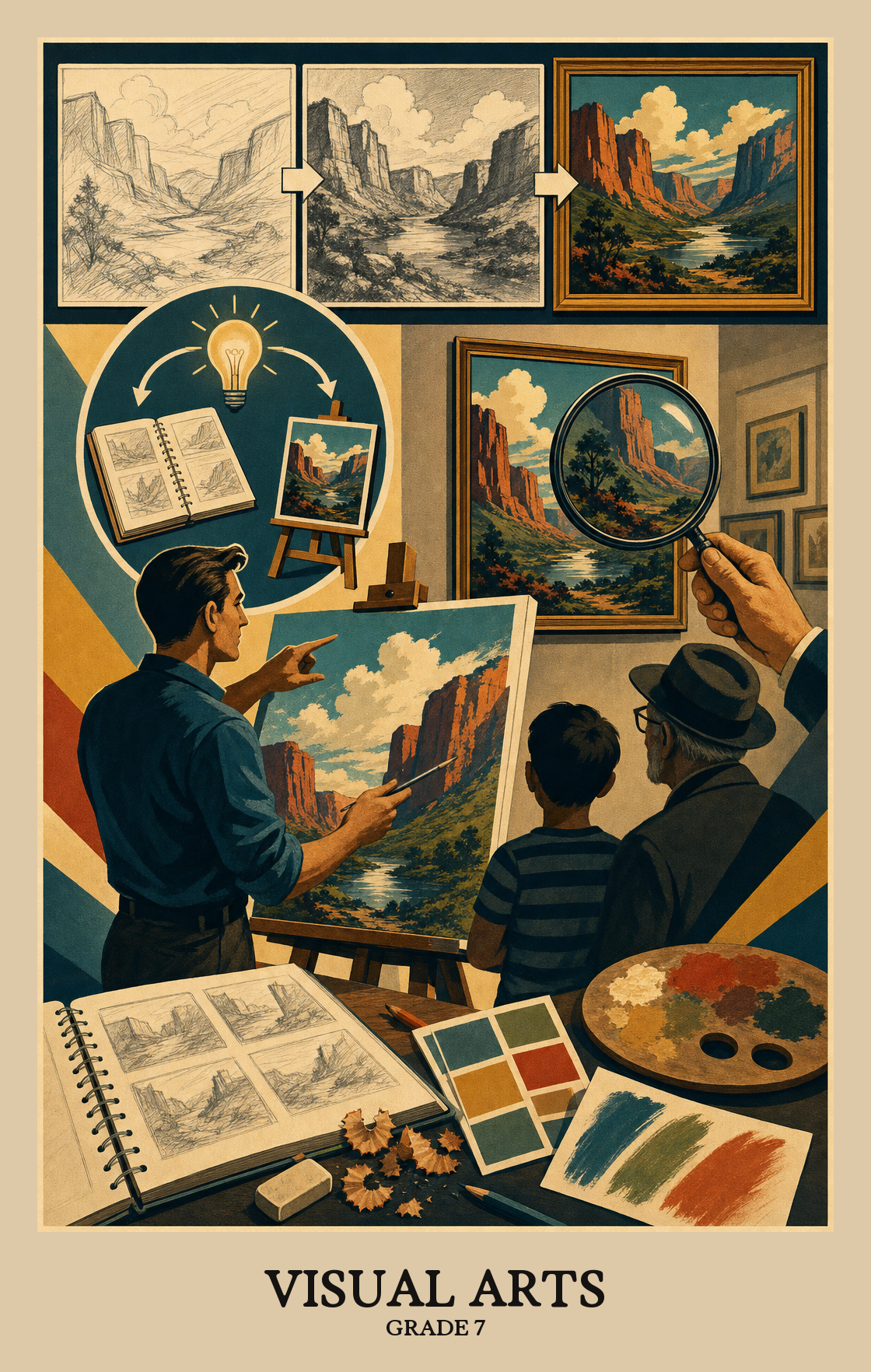
Students start the year by turning their own experiences and questions into art ideas. They keep a sketchbook of rough drawings and notes, and learn that good art usually starts with messy thinking.
Students practice with drawing, painting, sculpture, and digital tools. They focus on getting better at the craft itself, not just finishing a project, and learn to fix mistakes instead of starting over.
Students study artworks from different cultures and time periods. They learn to describe what they see, guess what the artist meant, and talk about why an artwork was made and who it was made for.
Students take a project from rough draft to finished work. They get feedback from classmates, make real changes, and learn that revising a piece is part of the art, not a sign something went wrong.
Students choose which pieces to display and decide how to present them. They think about what message the artwork sends to a viewer and write short statements explaining their choices.
Students draw on what they already know and what they've lived through to make creative choices in their artwork. Personal experience becomes part of the work itself.
Students look at artwork and connect it to the time, place, and culture it came from. Understanding that context changes how the work looks and what it means.
| Standard | Definition | Code |
|---|---|---|
| Synthesize and relate knowledge and personal experiences to make art | Students draw on what they already know and what they've lived through to make creative choices in their artwork. Personal experience becomes part of the work itself. | VA:Cn10.7 |
| Relate artistic ideas and works with societal, cultural | Students look at artwork and connect it to the time, place, and culture it came from. Understanding that context changes how the work looks and what it means. | VA:Cn11.7 |
Students brainstorm and develop original ideas before picking up a tool. The focus is on thinking through what to make and why, not just executing a technique.
Students take a rough sketch or early idea and shape it into finished artwork by making deliberate choices about composition, materials, and technique.
Students review a piece of artwork they've made, decide what isn't working, and revise it before calling it finished.
| Standard | Definition | Code |
|---|---|---|
| Generate and conceptualize artistic ideas and work | Students brainstorm and develop original ideas before picking up a tool. The focus is on thinking through what to make and why, not just executing a technique. | VA:Cr1.7 |
| Organize and develop artistic ideas and work | Students take a rough sketch or early idea and shape it into finished artwork by making deliberate choices about composition, materials, and technique. | VA:Cr2.7 |
| Refine and complete artistic work | Students review a piece of artwork they've made, decide what isn't working, and revise it before calling it finished. | VA:Cr3.7 |
Students review their own artwork and decide which pieces are strong enough to share with an audience. They explain what makes a piece worth presenting and why it represents their best thinking.
Students review their own artwork, make deliberate improvements, and prepare a finished piece to share with an audience.
Students choose how to display or share a piece of art so the viewer understands what it means. The layout, placement, and context all shape how the work lands.
| Standard | Definition | Code |
|---|---|---|
| Analyze, interpret, and select artistic work for presentation | Students review their own artwork and decide which pieces are strong enough to share with an audience. They explain what makes a piece worth presenting and why it represents their best thinking. | VA:Pr4.7 |
| Develop and refine artistic techniques and work for presentation | Students review their own artwork, make deliberate improvements, and prepare a finished piece to share with an audience. | VA:Pr5.7 |
| Convey meaning through the presentation of artistic work | Students choose how to display or share a piece of art so the viewer understands what it means. The layout, placement, and context all shape how the work lands. | VA:Pr6.7 |
Students look closely at a piece of art and describe what they notice: color, shape, composition, or mood. Then they explain how those choices work together to create meaning.
Students look at a piece of art and explain what they think the artist meant, using specific details from the work to back up their reading.
Students use a set of criteria, like a checklist of what makes a piece of work strong, to judge and explain the quality of their own art or someone else's.
| Standard | Definition | Code |
|---|---|---|
| Perceive and analyze artistic work | Students look closely at a piece of art and describe what they notice: color, shape, composition, or mood. Then they explain how those choices work together to create meaning. | VA:Re7.7 |
| Interpret intent and meaning in artistic work | Students look at a piece of art and explain what they think the artist meant, using specific details from the work to back up their reading. | VA:Re8.7 |
| Apply criteria to evaluate artistic work | Students use a set of criteria, like a checklist of what makes a piece of work strong, to judge and explain the quality of their own art or someone else's. | VA:Re9.7 |
Students move past following directions and start making real choices in their own work. They sketch ideas, pick what to keep, and finish pieces they can talk about. They also look closely at other artists and explain what the work might mean.
Keep a small sketchbook around and ask about things that interest them: a place, a memory, a song, a problem they care about. Ideas get stronger when students draw the same thing a few different ways before picking one. Avoid fixing their drawings for them.
At this age, students compare their work to others and often want to quit. Praise the thinking and the choices, not the talent. Short, low-pressure drawing time, ten minutes a few nights a week, helps more than long sessions.
Start with idea generation and sketchbook habits, then move into longer projects that ask for planning, revision, and a finished piece. Build in regular looking-and-talking about artworks from different times and cultures. Save presentation and self-evaluation for the back half of each unit.
Revision is the hardest part. Students want to call a piece done at the first draft. Plan short, structured critiques where students point to one thing working and one thing to change, and require a visible revision before a piece is finished.
By spring, students should be able to plan a piece, revise it, and explain why they made the choices they made. They should also be able to look at an unfamiliar artwork and say something specific about what it means and how it was made.
Both matter, but ideas and revision carry more weight this year than perfect technique. Students are expected to develop their craft through practice while also making thoughtful choices about meaning. A clean drawing with no thinking behind it is not the goal.
Students use specific criteria instead of saying a piece is good or bad. They point to what they see, connect it to the artist's intent, and suggest what could change. Modeling the language early in the year pays off for the rest of it.