Skip to content

What does a student learn in ?

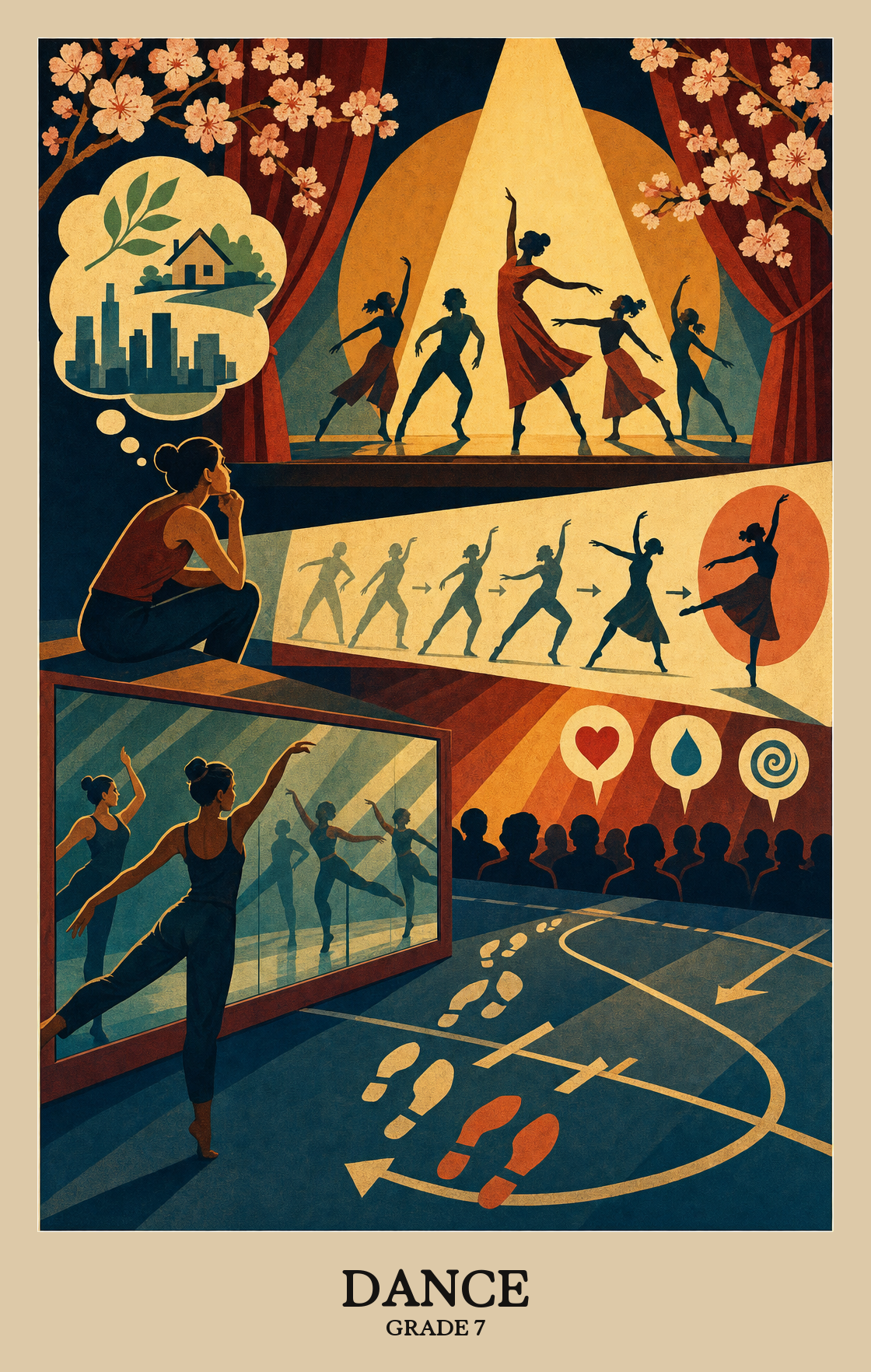
This is the year dance moves from learning steps to shaping a piece on purpose. Students pull from their own lives and from what they see in the world to build short dances with a clear idea behind them. They practice the work, sharpen the movement, and think about what they want an audience to feel. By spring, they can perform a short dance they helped create and explain the choices they made.

  • Choreography
  • Performing
  • Movement skills
  • Audience and meaning
  • Dance and culture
  • Giving feedback
Source: Delaware Delaware Content Standards
Year at a glance
How the year usually goes. Every school and district set their own curriculum, so treat this as a guide, not official pacing.
  1. 1

    Finding ideas for movement

    Students start the year exploring where dance ideas come from. They pull from their own lives, music, images, and stories, then shape those starting points into short movement sketches they can share with a partner or small group.

  2. 2

    Building and shaping dances

    Students take rough ideas and turn them into organized dances with a clear beginning, middle, and end. They practice choosing which moves to keep, which to cut, and how to use space, timing, and energy on purpose.

  3. 3

    Sharpening technique for the stage

    Students focus on how their bodies move. They work on balance, control, posture, and clean transitions so a viewer can read the dance. They also pick which pieces are ready to show and which still need work.

  4. 4

    Dance in context

    Students look at dances from different cultures, time periods, and communities. They notice what a choreographer was trying to say, compare it to their own work, and use that thinking to add meaning to the pieces they perform.

  5. 5

    Performing and giving feedback

    Students present finished pieces and watch each other perform. They use agreed-on criteria to talk about what worked, what the dance was about, and what they would change next time.

Mastery Learning Standards
The required skills a student should display by the end of Grade 7.
Connecting
  • Synthesize and relate knowledge and personal experiences to make art

    Students connect their own memories, feelings, or life experiences to the choices they make in a dance, so the movement carries personal meaning.

  • Relate artistic ideas and works with societal, cultural

    Students connect a dance to the time, place, or culture it came from, explaining what the movement reveals about people's lives and beliefs.

Creating
  • Generate and conceptualize artistic ideas and work

    Students brainstorm movement ideas and shape them into the beginnings of a dance. They experiment with how the body can tell a story or express an idea before settling on what to keep.

  • Organize and develop artistic ideas and work

    Students take a rough movement idea and shape it into a structured dance phrase, making deliberate choices about how steps connect and flow.

  • Refine and complete artistic work

    Students revisit a dance they have been building, make specific changes to improve how it looks and feels, and bring it to a finished, presentable state.

Performing/Presenting/Producing
  • Analyze, interpret, and select artistic work for presentation

    Students choose a dance or movement piece to perform and explain why it suits the moment, the audience, or the idea they want to express.

  • Develop and refine artistic techniques and work for presentation

    Students practice and improve their dance skills to get ready to perform in front of others. They refine specific movements and sequences until the work is ready to share with an audience.

  • Convey meaning through the presentation of artistic work

    Students perform a dance with a clear intention, making deliberate choices about movement so the audience understands what the piece is meant to express.

Responding
  • Perceive and analyze artistic work

    Students watch a dance and explain what they notice about how the movement is structured, why certain choices stand out, and what effect those choices create overall.

  • Interpret intent and meaning in artistic work

    Students analyze a dance and explain what they think the choreographer was trying to say. They support their reading with specific movements, patterns, or choices they observed in the piece.

  • Apply criteria to evaluate artistic work

    Students use specific criteria, like technique, intention, and execution, to judge a dance performance and explain why it does or does not meet the standard.

Common Questions
  • What does a year of dance look like at this level?

    Students move past copying steps and start making their own short dances. They build movement ideas from a topic or feeling, shape those ideas into a piece with a clear beginning and end, perform it, and talk about what worked.

  • How can families support dance at home?

    Make space for movement and ask about it. If a dance is being worked on for class, watch a run-through and ask what the piece is about. Five minutes of real interest goes a long way at this age, when students often feel shy about performing for family.

  • What should a student be able to do by the end of the year?

    Students should be able to take an idea, turn it into a short choreographed piece, rehearse it with attention to clean technique, and perform it for an audience. They should also be able to watch another dance and explain what it might mean and why.

  • How do I sequence a year when students arrive with very different backgrounds?

    Start with shared movement vocabulary and short improvisation tasks so everyone has something to work from. Build into small group choreography by midyear, then longer pieces with revision in the spring. Trained dancers can stretch through the role of choreographer or coach.

  • What if a student says dance is embarrassing or refuses to perform?

    This is common at this age. Low-pressure entry points help: dancing in pairs, dancing with the lights low, or choreographing for classmates instead of performing. Watching and analyzing dance still counts as real work in the class.

  • Does a student need formal dance training to do well?

    No. The class focuses on making and shaping movement, not on tricks or years of technique. A student who pays attention to detail, takes feedback, and finishes a piece will do well, even with no studio background.

  • Which part of the year usually needs the most reteaching?

    Revision. Students often want to set choreography once and call it done. Plan time for second and third drafts of a piece, with specific feedback on one element at a time, such as timing, spacing, or energy.

  • How does dance connect to history and culture at this level?

    Students start looking at where dances come from and what they meant to the people who made them. At home, watching a dance from a family tradition or a different culture together, and talking about what it might be saying, supports this work.

  • How do I know a student is ready for next year?

    A ready student can plan a short dance from a starting idea, rehearse it with a partner or group, perform it without falling apart under pressure, and give another dancer feedback that is specific rather than just nice.