Listening with a purpose
Students start the year by really listening to music. They notice fast and slow, loud and soft, and begin to describe what they hear in their own words.
This is the year music starts to feel like real work, not just play. Students make up short rhythms and melodies, then practice and polish them before sharing with the class. They listen closely to songs and start saying why a piece sounds happy, calm, or exciting, and what the composer might have meant. By spring, students can perform a short song they helped shape and explain one choice they made about how it should sound.
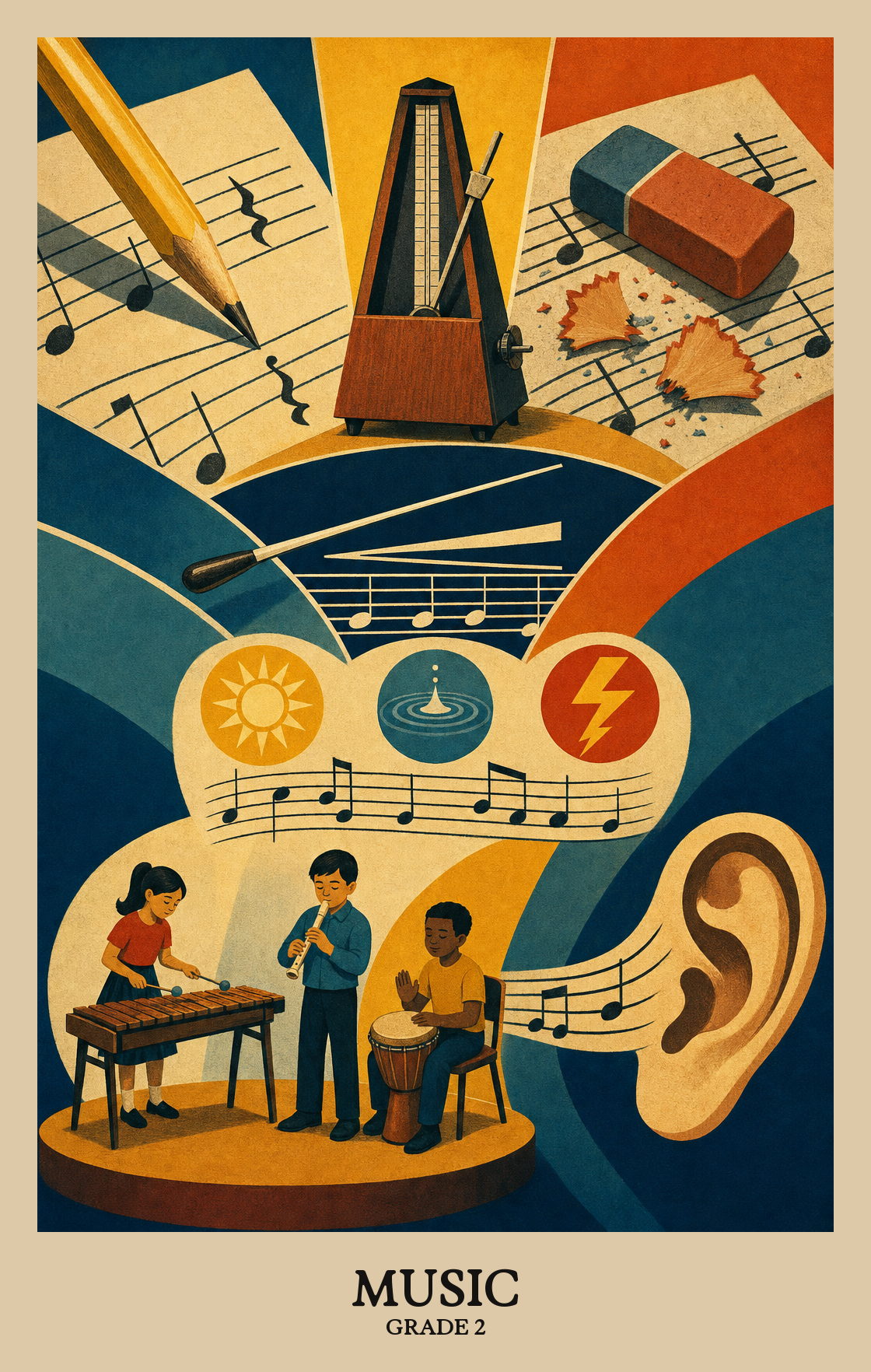
Students start the year by really listening to music. They notice fast and slow, loud and soft, and begin to describe what they hear in their own words.
Students try out short patterns of sound, clapping rhythms or singing little tunes they invent. They learn that a musical idea can come from a feeling, a picture, or a story.
Students pick which ideas to keep and practice them until they sound the way they want. They learn that practice and small fixes make a song better before showing it to others.
Students sing and play in front of classmates or family. They think about how to start, how to end, and how to show the feeling of the song while they perform.
Students connect songs to their own lives and to where the music comes from. They listen to music from different places and times and talk about what makes each one special.
Students connect a personal memory or feeling to a song or musical idea, then explain how that experience shaped what they made or chose.
Songs and music come from somewhere. Students learn how a piece of music connects to the time, place, or people it came from, and what that history tells us about why it sounds the way it does.
| Standard | Definition | Code |
|---|---|---|
| Synthesize and relate knowledge and personal experiences to make art | Students connect a personal memory or feeling to a song or musical idea, then explain how that experience shaped what they made or chose. | MU:Cn10.2 |
| Relate artistic ideas and works with societal, cultural | Songs and music come from somewhere. Students learn how a piece of music connects to the time, place, or people it came from, and what that history tells us about why it sounds the way it does. | MU:Cn11.2 |
Students come up with simple melody or rhythm ideas of their own, then try them out by singing, clapping, or playing an instrument.
Students arrange musical ideas into a short piece, making choices about which sounds come first, which come next, and how the whole thing fits together.
Students listen back to a short melody or rhythm they made, decide what to fix or keep, and finish it as a complete piece.
| Standard | Definition | Code |
|---|---|---|
| Generate and conceptualize artistic ideas and work | Students come up with simple melody or rhythm ideas of their own, then try them out by singing, clapping, or playing an instrument. | MU:Cr1.2 |
| Organize and develop artistic ideas and work | Students arrange musical ideas into a short piece, making choices about which sounds come first, which come next, and how the whole thing fits together. | MU:Cr2.2 |
| Refine and complete artistic work | Students listen back to a short melody or rhythm they made, decide what to fix or keep, and finish it as a complete piece. | MU:Cr3.2 |
Students choose a song or piece to perform and think about how they want it to sound before they play or sing it.
Students practice a song or piece until it sounds the way they want it to, then make small fixes before performing it for others.
Students perform a song or piece and make choices, like tempo or dynamics, that express a clear idea or feeling to the audience.
| Standard | Definition | Code |
|---|---|---|
| Analyze, interpret, and select artistic work for presentation | Students choose a song or piece to perform and think about how they want it to sound before they play or sing it. | MU:Pr4.2 |
| Develop and refine artistic techniques and work for presentation | Students practice a song or piece until it sounds the way they want it to, then make small fixes before performing it for others. | MU:Pr5.2 |
| Convey meaning through the presentation of artistic work | Students perform a song or piece and make choices, like tempo or dynamics, that express a clear idea or feeling to the audience. | MU:Pr6.2 |
Students listen to a short piece of music and describe what they notice, like tempo, rhythm, or how the mood shifts from one section to the next.
Students listen to a piece of music and explain what they think it means or how it makes them feel. There's no single right answer; the goal is to back up their thinking with something they actually heard.
Students listen to a piece of music and decide what makes it good, using simple questions like "Does the beat stay steady?" or "Do the instruments blend well?" Then they explain their thinking in words.
| Standard | Definition | Code |
|---|---|---|
| Perceive and analyze artistic work | Students listen to a short piece of music and describe what they notice, like tempo, rhythm, or how the mood shifts from one section to the next. | MU:Re7.2 |
| Interpret intent and meaning in artistic work | Students listen to a piece of music and explain what they think it means or how it makes them feel. There's no single right answer; the goal is to back up their thinking with something they actually heard. | MU:Re8.2 |
| Apply criteria to evaluate artistic work | Students listen to a piece of music and decide what makes it good, using simple questions like "Does the beat stay steady?" or "Do the instruments blend well?" Then they explain their thinking in words. | MU:Re9.2 |
Students sing, play simple instruments, move to a steady beat, and start making up short musical ideas of their own. They also listen to songs and talk about what they hear, like fast or slow, loud or soft, happy or calm.
Sing along to songs in the car, clap the beat together, or ask what a song reminds students of. Five minutes of paying attention to music counts. No instrument or training needed.
Not yet. Students start to recognize patterns like high and low notes, long and short sounds, and the steady beat. Reading full sheet music comes later.
Start with steady beat and matching pitch in the fall. Move into simple patterns, rhythm reading, and short improvisations by winter. Spring is a good time for small group performances and reflecting on the work.
Students can keep a steady beat, sing in tune most of the time, make up a short rhythm or melody, and say something specific about a piece of music they heard. They can also share why they chose a song to perform.
Most students this age are still finding their singing voice, and that is normal. Sing together at home in a comfortable range and keep it low pressure. Confidence grows with practice, not with talent.
Keeping a steady beat while singing or playing trips up a lot of students, as does telling the difference between beat and rhythm. Build in short, frequent practice rather than one long lesson.
Pull in songs from families, holidays, and cultures represented in the class. Connect rhythm to math patterns and lyrics to reading. Ask students where they hear music in their week.