Moving with purpose
Students start the year exploring how their bodies move through space. They try out levels, directions, and speeds, and learn to start and stop a movement with control.
This is the year dance starts to feel like a craft, not just movement. Students invent short dances from their own ideas, then shape them with clear beginnings, middles, and endings. They practice moves like balance and timing so a dance reads the way they want it to, and they talk about what a dance might mean. By spring, students can perform a short dance they helped create and explain the feeling or story behind it.
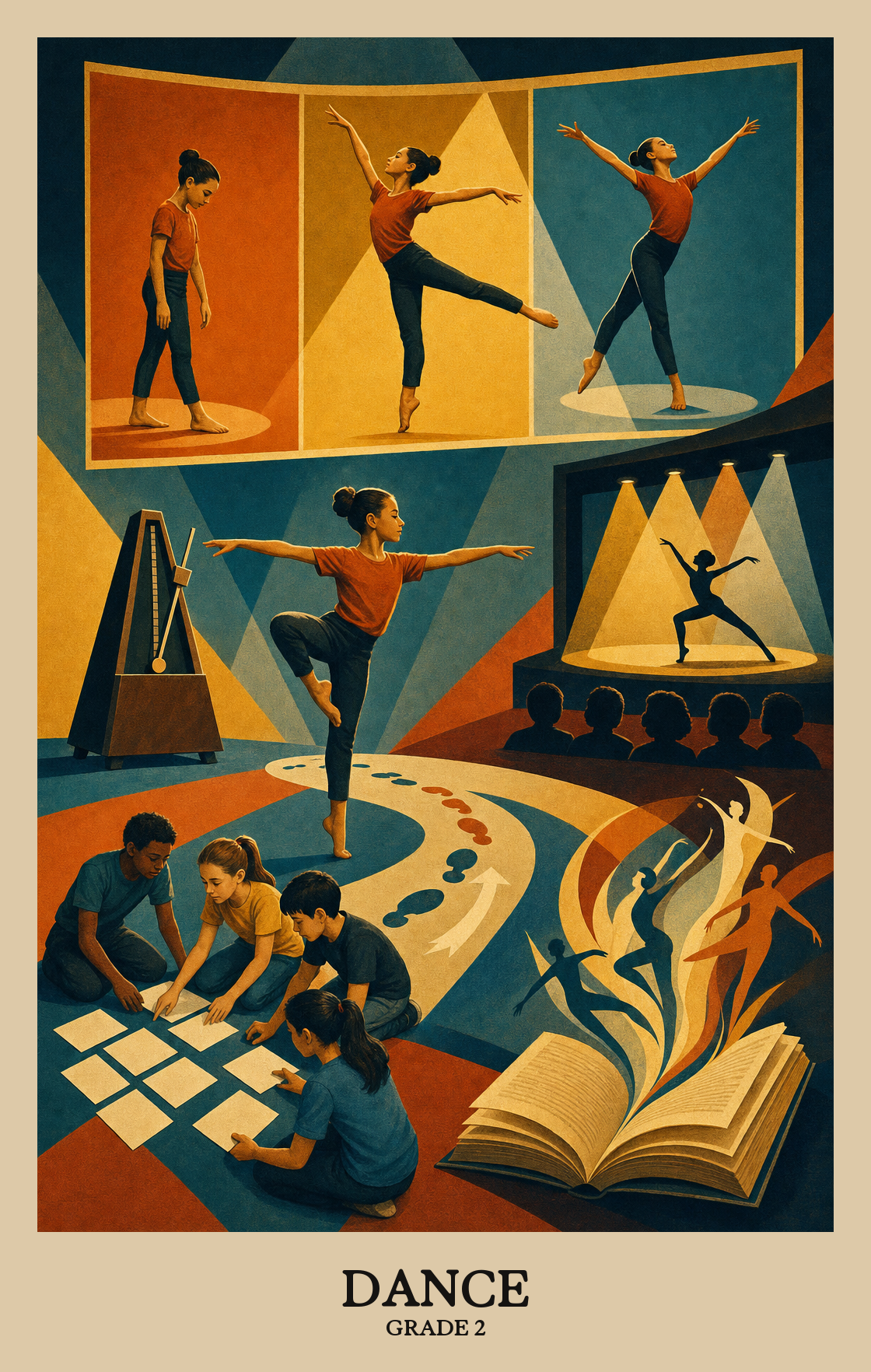
Students start the year exploring how their bodies move through space. They try out levels, directions, and speeds, and learn to start and stop a movement with control.
Students turn pictures, stories, and everyday experiences into short dances. They pick movements on purpose and put them in an order that makes sense to them.
Students rehearse their dances and make small changes to improve them. They work on steady balance, clear shapes, and remembering the sequence from start to finish.
Students perform short dances for classmates and watch others perform. They talk about what a dance might mean and what they noticed about how it was made.
Students learn dances and movement ideas from different places and times. They connect what they see to their own lives and notice how dance looks different around the world.
Students connect something from their own life to a dance they make or watch, explaining how the experience shapes the movement or meaning.
Students look at dances from different places and times to understand why people moved that way and what those movements meant to them.
| Standard | Definition | Code |
|---|---|---|
| Synthesize and relate knowledge and personal experiences to make art | Students connect something from their own life to a dance they make or watch, explaining how the experience shapes the movement or meaning. | DA:Cn10.2 |
| Relate artistic ideas and works with societal, cultural | Students look at dances from different places and times to understand why people moved that way and what those movements meant to them. | DA:Cn11.2 |
Students come up with their own movement ideas and start turning them into a short dance. They explore different ways to move their body before choosing what works best.
Students take a movement idea and shape it into a short dance by choosing which moves to keep, what order they go in, and how they connect.
Students revisit a dance they made, fix parts that feel off, and practice until it's ready to share.
| Standard | Definition | Code |
|---|---|---|
| Generate and conceptualize artistic ideas and work | Students come up with their own movement ideas and start turning them into a short dance. They explore different ways to move their body before choosing what works best. | DA:Cr1.2 |
| Organize and develop artistic ideas and work | Students take a movement idea and shape it into a short dance by choosing which moves to keep, what order they go in, and how they connect. | DA:Cr2.2 |
| Refine and complete artistic work | Students revisit a dance they made, fix parts that feel off, and practice until it's ready to share. | DA:Cr3.2 |
Students choose which dances to perform and explain why those pieces are worth sharing with an audience.
Students practice a dance until their movements are clean and ready to share with an audience. They focus on how the body moves, then keep improving until the piece feels performance-ready.
Students perform a dance they've practiced and make intentional choices, like timing or spacing, to share an idea or feeling with an audience.
| Standard | Definition | Code |
|---|---|---|
| Analyze, interpret, and select artistic work for presentation | Students choose which dances to perform and explain why those pieces are worth sharing with an audience. | DA:Pr4.2 |
| Develop and refine artistic techniques and work for presentation | Students practice a dance until their movements are clean and ready to share with an audience. They focus on how the body moves, then keep improving until the piece feels performance-ready. | DA:Pr5.2 |
| Convey meaning through the presentation of artistic work | Students perform a dance they've practiced and make intentional choices, like timing or spacing, to share an idea or feeling with an audience. | DA:Pr6.2 |
Students watch a dance and describe what they notice, such as how the dancer moves fast or slow, uses big or small shapes, or changes direction.
Students watch a dance and explain what they think the dancer is trying to show, using details from the movements they saw.
Students look at a dance and decide what makes it work well. They use simple rules, like whether the movements match the music or tell a clear story, to explain what they think.
| Standard | Definition | Code |
|---|---|---|
| Perceive and analyze artistic work | Students watch a dance and describe what they notice, such as how the dancer moves fast or slow, uses big or small shapes, or changes direction. | DA:Re7.2 |
| Interpret intent and meaning in artistic work | Students watch a dance and explain what they think the dancer is trying to show, using details from the movements they saw. | DA:Re8.2 |
| Apply criteria to evaluate artistic work | Students look at a dance and decide what makes it work well. They use simple rules, like whether the movements match the music or tell a clear story, to explain what they think. | DA:Re9.2 |
Students learn to move with control, create short movement ideas, and watch dances made by others. They explore how the body moves through space, how fast or slow, and how strong or soft. Most of the time is spent doing, not sitting.
Put on a song and ask students to make up a short movement that shows a feeling or a story. Five minutes of moving the furniture aside and dancing together is plenty. Ask what their movement was about and listen to the answer.
Sometimes, but not always. Performing can be as small as showing a short movement to a partner or to the class. The focus is on sharing an idea through movement, not on being a stage performer.
Students can make up a short dance with a clear beginning, middle, and end. They can name what their movement was about, watch a peer's dance, and say what they noticed. Cleaner shapes and steadier timing show real growth.
Start with body awareness and the basic elements of movement: space, time, and energy. Move into making short movement phrases, then into refining and sharing them. Save responding and giving feedback for after students have made work of their own.
Holding a shape with control and remembering the order of a short movement phrase. Students also need repeated practice giving kind, specific feedback to a peer instead of saying "it was good." Build a few simple sentence stems and reuse them all year.
Dance at this age is about ideas and effort, not talent. Praise specific choices, such as a strong freeze or a slow turn, instead of saying the whole dance was great. Dancing along with them takes the pressure off.
They can plan a short dance, perform it with focus, and talk about what a classmate's dance made them think of. They can also connect a dance to a story, a feeling, or something from their own life. That foundation is what next year builds on.