Exploring art materials
Students get their hands on crayons, paint, paper, and clay. They try out tools, notice what each one can do, and start making marks with purpose.
This is the year art class becomes a real subject, not just coloring time. Students learn to come up with their own ideas, try out crayons, paint, and clay, and talk about what they made and why. They also start looking at other people's art and noticing what they see. By spring, students can finish a piece of art, share it with the class, and explain the story or idea behind it.
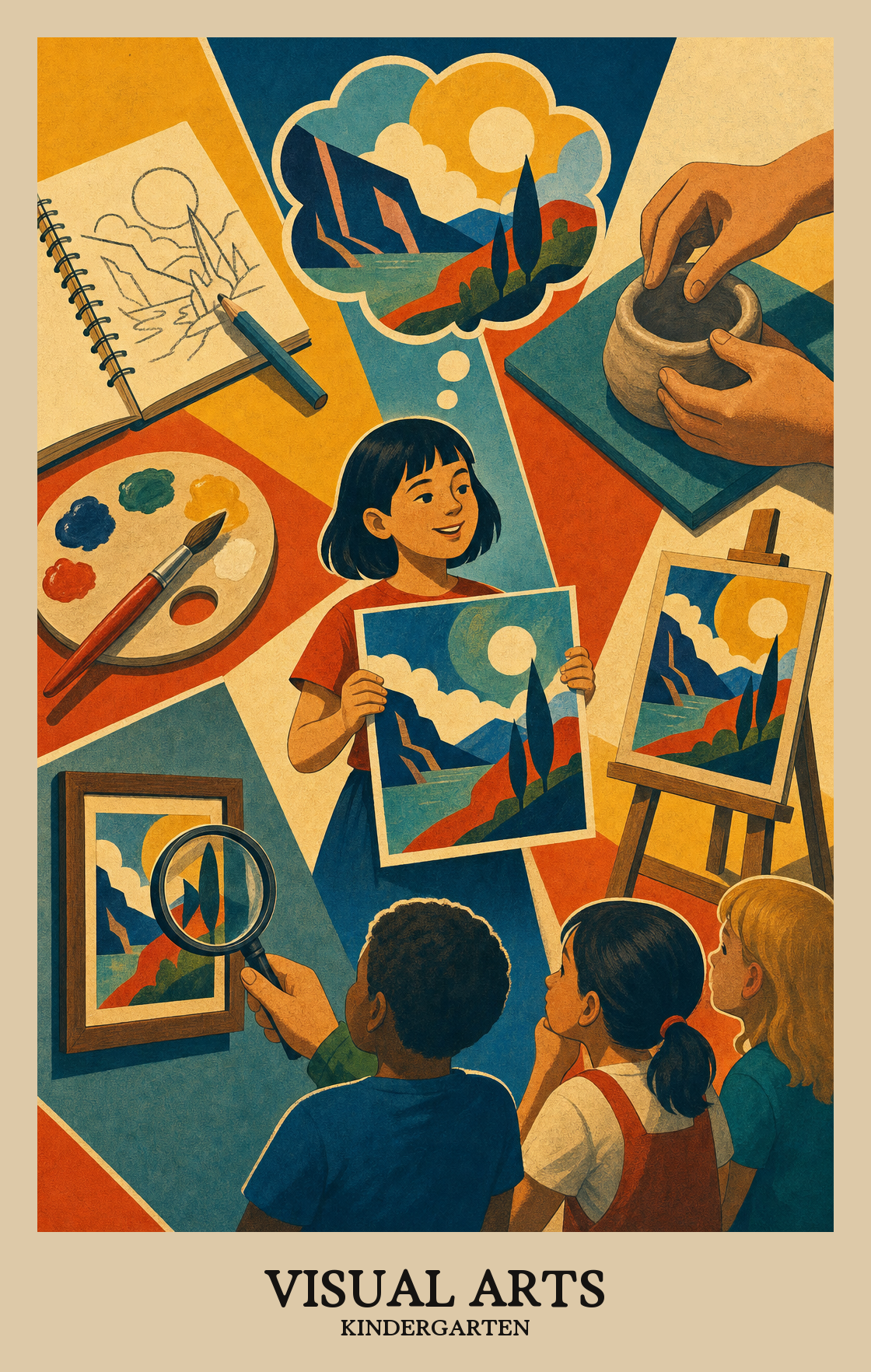
Students get their hands on crayons, paint, paper, and clay. They try out tools, notice what each one can do, and start making marks with purpose.
Students come up with what they want to draw or build, often based on their own family, pets, or favorite things. They learn that a picture can start with an idea in their head.
Students slow down to add details and decide when a piece is done. They pick a favorite to display and practice talking about what they made and why.
Students look closely at their own pieces and at art made by others. They describe what they see, guess what the artist was thinking, and say what they like about it.
Students draw on things they know and things they've lived through to make their own artwork. A picture of a pet, a memory from home, or something learned in class can all become the starting point.
Students look at artwork and talk about where it came from, who made it, and what was happening in that place or time. Connecting a picture or sculpture to real life helps it make more sense.
| Standard | Definition | Code |
|---|---|---|
| Synthesize and relate knowledge and personal experiences to make art | Students draw on things they know and things they've lived through to make their own artwork. A picture of a pet, a memory from home, or something learned in class can all become the starting point. | VA:Cn10.k |
| Relate artistic ideas and works with societal, cultural | Students look at artwork and talk about where it came from, who made it, and what was happening in that place or time. Connecting a picture or sculpture to real life helps it make more sense. | VA:Cn11.k |
Students come up with their own ideas for drawings, paintings, or other art before they start making it.
Students arrange shapes, colors, and materials to build a picture or artwork. They make choices about what goes where and why.
Students look at their own drawings or projects, decide what could be better, and make changes before calling the work done.
| Standard | Definition | Code |
|---|---|---|
| Generate and conceptualize artistic ideas and work | Students come up with their own ideas for drawings, paintings, or other art before they start making it. | VA:Cr1.k |
| Organize and develop artistic ideas and work | Students arrange shapes, colors, and materials to build a picture or artwork. They make choices about what goes where and why. | VA:Cr2.k |
| Refine and complete artistic work | Students look at their own drawings or projects, decide what could be better, and make changes before calling the work done. | VA:Cr3.k |
Students choose which of their drawings or artwork to share with others, and explain why they picked it.
Students practice a drawing or craft until it looks the way they want, then get it ready to share with others.
Students share their artwork and explain, in their own words, what they made and why. The work itself becomes part of the message.
| Standard | Definition | Code |
|---|---|---|
| Analyze, interpret, and select artistic work for presentation | Students choose which of their drawings or artwork to share with others, and explain why they picked it. | VA:Pr4.k |
| Develop and refine artistic techniques and work for presentation | Students practice a drawing or craft until it looks the way they want, then get it ready to share with others. | VA:Pr5.k |
| Convey meaning through the presentation of artistic work | Students share their artwork and explain, in their own words, what they made and why. The work itself becomes part of the message. | VA:Pr6.k |
Students look closely at a picture or sculpture and talk about what they notice, like shapes, colors, and what the artwork might show.
Students look at a drawing or painting and talk about what they think the artist was trying to show or how it makes them feel.
Students look at a drawing or painting and decide what they like about it and why. They practice giving a simple reason for their thinking.
| Standard | Definition | Code |
|---|---|---|
| Perceive and analyze artistic work | Students look closely at a picture or sculpture and talk about what they notice, like shapes, colors, and what the artwork might show. | VA:Re7.k |
| Interpret intent and meaning in artistic work | Students look at a drawing or painting and talk about what they think the artist was trying to show or how it makes them feel. | VA:Re8.k |
| Apply criteria to evaluate artistic work | Students look at a drawing or painting and decide what they like about it and why. They practice giving a simple reason for their thinking. | VA:Re9.k |
Students try out drawing, painting, cutting, gluing, and building with simple materials. They make art about things they know, like family, pets, and favorite places. The point is to explore ideas and tools, not to make a finished masterpiece.
Keep a basket of crayons, paper, scissors, and glue where students can reach it. Ask what they made and listen to the story behind it before saying anything about how it looks. Short, regular drawing time matters more than fancy supplies.
No. At this age, art is about trying ideas and using tools safely. A stick-figure family with a purple sun is exactly what kindergarten art should look like.
Start with basic tool handling, like holding a crayon, using scissors, and gluing without flooding the paper. Move into shape, line, and color, then into making art from personal experience and looking at art by others. Save group critique and simple self-evaluation for the second half of the year.
Scissor grip, glue amount, and cleanup routines come back again and again. Talking about art also needs practice, since students often say only "I like it" or "It's bad." Give simple sentence starters like "I see" and "It reminds me of."
By June, students should be able to come up with an idea, pick materials, finish a piece, and say something about what it means. They should also be able to look at another artist's work and share what they notice without judging it as good or bad.
It means looking at art from different places and times and noticing what feels familiar or new. Show a few picture books, museum prints, or short videos across the year and ask what students see. Avoid long history lessons; one or two minutes of looking is plenty.
Ask three small questions: What do you see? What is happening? How does it make you feel? Listen to the answer and add one thing you notice too. Five minutes with a picture book counts.