Moving safely in shared space
Students learn to walk, run, and stop on cue without bumping into classmates. They practice listening for signals and keeping their hands and feet to themselves during games.
This is the year movement becomes a skill students practice on purpose. Students learn to run, jump, hop, skip, and gallop with more control, and they start to throw, catch, and kick simple objects. They also learn how to share space safely, take turns, and follow directions during games. By spring, students can move through an obstacle course without bumping into classmates and toss a ball to a partner who is ready to catch it.
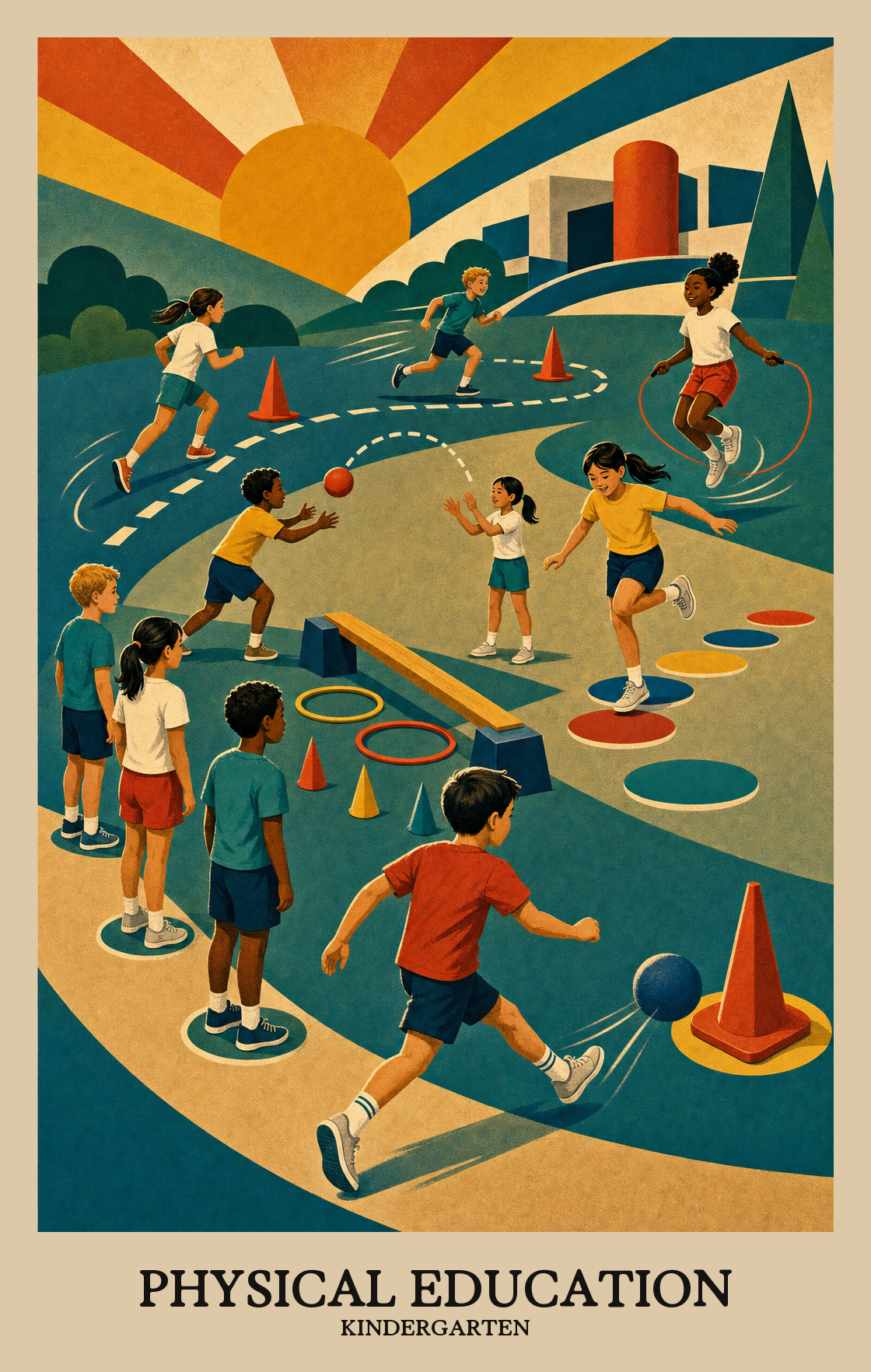
Students learn to walk, run, and stop on cue without bumping into classmates. They practice listening for signals and keeping their hands and feet to themselves during games.
Students try out skipping, hopping, galloping, and jumping. They also bend, twist, and balance in place, building the body control that early sports and playground games rely on.
Students start working with balls and beanbags. They practice tossing underhand, catching with two hands, and kicking a ball toward a target.
Students take turns, share equipment, and play simple group games. They learn to follow rules, cheer for classmates, and handle winning and losing without big reactions.
Students notice what their body does when they run and play, like a faster heartbeat and warmer skin. They talk about why active play and rest both matter every day.
Students practice moving their bodies in different ways: running, jumping, balancing, and throwing or catching objects. These early movement skills help build the habits that keep kids active for life.
Students learn basic ideas about how their bodies move and stay healthy, then put those ideas to work during games and activities. For example, they might bend their knees to jump farther or move faster to get their heart pumping.
Students practice taking turns, listening to others, and working as a group during movement activities. Games and exercises give them a chance to show respect and cooperate with classmates.
Students practice basic movement skills and start to notice how being active makes them feel. The goal is to enjoy moving enough to keep doing it.
| Standard | Definition | Code |
|---|---|---|
| Develop a variety of motor skills, including locomotor, non-locomotor | Students practice moving their bodies in different ways: running, jumping, balancing, and throwing or catching objects. These early movement skills help build the habits that keep kids active for life. | DE-PE.1.k |
| Apply knowledge related to movement, performance | Students learn basic ideas about how their bodies move and stay healthy, then put those ideas to work during games and activities. For example, they might bend their knees to jump farther or move faster to get their heart pumping. | DE-PE.2.k |
| Develop social skills through movement, including respect for self and others… | Students practice taking turns, listening to others, and working as a group during movement activities. Games and exercises give them a chance to show respect and cooperate with classmates. | DE-PE.3.k |
| Develop personal skills, identify personal benefits of movement | Students practice basic movement skills and start to notice how being active makes them feel. The goal is to enjoy moving enough to keep doing it. | DE-PE.4.k |
Students practice basic ways of moving: running, jumping, hopping, skipping, balancing, and tossing or catching a ball. Most of the year is about trying movements in a safe space and getting more confident, not about competing or keeping score.
Aim for short bursts of active play most days, like a walk to the park, a game of tag, or tossing a soft ball back and forth. Ten to twenty minutes of moving together does more than any worksheet at this age.
That is very normal at this age. Coordination grows with practice, so keep offering chances to climb, balance on a curb, kick a ball, or hop on one foot. Avoid comparing to siblings or classmates.
Start with locomotor skills like walking, running, and jumping in open space, then layer in non-locomotor moves like bending, twisting, and balancing. Save manipulative skills like throwing, catching, and kicking for later units once students can control their bodies in shared space.
Skipping, galloping, and catching a tossed ball tend to lag behind running and jumping. Plan to revisit these in short warmups across multiple units rather than teaching them once and moving on.
A big piece of the year is learning to share space, take turns, follow signals like a whistle or freeze cue, and play without pushing or grabbing equipment. These habits get as much attention as the physical skills.
Offer a smaller role first, like holding cones or being a partner watcher, and rotate them in once they feel safe. Most reluctance at this age comes from being unsure of the rules, not from defiance.
By spring, students should move around a busy gym without crashing, perform basic locomotor skills on cue, toss and catch a large ball at short distance, and follow simple rules in a group game. They should also name one or two reasons moving their body feels good.