Exploring art materials
Students get comfortable with crayons, markers, paint, paper, and clay. Early in the year, the focus is on trying things out and learning how each material feels and behaves.
This is the year students discover that their own ideas can become art. Students try out crayons, paint, paper, and clay, and start to talk about what they made and why. They notice colors and shapes in the art around them and share what they like about a picture. By spring, students can make a drawing or painting from an idea in their head and tell a grown-up the story behind it.
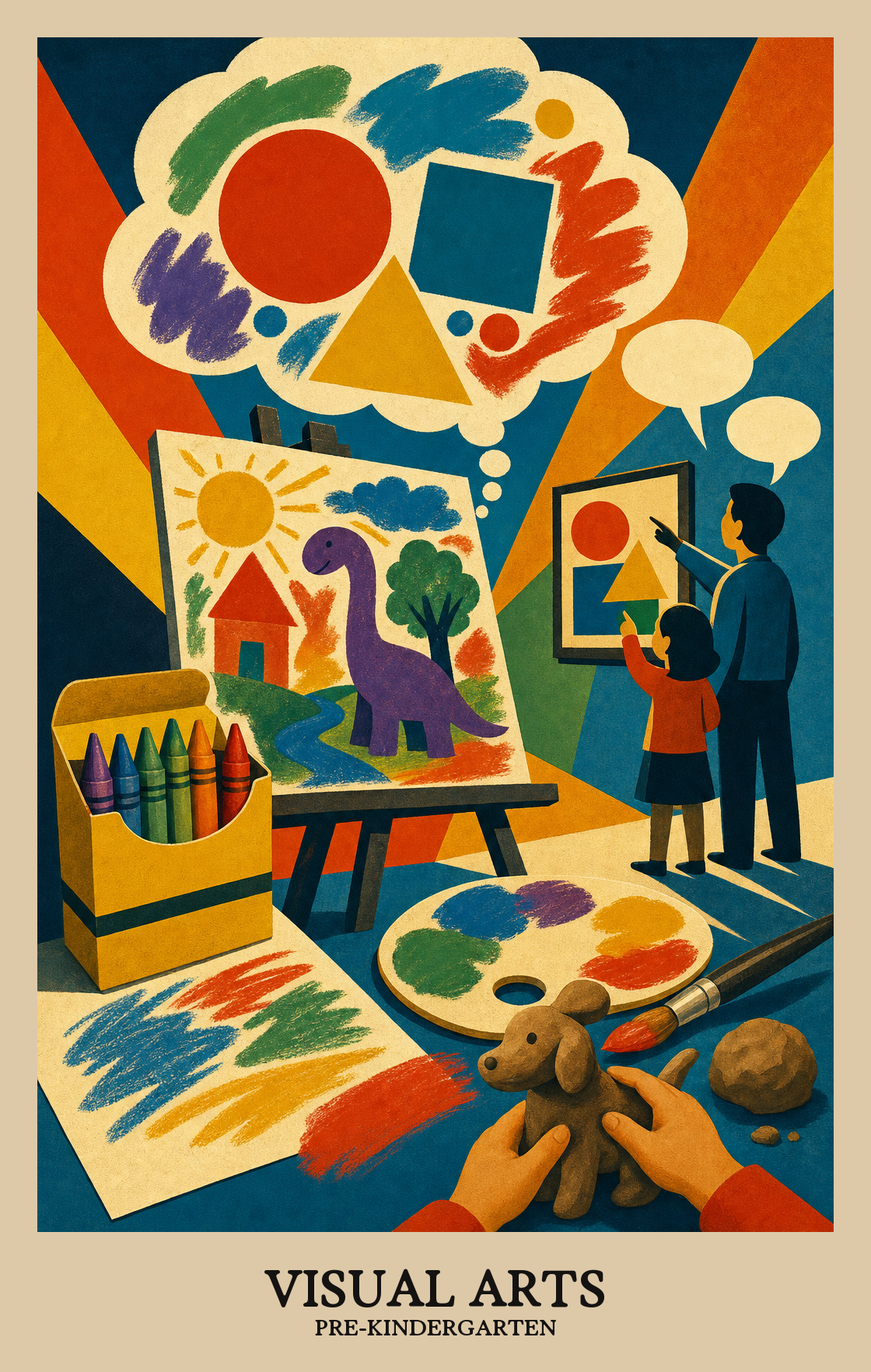
Students get comfortable with crayons, markers, paint, paper, and clay. Early in the year, the focus is on trying things out and learning how each material feels and behaves.
Students start making art on purpose, drawing pictures of family, pets, and things they see at home or outside. Each piece begins with an idea instead of random marks.
Students slow down to look at pictures and sculptures and talk about what they see. They begin describing colors, shapes, and what might be happening in a piece.
Students take a project from start to finish and share it with classmates or family. They practice deciding when a piece is done and saying what it means to them.
Students draw on what they know and what they've lived through to make their own art. A drawing might come from a family meal, a favorite toy, or something they noticed outside.
Students look at artwork and talk about where it came from, who made it, and what was happening in that place and time. Connecting a picture or object to its story helps students understand what they're seeing.
| Standard | Definition | Code |
|---|---|---|
| Synthesize and relate knowledge and personal experiences to make art | Students draw on what they know and what they've lived through to make their own art. A drawing might come from a family meal, a favorite toy, or something they noticed outside. | VA:Cn10.pk |
| Relate artistic ideas and works with societal, cultural | Students look at artwork and talk about where it came from, who made it, and what was happening in that place and time. Connecting a picture or object to its story helps students understand what they're seeing. | VA:Cn11.pk |
Students come up with their own ideas for art before they start making something. This is the imaginative thinking that happens before the crayon or paintbrush ever touches the page.
Students arrange colors, shapes, and materials to make a picture or object on purpose. This is the planning side of art, where choices about what to use and where to put it start to matter.
Students look at their own drawings or artwork, decide if anything needs fixing, and finish the piece.
| Standard | Definition | Code |
|---|---|---|
| Generate and conceptualize artistic ideas and work | Students come up with their own ideas for art before they start making something. This is the imaginative thinking that happens before the crayon or paintbrush ever touches the page. | VA:Cr1.pk |
| Organize and develop artistic ideas and work | Students arrange colors, shapes, and materials to make a picture or object on purpose. This is the planning side of art, where choices about what to use and where to put it start to matter. | VA:Cr2.pk |
| Refine and complete artistic work | Students look at their own drawings or artwork, decide if anything needs fixing, and finish the piece. | VA:Cr3.pk |
Students choose which of their drawings or creations to share with the class and can say something simple about why they picked it.
Students practice and improve a piece of artwork to get it ready to share with others.
Students share their drawings or artwork and explain, in their own words, what it means to them. Showing the work is part of making it.
| Standard | Definition | Code |
|---|---|---|
| Analyze, interpret, and select artistic work for presentation | Students choose which of their drawings or creations to share with the class and can say something simple about why they picked it. | VA:Pr4.pk |
| Develop and refine artistic techniques and work for presentation | Students practice and improve a piece of artwork to get it ready to share with others. | VA:Pr5.pk |
| Convey meaning through the presentation of artistic work | Students share their drawings or artwork and explain, in their own words, what it means to them. Showing the work is part of making it. | VA:Pr6.pk |
Students look closely at a picture or object and talk about what they notice, like shapes, colors, or how it makes them feel.
Students look at a drawing or painting and talk about what they think the artist was trying to show. They practice putting their ideas about art into words.
Students look at a drawing or painting and say what they notice and what they think about it. They start to explain why they like something or think it could be different.
| Standard | Definition | Code |
|---|---|---|
| Perceive and analyze artistic work | Students look closely at a picture or object and talk about what they notice, like shapes, colors, or how it makes them feel. | VA:Re7.pk |
| Interpret intent and meaning in artistic work | Students look at a drawing or painting and talk about what they think the artist was trying to show. They practice putting their ideas about art into words. | VA:Re8.pk |
| Apply criteria to evaluate artistic work | Students look at a drawing or painting and say what they notice and what they think about it. They start to explain why they like something or think it could be different. | VA:Re9.pk |
Students draw, paint, cut, glue, and build with clay or blocks. The point is exploring materials and sharing ideas, not making something that looks realistic. A scribble of a family or a blob of clay shaped like a dog both count as real art at this age.
Keep crayons, paper, child-safe scissors, glue sticks, and a few recycled boxes in one spot students can reach. Let them make whatever they want for ten or fifteen minutes a few times a week. Ask what they made and write their words on the back.
Skip praise about talent and skip fixing their work. Instead, notice specific choices: the color they picked, the lines they used, the part they spent the most time on. Students who feel safe trying will keep drawing.
Rotate through a few core materials each month: drawing tools, paint, collage, clay, and building materials. Repeat each one several times so students get past the novelty and start making real choices. Tie projects to books, seasons, and what students are noticing in the classroom.
Lean heavily toward exploration at this age. Short demos of one skill, like rolling a clay coil or mixing two paint colors, are useful when students are ready for them. Most of the time should be open work where students decide what to make.
Ask students to point out what they see, what they think is happening, and what it reminds them of. Use real artwork from books, museum websites, or family photos. The goal is noticing details and sharing ideas, not naming artists or styles.
Holding scissors, using glue in small amounts, and cleaning up brushes take the longest to settle. Build short routines for each one and practice them on low-stakes projects before bigger work. Expect to model these again after every break.
By spring, students should pick their own subject, stick with a project long enough to finish it, and talk about what they made and why. They should also handle basic tools without constant help. Polished products are not the goal.