Pretend play and stories
Students step into make-believe with familiar characters and simple stories. Parents may notice their child acting out a trip to the store or a favorite book at home.
This is the year pretending becomes the first step toward acting. Students invent characters during play, try on different voices and movements, and act out little stories from books or their own lives. They share short scenes with classmates and talk about what they saw. By spring, students can step into a role, stay in it for a short pretend scene, and say what a story made them feel.
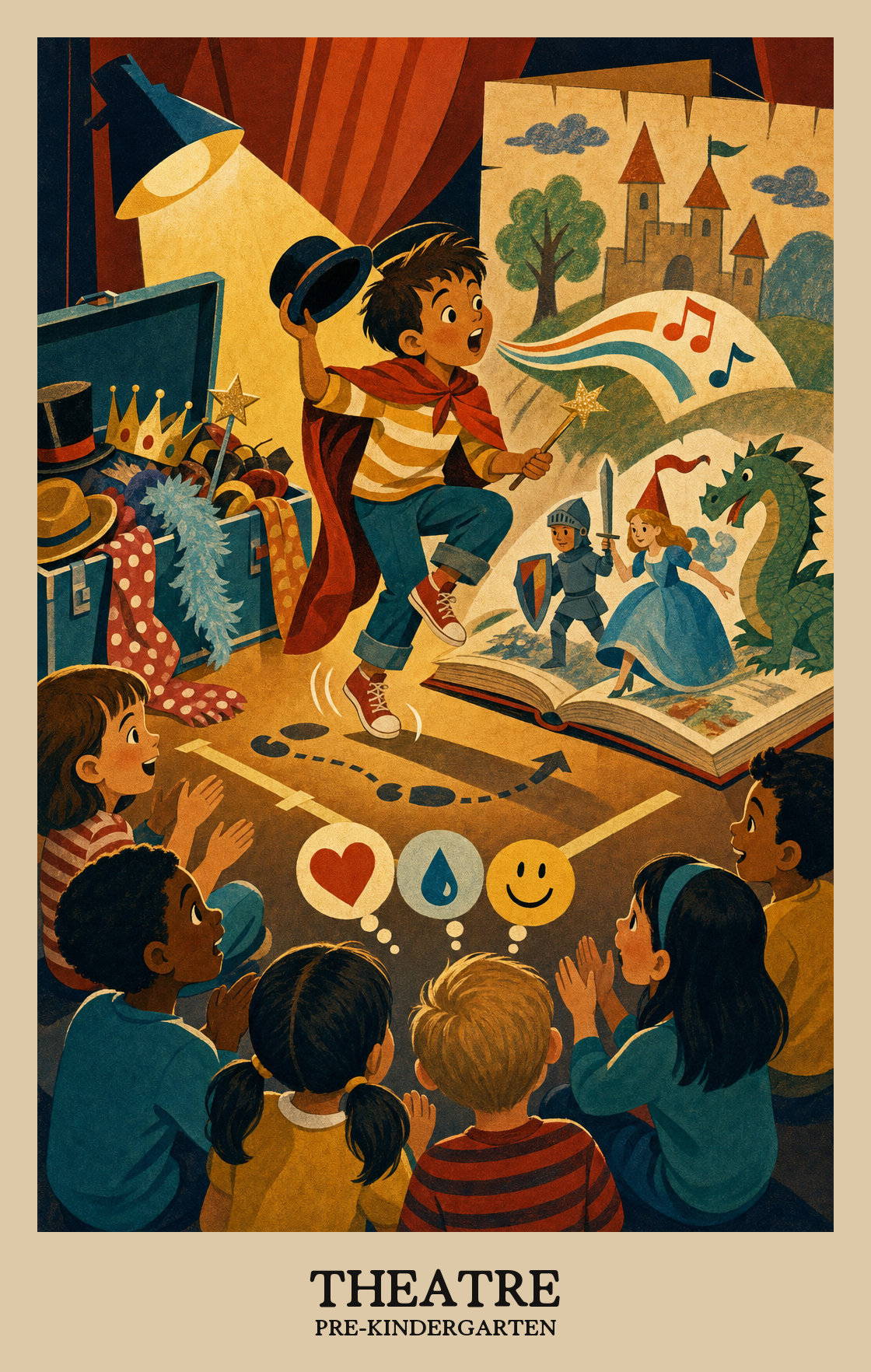
Students step into make-believe with familiar characters and simple stories. Parents may notice their child acting out a trip to the store or a favorite book at home.
Students try on different voices, faces, and movements to show how a character feels. They start adding their own ideas to a story instead of just copying one.
Students practice short scenes and show them to classmates or family. They learn what it feels like to be the one watching and the one being watched.
Students notice what happened in a story or scene and say what they liked or what felt funny, scary, or surprising. They connect the play to things from their own lives.
Students connect something from their own life to a story or character they act out in class.
Students connect stories and characters in plays to their own lives and the world around them, noticing how people and places can be similar or different.
| Standard | Definition | Code |
|---|---|---|
| Synthesize and relate knowledge and personal experiences to make art | Students connect something from their own life to a story or character they act out in class. | TH:Cn10.pk |
| Relate artistic ideas and works with societal, cultural | Students connect stories and characters in plays to their own lives and the world around them, noticing how people and places can be similar or different. | TH:Cn11.pk |
Students make up characters, stories, and pretend situations through play and imagination.
Students act out simple stories or ideas through pretend play, using movement and voice to bring a character or scene to life.
Students finish a piece of creative work, making small changes until it feels ready to share.
| Standard | Definition | Code |
|---|---|---|
| Generate and conceptualize artistic ideas and work | Students make up characters, stories, and pretend situations through play and imagination. | TH:Cr1.pk |
| Organize and develop artistic ideas and work | Students act out simple stories or ideas through pretend play, using movement and voice to bring a character or scene to life. | TH:Cr2.pk |
| Refine and complete artistic work | Students finish a piece of creative work, making small changes until it feels ready to share. | TH:Cr3.pk |
Students choose a character or short scene to act out and practice showing it to others. This is an early step in learning how to prepare and share a performance.
Students practice a song, a line, or a simple movement until they feel ready to show it to others. Rehearsing helps the performance come out the way they practiced it.
Students use a simple story, puppet, or pretend scene to show an idea or feeling to others.
| Standard | Definition | Code |
|---|---|---|
| Analyze, interpret, and select artistic work for presentation | Students choose a character or short scene to act out and practice showing it to others. This is an early step in learning how to prepare and share a performance. | TH:Pr4.pk |
| Develop and refine artistic techniques and work for presentation | Students practice a song, a line, or a simple movement until they feel ready to show it to others. Rehearsing helps the performance come out the way they practiced it. | TH:Pr5.pk |
| Convey meaning through the presentation of artistic work | Students use a simple story, puppet, or pretend scene to show an idea or feeling to others. | TH:Pr6.pk |
Students look at a short play or puppet show and share what they noticed, describing what a character did or how a scene made them feel.
Students talk about what they think a character is feeling or why something happens in a story they act out or watch.
Students look at a drawing, a performance, or a story and say what they liked and why. They start learning that opinions about art can be explained, not just felt.
| Standard | Definition | Code |
|---|---|---|
| Perceive and analyze artistic work | Students look at a short play or puppet show and share what they noticed, describing what a character did or how a scene made them feel. | TH:Re7.pk |
| Interpret intent and meaning in artistic work | Students talk about what they think a character is feeling or why something happens in a story they act out or watch. | TH:Re8.pk |
| Apply criteria to evaluate artistic work | Students look at a drawing, a performance, or a story and say what they liked and why. They start learning that opinions about art can be explained, not just felt. | TH:Re9.pk |
Most of the work is pretend play. Students take on roles, act out stories they know, and use their voices and bodies to show characters and feelings. There are no scripts or stage productions at this point.
Act out favorite picture books together. Let students pick the characters and decide what happens next. Five minutes of pretending to be a bear, a baker, or a bus driver counts as real practice.
Yes. When students step into a character, they practice language, listening, and thinking about how other people feel. These are the same skills that show up later in reading comprehension and writing.
Start with familiar roles like family members or pets, then move to characters from stories read in class. By spring, students can act out short sequences with a beginning, middle, and end. Add audience moments once routines feel steady.
Performing for an audience is not the goal yet. Watching, suggesting ideas, handling a puppet, or playing a small part all count. Comfort with pretending in front of others builds slowly over the year.
Staying in a role for more than a moment, and listening while another student takes a turn. Short, repeated play sessions with clear roles help more than long ones. Puppets and props give students something to focus on.
Look for students who can take on a pretend role, use a different voice or movement for a character, and talk briefly about a story or play afterward. Sharing an opinion about what they liked is a strong sign.
Ask which character they liked and why, or what they would change about the ending. Short conversations like this build the habit of noticing and responding to stories, which is the heart of theatre at this age.