Skip to content

What does a student learn in ?

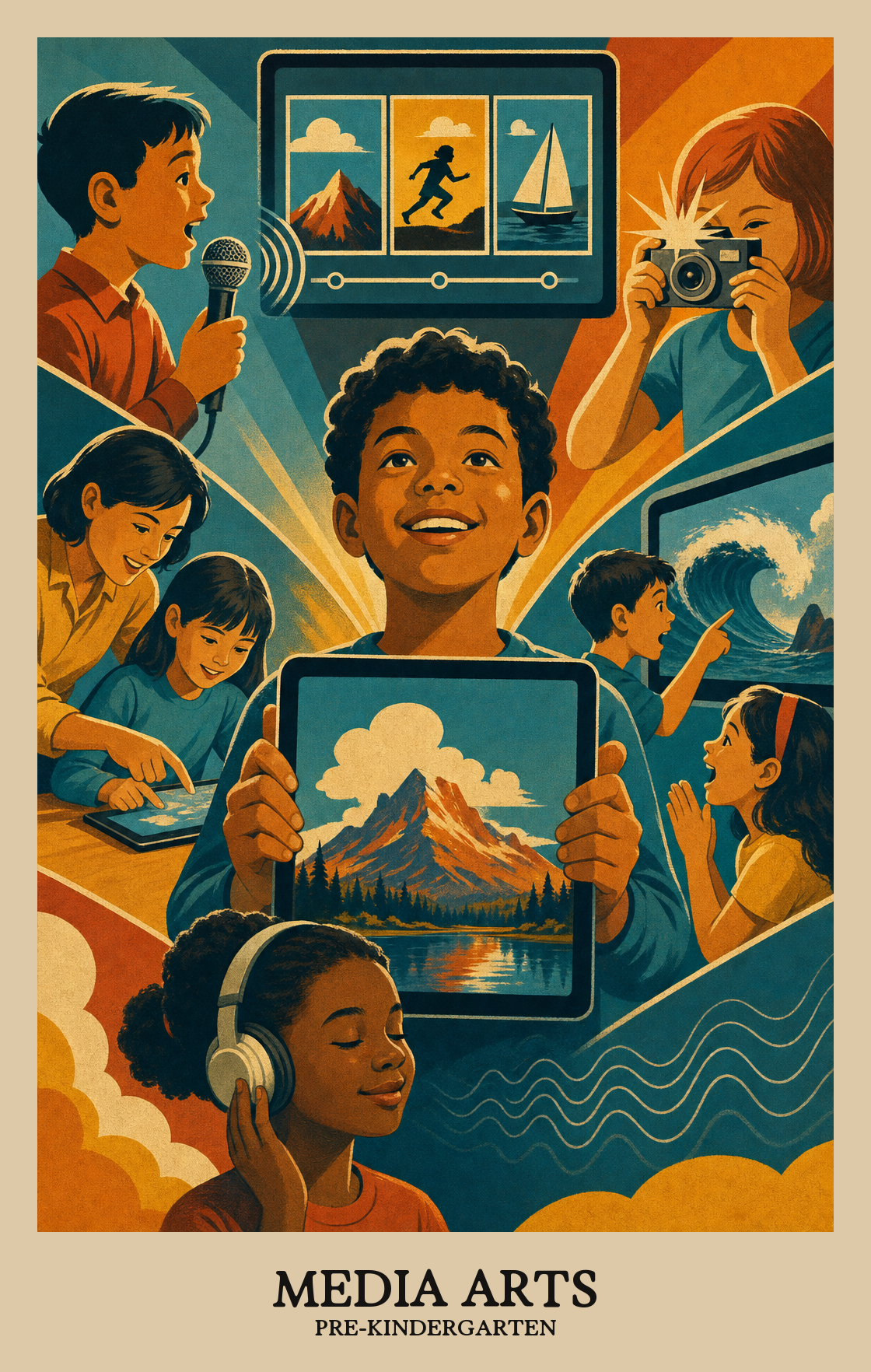
This is the year students first play with the tools that make pictures, sounds, and short videos. With help from a teacher, they snap photos, record their voices, or build a simple story using pictures on a screen. Students share what they made and say what they like about a classmate's work. By spring, they can point to something they created with a camera or tablet and explain what it shows.

  • Cameras and tablets
  • Making pictures
  • Recording sound
  • Telling a story
  • Sharing work
Source: Connecticut Connecticut Core Standards
Year at a glance
How the year usually goes. Every school and district set their own curriculum, so treat this as a guide, not official pacing.
  1. 1

    Exploring tools and ideas

    Students start the year getting comfortable with cameras, tablets, microphones, and other simple media tools. They try out ideas from their own lives, like a favorite toy or a family pet, and turn them into something to share.

  2. 2

    Making short media pieces

    Students put their ideas together into small projects like a photo story, a short video, or a recorded sound. They learn that a project has parts that go in order and that small changes can make it better.

  3. 3

    Sharing work with others

    Students pick a piece they are proud of and get it ready to show classmates or family. They practice presenting, talk about what they wanted the piece to say, and notice how an audience reacts.

  4. 4

    Looking at and talking about media

    Students watch, listen to, and look closely at pictures, videos, and sounds made by themselves and others. They share what they notice, what they like, and what the work might be about.

Mastery Learning Standards
The required skills a student should display by the end of Pre-Kindergarten.
Connecting
  • Synthesize and relate knowledge and personal experiences to make art

    Students connect something from their own life, like a memory or a favorite place, to the art they make. Their personal experiences shape what they create.

  • Relate artistic ideas and works with societal, cultural

    Students connect art they make or see to the world around them, noticing how a piece of art can reflect a family tradition, a community, or a story from long ago.

Creating
  • Generate and conceptualize artistic ideas and work

    Students explore and play with simple art-making tools like crayons, paint, and clay to come up with their own creative ideas.

  • Organize and develop artistic ideas and work

    Students pick their favorite colors, shapes, or sounds and put them together to make something on purpose. This is where the creative idea becomes an actual piece of work.

  • Refine and complete artistic work

    Students finish a media art project by looking at it again and making small changes before calling it done.

Performing/Presenting/Producing
  • Analyze, interpret, and select artistic work for presentation

    Students pick which of their media art projects to share with others, making a simple choice about what feels ready or interesting enough to show.

  • Develop and refine artistic techniques and work for presentation

    Students practice a media art project more than once to make it better before sharing it with others.

  • Convey meaning through the presentation of artistic work

    Students share drawings, sounds, or simple creations and explain what they made and why. The work itself carries the message.

Responding
  • Perceive and analyze artistic work

    Students look closely at a photo, video, or drawing and talk about what they notice. This is the beginning of learning to read images the way readers learn to read words.

  • Interpret intent and meaning in artistic work

    Students look at a drawing, photo, or short video and say what they think it means or how it makes them feel. This is an early step in learning to "read" images the way readers read words.

  • Apply criteria to evaluate artistic work

    Students look at a piece of art or a video and say what they like about it and why. They start building the habit of having a reason for their opinion.

Common Questions
  • What is media arts at this age?

    Media arts means making and sharing things with simple tools like a tablet camera, a voice recorder, a flashlight, or a photo app. At this age it looks like taking pictures of a block tower, recording a silly story, or watching a short video and talking about it.

  • What should my child be able to do by the end of the year?

    Students should be able to come up with an idea, use a simple tool to capture or make it, and share it with someone. They should also be able to look at a picture or short video and say what they notice and what they think it means.

  • How can I support media arts at home?

    Hand over the camera. Let students take pictures or short videos of things they care about, then sit together and talk about why they chose those shots. Five minutes of looking and talking matters more than a finished product.

  • Does my child need a fancy device or app?

    No. A phone camera, a voice memo app, and a stack of printed photos are plenty. The skills are about noticing, choosing, and sharing, not about the tool.

  • How should I sequence media arts across the year?

    Start with noticing and responding to pictures, sounds, and short videos. Move into making with one tool at a time, such as photos, then sound, then simple video. Save sharing and reflecting for the end of each small project so students get used to the full cycle.

  • What does mastery look like at this age?

    Mastery looks like a student picking an idea, using a tool with some help, and telling someone what the piece is about. Polish is not the goal. The goal is that students can connect a personal idea to something they made and shared.

  • Which skills usually need the most reteaching?

    Refining work and applying simple criteria are the hardest at this age. Students want to call something finished the moment they make it. Build short routines where students look again, change one thing, and say why a piece works.

  • How do I tie media arts to culture and personal experience?

    Bring in pictures, songs, and short clips from the families and communities in the room. Ask students what the piece reminds them of and what they would make about their own home or neighborhood. That connection is the heart of the connecting standards.

  • How do I know students are ready for the next year?

    Students are ready when they can plan a small piece, make it with a familiar tool, share it with a peer, and say something about another student's work. Listen for ideas and reasons, not vocabulary.