Building characters and stories
Students start the year inventing characters and the worlds those characters live in. They draw on books they have read and moments from their own lives to come up with story ideas worth acting out.
This is the year theatre work starts to feel like real craft. Students build characters and scenes from their own ideas, then rehearse and revise them until the meaning comes through on stage. They also start watching plays with a sharper eye, asking what the story means and how well the choices worked. By spring, students can plan a short scene, perform it for an audience, and explain why a play they watched did or didn't land.
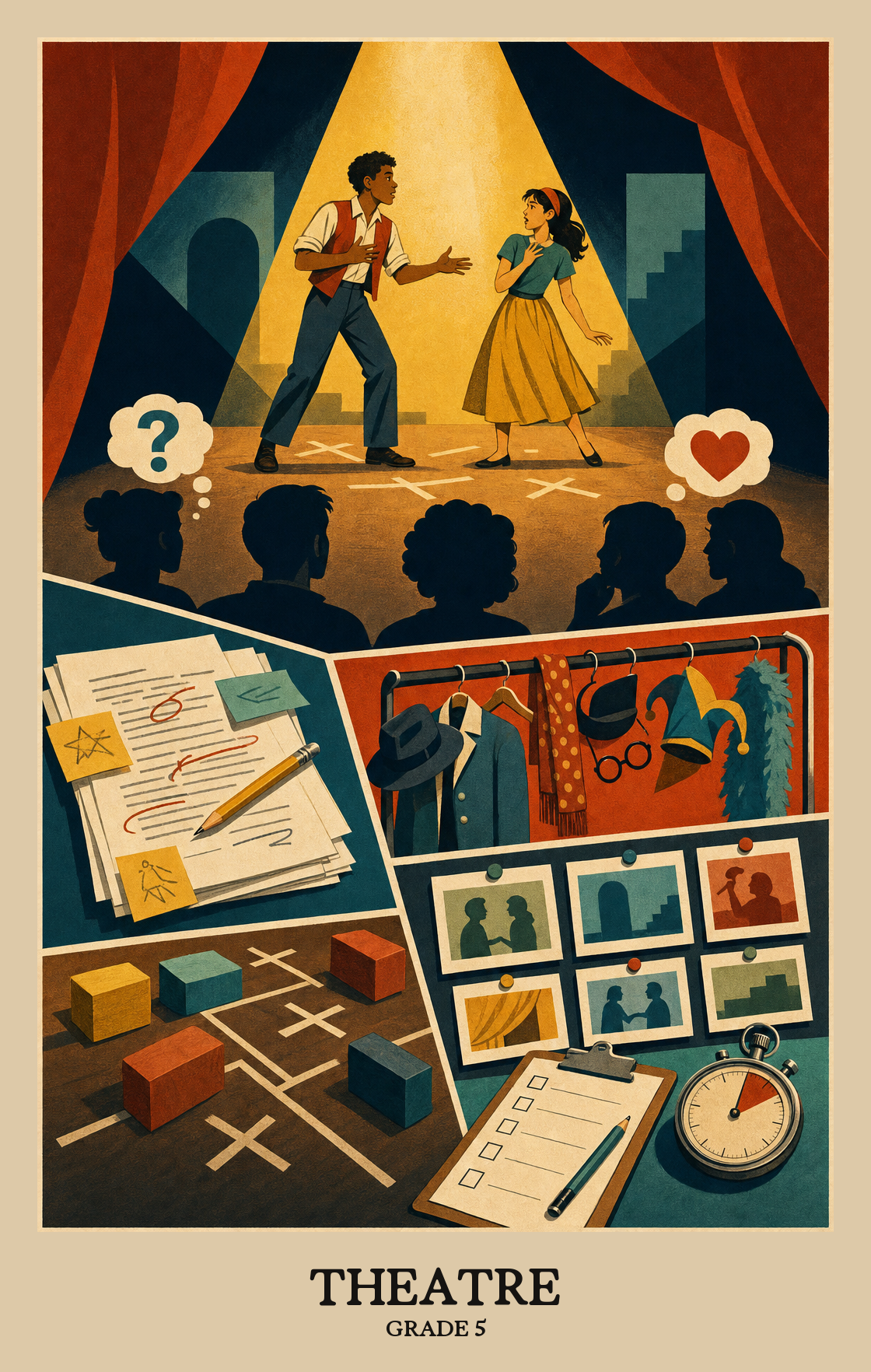
Students start the year inventing characters and the worlds those characters live in. They draw on books they have read and moments from their own lives to come up with story ideas worth acting out.
Students work in small groups to turn rough ideas into scenes with a beginning, middle, and end. They try out different choices for how a character might move or speak, then keep what works.
Students practice using voice, face, and body to show what a character is feeling. They rehearse the same scene more than once, taking notes from the teacher and each other to make the next try clearer.
Students pick a finished piece to share and think through how to make the meaning land for people watching. They perform for classmates or families and talk about what choices they made and why.
Students watch live or recorded performances and discuss what the artists were trying to say. They learn to back up their opinions with specific things they saw or heard, and connect the story to history or their own community.
Students connect something from their own life to a character, story, or scene they are creating in theatre class. That personal link shapes the choices they make when writing, acting, or designing a performance.
Students connect a play or performance to the time and place it came from. Knowing the history or culture behind a story helps students understand why characters act the way they do.
| Standard | Definition | Code |
|---|---|---|
| Synthesize and relate knowledge and personal experiences to make art | Students connect something from their own life to a character, story, or scene they are creating in theatre class. That personal link shapes the choices they make when writing, acting, or designing a performance. | TH:Cn10.5 |
| Relate artistic ideas and works with societal, cultural | Students connect a play or performance to the time and place it came from. Knowing the history or culture behind a story helps students understand why characters act the way they do. | TH:Cn11.5 |
Students brainstorm characters, settings, and story ideas to build the foundation for a scene or play. The focus is on generating original ideas before any rehearsal begins.
Students take their story ideas and shape them into a short scene, making choices about what characters say, how they move, and what happens next.
Students revisit a scene or script they drafted, make specific improvements based on feedback, and bring the piece to a finished, performable state.
| Standard | Definition | Code |
|---|---|---|
| Generate and conceptualize artistic ideas and work | Students brainstorm characters, settings, and story ideas to build the foundation for a scene or play. The focus is on generating original ideas before any rehearsal begins. | TH:Cr1.5 |
| Organize and develop artistic ideas and work | Students take their story ideas and shape them into a short scene, making choices about what characters say, how they move, and what happens next. | TH:Cr2.5 |
| Refine and complete artistic work | Students revisit a scene or script they drafted, make specific improvements based on feedback, and bring the piece to a finished, performable state. | TH:Cr3.5 |
Students choose a scene or script to perform and explain why it fits the story they want to tell. They think about character, conflict, and what the audience will see.
Students practice and improve their performance skills to get ready to present a scene or show to an audience. Rehearsal is where the real work happens.
Students perform a scene or monologue and make clear choices about voice, movement, and character so the audience understands what the piece is about.
| Standard | Definition | Code |
|---|---|---|
| Analyze, interpret, and select artistic work for presentation | Students choose a scene or script to perform and explain why it fits the story they want to tell. They think about character, conflict, and what the audience will see. | TH:Pr4.5 |
| Develop and refine artistic techniques and work for presentation | Students practice and improve their performance skills to get ready to present a scene or show to an audience. Rehearsal is where the real work happens. | TH:Pr5.5 |
| Convey meaning through the presentation of artistic work | Students perform a scene or monologue and make clear choices about voice, movement, and character so the audience understands what the piece is about. | TH:Pr6.5 |
Students watch a short scene or performance and break down how the acting choices, set, and sound work together to tell the story.
Students explain what a scene or performance is really about, looking past the surface action to describe what the playwright or actor was trying to say.
Students look at a scene or performance and judge what works and what doesn't, using a clear set of criteria rather than just "I liked it" or "I didn't."
| Standard | Definition | Code |
|---|---|---|
| Perceive and analyze artistic work | Students watch a short scene or performance and break down how the acting choices, set, and sound work together to tell the story. | TH:Re7.5 |
| Interpret intent and meaning in artistic work | Students explain what a scene or performance is really about, looking past the surface action to describe what the playwright or actor was trying to say. | TH:Re8.5 |
| Apply criteria to evaluate artistic work | Students look at a scene or performance and judge what works and what doesn't, using a clear set of criteria rather than just "I liked it" or "I didn't." | TH:Re9.5 |
Students make up scenes, build characters, and put on short performances for classmates. They also watch plays and talk about what the story meant and how the acting worked. Most work happens in small groups, not solo auditions.
Ask students to retell a favorite movie or book scene as if acting it out, using a different voice for each character. Read picture books aloud together and ham it up. Five minutes of pretend play counts more than any worksheet at this age.
No. Most of the work is in small groups, not solo performance. Shy students often do well behind the scenes first, helping plan a scene or suggesting ideas, then warm up to acting once they trust the group.
Start with short improv and character games to build trust and vocabulary. Move into devising original scenes from prompts, stories, or social studies content. End the year with a refined short piece students rehearse, revise, and present to an audience.
Students can build a believable character with voice and body, work with a small group to shape a scene from idea to performance, and give specific feedback on a peer's work using shared criteria. They can also explain choices they made as an actor or creator.
Sometimes, for a short scene or a class performance. Most of the year is improv and devised work where students create the lines themselves. If lines come home to learn, run them at dinner and trade parts so it feels like a game.
Scenes pull from history, current events, and books students are already reading. A unit on the American Revolution can become a short scene between two characters with different views. This makes theatre a strong place to deepen reading comprehension and social studies thinking.
Giving useful feedback and revising a scene. Students default to saying a scene was good or bad. Spend time modeling specific feedback tied to clear criteria, then build in time to actually rework the scene before showing it again.
They can take a rough idea and shape it into a scene with a beginning, middle, and clear ending. They can rehearse, take a note from a peer or teacher, and try the scene a different way. Confidence in front of an audience matters less than willingness to revise.