How scientists actually work
Students start the year learning how science gets done. They ask questions that can be tested, run small experiments, and figure out the difference between a guess, a theory, and a law.
This is the year science stops being a tour of cool facts and starts being a way of thinking. Students learn to ask questions they can actually test, run a fair experiment, and back up what they say with evidence. They look closely at Earth in space, how weather works, how living things are built from cells, and what matter and energy do. By spring, they can plan an investigation, collect data, and explain what the results mean.
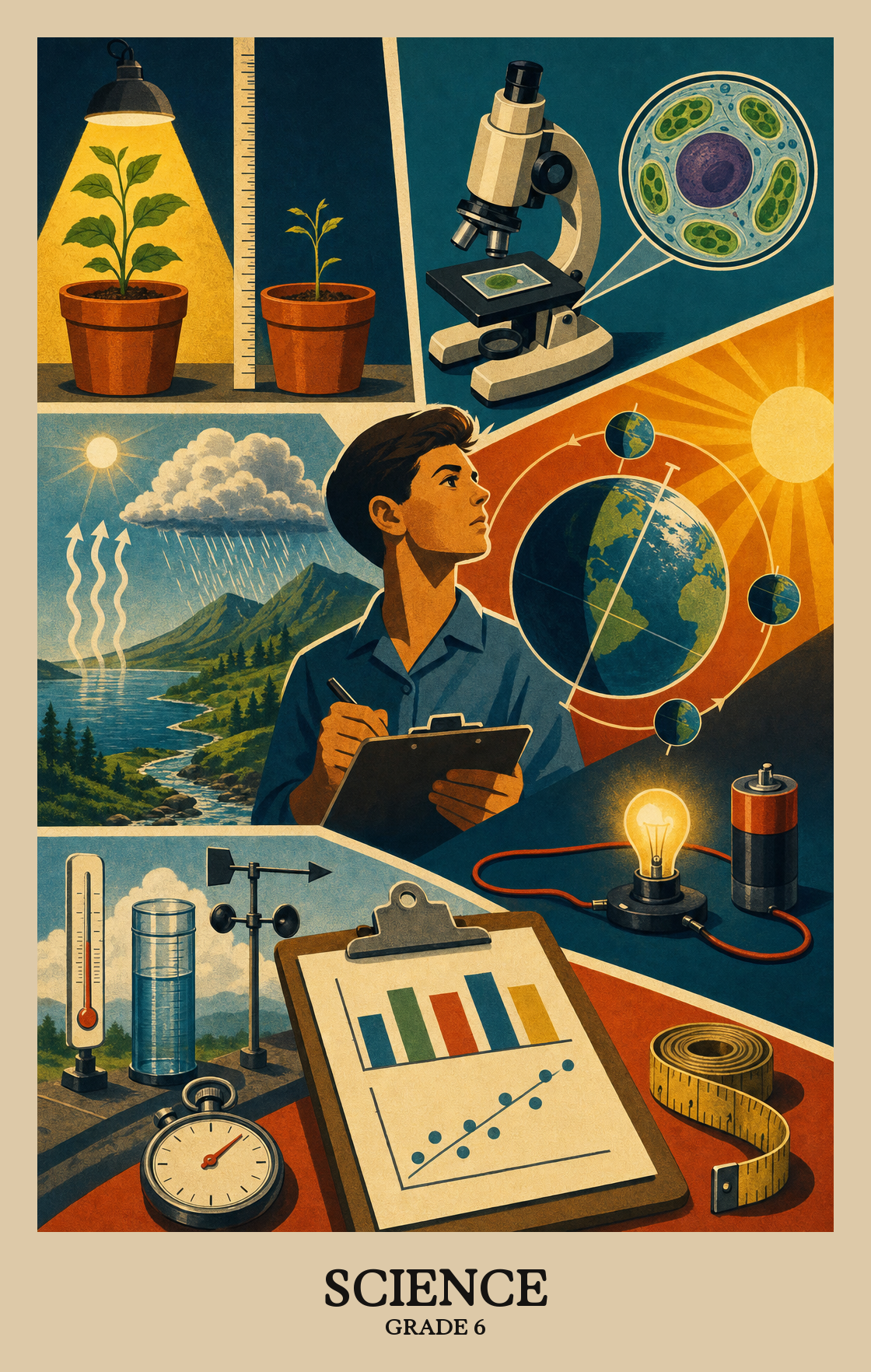
Students start the year learning how science gets done. They ask questions that can be tested, run small experiments, and figure out the difference between a guess, a theory, and a law.
Students study where Earth sits in the universe and why we have day, night, and seasons. They look at rocks, oceans, and air, and learn what drives the weather outside the window.
Students zoom in on cells and how they build up into plants, animals, and people. They look at how traits pass from parents to offspring and why kids in the same family can look so different.
Students follow food, water, and energy through ponds, forests, and other ecosystems. They also look at how species have changed over long stretches of time and why some no longer exist.
Students close the year with the physics of everyday life. They study what matter is made of, how heat and electricity move from one place to another, and why a pushed object speeds up, slows down, or turns.
Students learn to turn curiosity into a real question, plan a fair test to answer it, and use the results as evidence before drawing a conclusion.
Science doesn't stay still. Students learn how scientists test ideas, challenge each other's findings, and update what they know when new evidence shows up.
Theories explain why things happen, laws describe what always happens, hypotheses are testable guesses, and models are simplified pictures of how something works. Students learn which tool to reach for when making sense of a science question.
| Standard | Definition | Code |
|---|---|---|
| The Practice of Science | Students learn to turn curiosity into a real question, plan a fair test to answer it, and use the results as evidence before drawing a conclusion. | FL-SCI.NATURE.6.1 |
| The Characteristics of Scientific Knowledge | Science doesn't stay still. Students learn how scientists test ideas, challenge each other's findings, and update what they know when new evidence shows up. | FL-SCI.NATURE.6.2 |
| The Role of Theories, Laws, and Models | Theories explain why things happen, laws describe what always happens, hypotheses are testable guesses, and models are simplified pictures of how something works. Students learn which tool to reach for when making sense of a science question. | FL-SCI.NATURE.6.3 |
Students learn why we have day and night and why seasons change throughout the year. This comes down to how Earth spins on its axis and travels around the sun.
Students learn how Earth is put together, from the rocky layers underground to the oceans and the air above. They study how those layers interact and change over time.
Weather is what happens outside today. Climate is the pattern of weather a place gets over many years. Students learn what causes both, including how land, water, and the atmosphere shape the conditions of a region.
| Standard | Definition | Code |
|---|---|---|
| Earth in Space and Time | Students learn why we have day and night and why seasons change throughout the year. This comes down to how Earth spins on its axis and travels around the sun. | FL-SCI.ESS.6.1 |
| Earth's Structures | Students learn how Earth is put together, from the rocky layers underground to the oceans and the air above. They study how those layers interact and change over time. | FL-SCI.ESS.6.2 |
| Weather and Climate | Weather is what happens outside today. Climate is the pattern of weather a place gets over many years. Students learn what causes both, including how land, water, and the atmosphere shape the conditions of a region. | FL-SCI.ESS.6.3 |
Cells are the building blocks of every living thing. Students learn how cells group into tissues, tissues into organs, and organs into the systems that keep a body running.
Students learn how living things pass traits from parent to offspring, how offspring grow and change over time, and how DNA carries the instructions that shape each organism.
Students learn why living things come in so many forms and how species have changed across generations. They look at fossils, body structures, and other evidence to trace how life on Earth has shifted over millions of years.
Students learn how living things depend on each other to survive and how matter like water, carbon, and nutrients cycles through an ecosystem while energy flows from the sun through plants, animals, and decomposers.
| Standard | Definition | Code |
|---|---|---|
| Organization and Development | Cells are the building blocks of every living thing. Students learn how cells group into tissues, tissues into organs, and organs into the systems that keep a body running. | FL-SCI.LS.6.1 |
| Heredity and Reproduction | Students learn how living things pass traits from parent to offspring, how offspring grow and change over time, and how DNA carries the instructions that shape each organism. | FL-SCI.LS.6.2 |
| Diversity and Evolution | Students learn why living things come in so many forms and how species have changed across generations. They look at fossils, body structures, and other evidence to trace how life on Earth has shifted over millions of years. | FL-SCI.LS.6.3 |
| Interdependence | Students learn how living things depend on each other to survive and how matter like water, carbon, and nutrients cycles through an ecosystem while energy flows from the sun through plants, animals, and decomposers. | FL-SCI.LS.6.4 |
Students learn what matter is made of and how its properties, like mass, volume, and state, can change. They explore why ice melts, why substances dissolve, and what happens to matter when it's heated, cooled, or mixed.
Students learn that energy comes in different forms (light, heat, sound, motion) and that it can move from one object to another without being created or destroyed.
Students learn how pushes, pulls, and other forces change the way objects move. They practice predicting what happens to speed and direction when forces act on something.
| Standard | Definition | Code |
|---|---|---|
| Properties of Matter | Students learn what matter is made of and how its properties, like mass, volume, and state, can change. They explore why ice melts, why substances dissolve, and what happens to matter when it's heated, cooled, or mixed. | FL-SCI.PS.6.1 |
| Forms of Energy | Students learn that energy comes in different forms (light, heat, sound, motion) and that it can move from one object to another without being created or destroyed. | FL-SCI.PS.6.2 |
| Forces and Motion | Students learn how pushes, pulls, and other forces change the way objects move. They practice predicting what happens to speed and direction when forces act on something. | FL-SCI.PS.6.3 |
Florida Statewide Science Assessment given annually in grade 8 covering NGSSS Science.
Federally administered sample-based assessment in reading, mathematics, science, and writing. NAEP results inform state-by-state comparisons rather than individual student or school accountability.
Students study four big areas: how scientists work, Earth and space, living things, and matter and energy. They look at things like seasons, weather, cells, ecosystems, forces, and how energy moves. The goal is to ask good questions and back up answers with evidence.
Ask students to explain what they learned in their own words, then ask why they think it works that way. Cooking, gardening, watching the weather, and looking at the moon all count as science talk. Five minutes of curious questions beats a worksheet.
Some words matter, like cell, force, energy, and atmosphere. But memorizing definitions is not the point. Students should be able to use the words to explain something real, like why ice melts in a warm drink or why summer days are longer.
Most teachers start with how science works, since those habits show up in every unit. Earth and space often comes next because it connects to weather students can observe. Life science and physical science can go in either order, depending on lab access and seasonal fit.
Students often confuse weather and climate, mix up cells and atoms, and struggle to tell a hypothesis from a theory. Forces also trip them up, especially the idea that an object at rest still has forces acting on it. Plan extra time and a second lab for each.
Students should ask a question that can be tested, change one thing at a time, record what happens, and explain the results using evidence. The write-up matters as much as the lab. A clear claim with two pieces of evidence is a strong target.
Pick one thing that interests them and follow it: volcanoes, space, animals, slime, sharks, anything. Short videos, a library book, or a backyard experiment can pull them back in. Science feels boring when it lives only in a textbook.
By spring, students should be able to design a simple experiment, read a chart or graph, and explain a science idea using evidence instead of opinion. They should also recognize basic ideas in each of the four strands, even if they need a prompt to get started.