Setting up strong habits
Students settle into longer books and articles, building stamina to read carefully and pick up the main idea. They practice talking and writing about what they read in clear, respectful ways.
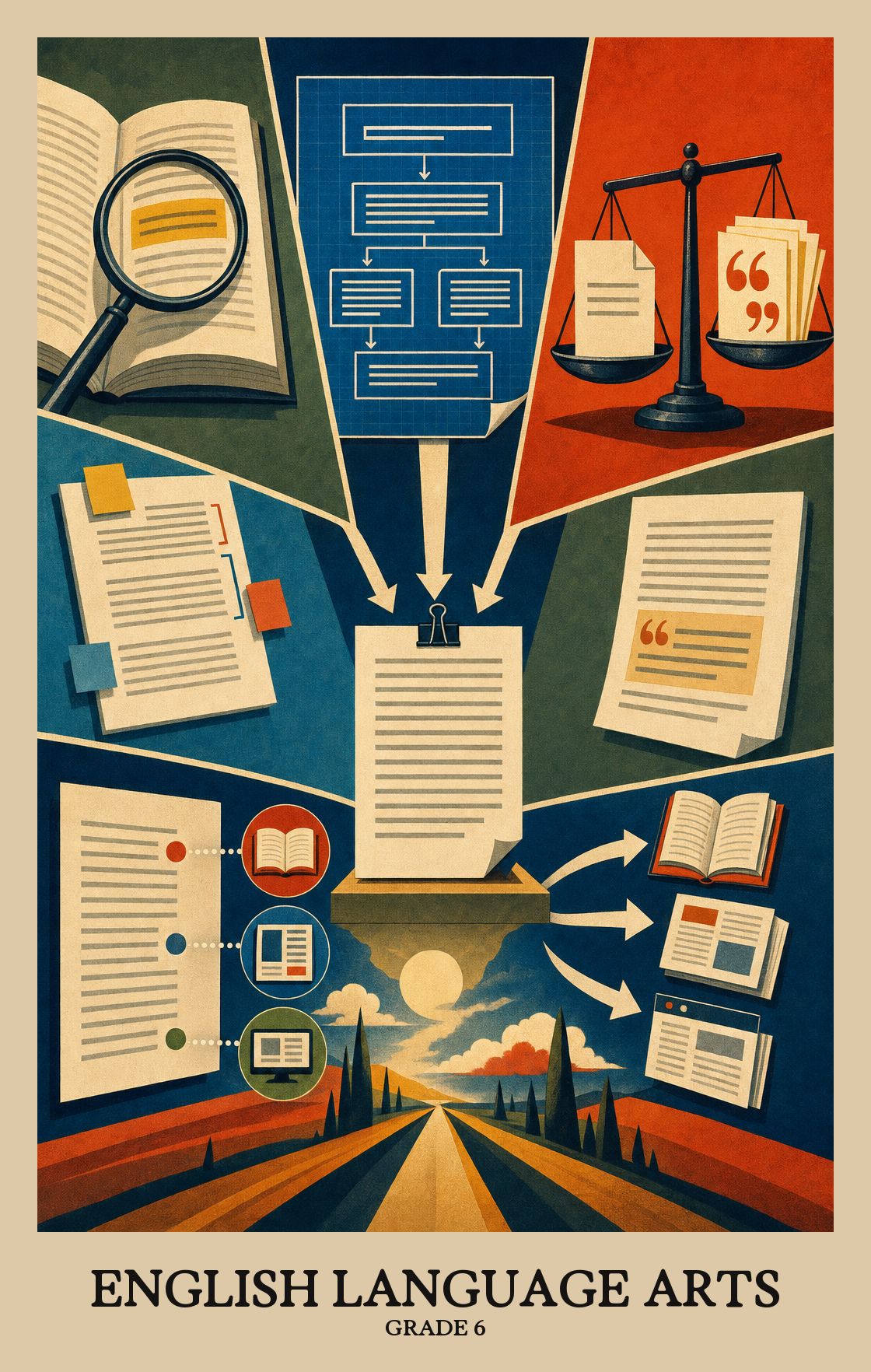
This is the year reading shifts from following a story to studying how an author built it. Students dig into why a writer picked certain words, how a chapter is laid out, and whether an argument actually holds up. Writing grows into full pieces with a clear point and quotes from the text to back it up. By spring, students can write a short research paper that uses real sources and cites them.
Students settle into longer books and articles, building stamina to read carefully and pick up the main idea. They practice talking and writing about what they read in clear, respectful ways.
Students dig into novels and short stories to track how characters change and what the story is really about. They notice how an author's word choices shape the mood of a scene.
Students shift to articles and nonfiction books. They learn to spot how a piece is put together, follow the author's argument, and tell a strong reason from a weak one.
Students write longer pieces that make a claim and back it up with quotes and facts from what they read. Grammar, punctuation, and citing sources get real attention here.
Students run a short research project, pull from a few trusted sources, and share what they found in a presentation with slides or visuals. They give and take feedback from classmates.
Students compare books, articles, and speeches on the same topic and notice where they agree, disagree, or fill in each other's gaps. Vocabulary work picks up as readings get harder.
Students pull together what they already know and what they've read to find connections between ideas, whether inside one text or across several.
Students read sixth-grade texts out loud smoothly and accurately, with enough understanding to explain what they read. The focus is on sounding out words correctly while keeping pace and meaning at the same time.
Students read a passage and draw conclusions the author implies but never states outright, then point to the specific lines that back up their thinking.
Students pick a claim or conclusion, then back it up with proof from the text and from what they already know about the topic.
Students write and speak using correct grammar, spelling, and punctuation. This standard covers the everyday rules of English that make writing clear and easy to follow.
Students read and discuss texts that explore what it means to be a good citizen and person. The focus is on building the habits of mind that shape how students treat others and take part in their communities.
| Standard | Definition | Code |
|---|---|---|
| Think Critically | Students pull together what they already know and what they've read to find connections between ideas, whether inside one text or across several. | FL-ELA.EE.6.1 |
| Read Fluently | Students read sixth-grade texts out loud smoothly and accurately, with enough understanding to explain what they read. The focus is on sounding out words correctly while keeping pace and meaning at the same time. | FL-ELA.EE.6.2 |
| Make Inferences | Students read a passage and draw conclusions the author implies but never states outright, then point to the specific lines that back up their thinking. | FL-ELA.EE.6.3 |
| Use Evidence | Students pick a claim or conclusion, then back it up with proof from the text and from what they already know about the topic. | FL-ELA.EE.6.4 |
| Communicate Effectively | Students write and speak using correct grammar, spelling, and punctuation. This standard covers the everyday rules of English that make writing clear and easy to follow. | FL-ELA.EE.6.5 |
| Engage with Civics and Character | Students read and discuss texts that explore what it means to be a good citizen and person. The focus is on building the habits of mind that shape how students treat others and take part in their communities. | FL-ELA.EE.6.6 |
Students read stories and break down how the plot unfolds, what drives the characters, and what bigger idea the author is getting at. This is the core close-reading work for sixth-grade fiction.
Students study the words and phrases an author chose, looking at how specific language, vivid descriptions, and comparisons shape the feeling and meaning of a passage.
Students find the main message or idea in a story or article, then track how it builds from beginning to end. A summary shows how the details along the way support that central idea.
Students look at how a nonfiction article or book is put together, such as why the author chose to compare two ideas or explain a cause and effect, and what that choice does to the reader's understanding.
Students read informational writing and decide whether the author's argument holds up. They spot reasoning that makes sense and flag claims that don't have enough evidence behind them.
Students read two or more texts on the same topic and explain what the texts share and where they differ, whether in the ideas they explore or the way they are organized.
| Standard | Definition | Code |
|---|---|---|
| Literary Elements | Students read stories and break down how the plot unfolds, what drives the characters, and what bigger idea the author is getting at. This is the core close-reading work for sixth-grade fiction. | FL-ELA.R.6.1 |
| Author's Craft | Students study the words and phrases an author chose, looking at how specific language, vivid descriptions, and comparisons shape the feeling and meaning of a passage. | FL-ELA.R.6.2 |
| Central Ideas | Students find the main message or idea in a story or article, then track how it builds from beginning to end. A summary shows how the details along the way support that central idea. | FL-ELA.R.6.3 |
| Informational Text Structure | Students look at how a nonfiction article or book is put together, such as why the author chose to compare two ideas or explain a cause and effect, and what that choice does to the reader's understanding. | FL-ELA.R.6.4 |
| Argument and Reasoning | Students read informational writing and decide whether the author's argument holds up. They spot reasoning that makes sense and flag claims that don't have enough evidence behind them. | FL-ELA.R.6.5 |
| Compare Texts | Students read two or more texts on the same topic and explain what the texts share and where they differ, whether in the ideas they explore or the way they are organized. | FL-ELA.R.6.6 |
Students practice listening carefully, speaking clearly, and working with classmates to share ideas. The focus is on being respectful and easy to understand in group conversations and discussions.
Students apply grammar, capitalization, punctuation, and spelling rules in their writing and speaking. This covers the mechanical habits that make written and spoken sentences clear and correct.
Students practice writing in different modes: a story, an explanation, a persuasive paragraph. Each piece should have a clear point, a logical order, and a consistent voice from start to finish.
Students research a topic, find trustworthy sources, and weave specific evidence into their writing with proper citations. This applies to both quick one-day projects and longer multi-week research assignments.
Students plan and build presentations that mix text, images, or audio, then work with classmates to sharpen the ideas before the final version.
| Standard | Definition | Code |
|---|---|---|
| Communicating with Others | Students practice listening carefully, speaking clearly, and working with classmates to share ideas. The focus is on being respectful and easy to understand in group conversations and discussions. | FL-ELA.C.6.1 |
| Following Conventions | Students apply grammar, capitalization, punctuation, and spelling rules in their writing and speaking. This covers the mechanical habits that make written and spoken sentences clear and correct. | FL-ELA.C.6.2 |
| Writing | Students practice writing in different modes: a story, an explanation, a persuasive paragraph. Each piece should have a clear point, a logical order, and a consistent voice from start to finish. | FL-ELA.C.6.3 |
| Researching | Students research a topic, find trustworthy sources, and weave specific evidence into their writing with proper citations. This applies to both quick one-day projects and longer multi-week research assignments. | FL-ELA.C.6.4 |
| Creating and Collaborating | Students plan and build presentations that mix text, images, or audio, then work with classmates to sharpen the ideas before the final version. | FL-ELA.C.6.5 |
Students learn the specific words that show up in textbooks, assignments, and classroom discussions, then use those words correctly when they speak and write.
When students hit a word they don't know, they figure it out by looking at surrounding sentences, familiar word parts like prefixes and suffixes, or a dictionary. The goal is to work out the meaning without stopping cold.
Students learn where English words come from, including Latin and Greek roots, and use that knowledge to figure out unfamiliar words. Recognizing a root like "aud" (hear) or "port" (carry) helps decode dozens of words at once.
| Standard | Definition | Code |
|---|---|---|
| Acquiring Vocabulary | Students learn the specific words that show up in textbooks, assignments, and classroom discussions, then use those words correctly when they speak and write. | FL-ELA.V.6.1 |
| Word Relationships | When students hit a word they don't know, they figure it out by looking at surrounding sentences, familiar word parts like prefixes and suffixes, or a dictionary. The goal is to work out the meaning without stopping cold. | FL-ELA.V.6.2 |
| Word Origins | Students learn where English words come from, including Latin and Greek roots, and use that knowledge to figure out unfamiliar words. Recognizing a root like "aud" (hear) or "port" (carry) helps decode dozens of words at once. | FL-ELA.V.6.3 |
FAST ELA Reading for grades 6 through 8, given three times per year with PM3 as the summative result.
Sixth graders move from reading short passages to working through full chapters, articles, and short stories. They write paragraphs and essays that make a point and back it up with specific lines from the text. Speaking and listening also count, since students discuss readings and share short presentations.
Have students read a short section out loud, then ask what just happened and what part of the text shows that. If they cannot find a line, read it together and look up one or two hard words. Ten minutes of this a few nights a week makes a real difference.
It means students point to a specific sentence or detail in the story or article that proves their answer. Instead of saying the main character is brave, they quote the line where the character does something brave. Ask students to show the spot in the book when they answer a question.
Start with shorter texts so students practice finding the main idea and pulling quotes. Move into longer literary and informational texts where students track themes and author choices. Build writing alongside reading, so each unit ends with a piece that uses evidence from what students just read.
Inference and evidence selection are the two big ones. Students often pick a quote that sounds important but does not actually prove their claim. Plan time to model how to choose a tight quote and explain how it connects to the point being made.
Yes. Sixth graders are expected to write clear sentences with correct punctuation, capitalization, and spelling. At home, ask students to read their writing out loud before turning it in, since their ear often catches mistakes their eyes miss.
When students hit an unfamiliar word, have them try the surrounding sentences first and then check a dictionary. Keeping a short list of new words from books and articles, with a quick definition next to each, works better than memorizing long lists from a workbook.
Students pick a focused question, find a few credible sources, and pull quotes or facts to use in their writing with simple citations. Short research projects of a week or two work well early in the year. Save longer projects for later, once students can evaluate a source on their own.
By spring, students should read a chapter or article and explain the main idea, the author's point of view, and one or two details that back it up. They should also write a multi-paragraph essay that states a claim and uses quotes from the text. If those feel hard, focus practice there.