Rules, leaders, and our country
Students start the year learning why communities need rules and who makes them. They meet early American leaders and look at how our country began and what its founders believed in.
This is the year students step outside their own family and look at how communities work. Students learn what a citizen is, why rules and leaders matter, and how neighborhoods fit into a bigger country and world. They use simple maps to find places and start to see how people earn, save, and spend money. By spring, students can name basic rights and responsibilities of a citizen and point to their state and country on a map.
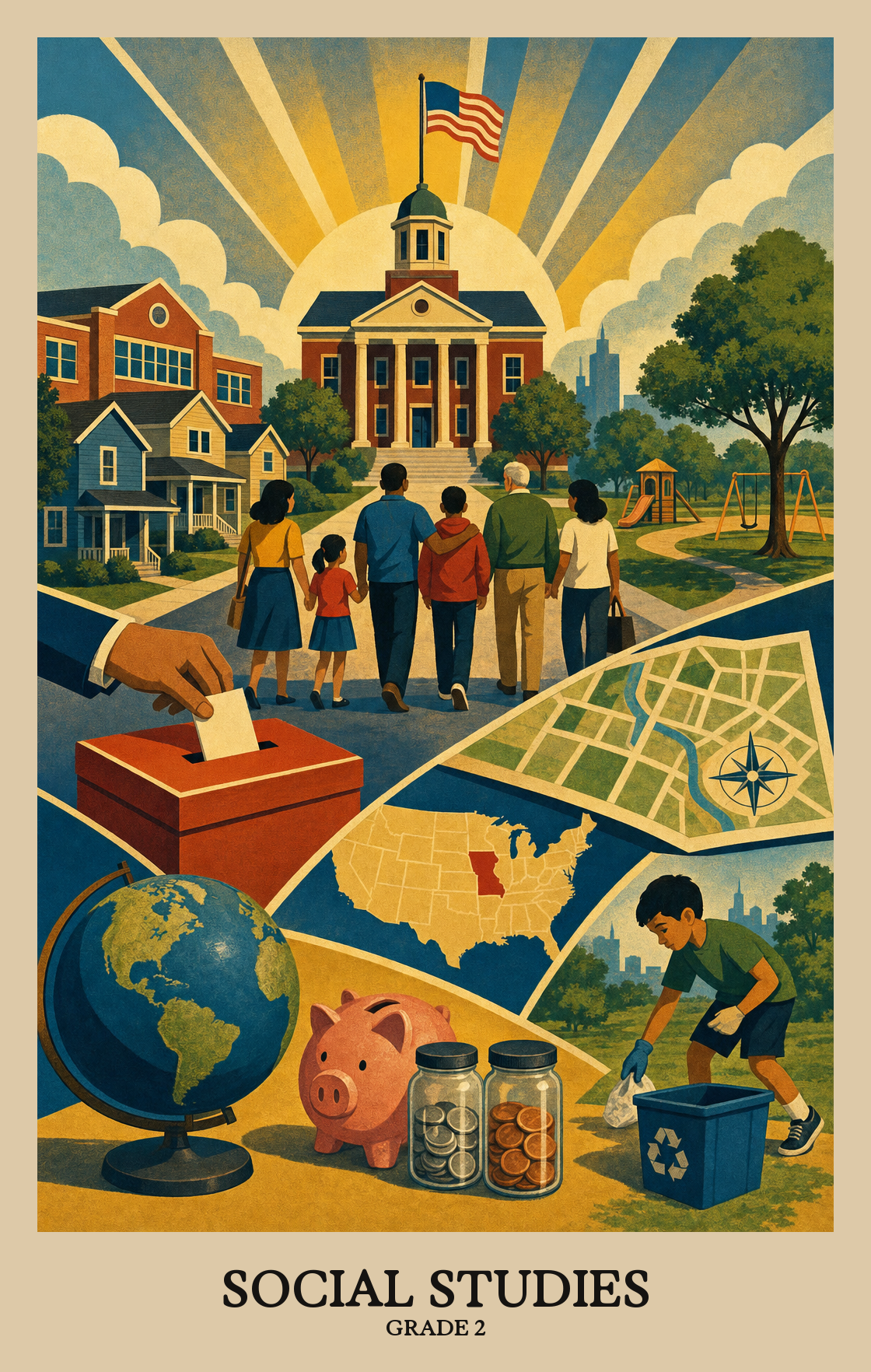
Students start the year learning why communities need rules and who makes them. They meet early American leaders and look at how our country began and what its founders believed in.
Students use maps and globes to find cities, states, and countries. They notice how land, weather, and people shape a place, and how a neighborhood looks different from a farm or a city.
Students travel back in time to ancient places like Egypt, Greece, and Rome. They see how people built cities, traded goods, and shared ideas that still show up in daily life today.
Students learn that families and stores cannot have everything, so they make choices. They practice saving, spending, and budgeting, and see how prices and trade connect people near and far.
Students close the year by looking at how local, state, and national governments work together. They learn how voting, speaking up, and helping neighbors are part of being a citizen.
Students learn why the Founders created the Constitution and what it says about how the government works. They explore the ideas behind American self-government and what documents like the Constitution and Bill of Rights actually do.
Students learn about major turning points in American history, like the founding of the country or key moments in government, and explain why those events still matter today.
Students look at how life in America has stayed the same and how it has changed over time. They study real people and groups who helped shape those changes.
| Standard | Definition | Code |
|---|---|---|
| American Founding | Students learn why the Founders created the Constitution and what it says about how the government works. They explore the ideas behind American self-government and what documents like the Constitution and Bill of Rights actually do. | FL-SS.AH.2.1 |
| American Eras | Students learn about major turning points in American history, like the founding of the country or key moments in government, and explain why those events still matter today. | FL-SS.AH.2.2 |
| Continuity and Change | Students look at how life in America has stayed the same and how it has changed over time. They study real people and groups who helped shape those changes. | FL-SS.AH.2.3 |
Second graders look at early civilizations like ancient Egypt and ancient Greece to learn how people long ago built governments, traded goods, and created art, writing, and laws that still shape the world today.
Second graders learn that history is divided into big periods of time. They explore what life looked like during the Middle Ages, the Renaissance, and the age of exploration, then trace how the world changed into the era we live in now.
Trade, war, movement, and shared ideas connect people across the world. Students look at how ancient civilizations shaped each other by doing business, fighting, moving to new places, and passing on beliefs and inventions.
| Standard | Definition | Code |
|---|---|---|
| Ancient and Classical Civilizations | Second graders look at early civilizations like ancient Egypt and ancient Greece to learn how people long ago built governments, traded goods, and created art, writing, and laws that still shape the world today. | FL-SS.WH.2.1 |
| World Eras | Second graders learn that history is divided into big periods of time. They explore what life looked like during the Middle Ages, the Renaissance, and the age of exploration, then trace how the world changed into the era we live in now. | FL-SS.WH.2.2 |
| Global Interactions | Trade, war, movement, and shared ideas connect people across the world. Students look at how ancient civilizations shaped each other by doing business, fighting, moving to new places, and passing on beliefs and inventions. | FL-SS.WH.2.3 |
Students use maps and globes to find where places are and compare how big different regions are relative to each other.
Students learn what makes a place look and feel the way it does, from its land and weather to the buildings and people who live there, and how those things shift over the years.
Students learn why people move to new places and how those moves change the neighborhoods, traditions, and daily life of the communities that grow there.
| Standard | Definition | Code |
|---|---|---|
| The World in Spatial Terms | Students use maps and globes to find where places are and compare how big different regions are relative to each other. | FL-SS.GEO.2.1 |
| Places and Regions | Students learn what makes a place look and feel the way it does, from its land and weather to the buildings and people who live there, and how those things shift over the years. | FL-SS.GEO.2.2 |
| Human Systems | Students learn why people move to new places and how those moves change the neighborhoods, traditions, and daily life of the communities that grow there. | FL-SS.GEO.2.3 |
Scarcity means there is never enough of everything, so people must choose. Students learn how families decide what to buy, how businesses decide what to sell, and why every choice means giving something else up.
Markets are places where buyers and sellers agree on prices. When many sellers offer the same thing, they compete to attract buyers, and prices tend to drop. That competition decides who gets what and at what cost.
Students learn to make simple money decisions: when to spend, when to save, and how to plan ahead so their money covers what they need.
| Standard | Definition | Code |
|---|---|---|
| Economic Decision Making | Scarcity means there is never enough of everything, so people must choose. Students learn how families decide what to buy, how businesses decide what to sell, and why every choice means giving something else up. | FL-SS.ECON.2.1 |
| Markets and the Economy | Markets are places where buyers and sellers agree on prices. When many sellers offer the same thing, they compete to attract buyers, and prices tend to drop. That competition decides who gets what and at what cost. | FL-SS.ECON.2.2 |
| Personal Financial Literacy | Students learn to make simple money decisions: when to spend, when to save, and how to plan ahead so their money covers what they need. | FL-SS.ECON.2.3 |
Students learn why America has a government and where its rules come from. They read about founding documents like the Constitution and explore the ideas behind how a democracy works.
Citizens have rights (like going to school or speaking freely) and responsibilities (like following rules and helping the community). Students learn what it means to take part in civic life.
Students learn that the U.S. has three layers of government: national, state, and local. Each layer handles different jobs, like making laws or running schools, and they work together to keep communities running.
Students learn how people take part in running their community, from voting in elections to speaking up for a cause or volunteering to help others.
| Standard | Definition | Code |
|---|---|---|
| Foundations of Government | Students learn why America has a government and where its rules come from. They read about founding documents like the Constitution and explore the ideas behind how a democracy works. | FL-SS.CIV.2.1 |
| Roles, Rights, and Responsibilities | Citizens have rights (like going to school or speaking freely) and responsibilities (like following rules and helping the community). Students learn what it means to take part in civic life. | FL-SS.CIV.2.2 |
| Government Structures | Students learn that the U.S. has three layers of government: national, state, and local. Each layer handles different jobs, like making laws or running schools, and they work together to keep communities running. | FL-SS.CIV.2.3 |
| Civic Engagement | Students learn how people take part in running their community, from voting in elections to speaking up for a cause or volunteering to help others. | FL-SS.CIV.2.4 |
Federally administered sample-based assessment in reading, mathematics, science, and writing. NAEP results inform state-by-state comparisons rather than individual student or school accountability.
Students learn how communities, leaders, and rules shape daily life. They start with basics of American history and government, look at people and places around the world, read simple maps, and talk about how families make choices with money.
Pull up a map before a trip and find home, the store, and the highway. Spin a globe and point out where relatives live or where a favorite food comes from. Five minutes of this a week goes a long way.
Students should understand that money is limited, so people make choices about what to buy, save, and skip. They should be able to talk about saving for something they want and the difference between wants and needs.
Most teachers anchor the year in civics and community first, since it sets up shared vocabulary. American history and geography work well in the middle of the year, with world history and economics woven in through stories, holidays, and class jobs.
Map directions and the difference between a city, state, and country trip up many students. Economic vocabulary like scarcity, goods, and services also needs repeated practice through real classroom examples before it sticks.
Tell family stories and look at old photos together. Visit a local museum, monument, or historic site and talk about what life was like back then. Picture books about figures like George Washington or Harriet Tubman are a great starting point.
Class jobs, voting on small decisions, and following classroom rules are the core practice. Pair these routines with short lessons on the flag, the pledge, and the three branches so students see the connection between class life and government.
By spring, students should name basic rights and responsibilities, point out the United States on a map, describe a few historical figures, and explain a simple trade-off with money. Comfort talking about communities matters more than memorized facts.