Founding of the United States
Students start the year with the story of how the country began. They read about the Declaration of Independence and the Constitution, and learn the basic ideas that shaped American government.
This is the year social studies pulls back to look at the whole American story, from the founding documents to the people who shaped the country. Students also travel further out, studying ancient civilizations, the Middle Ages, and the explorers who connected them. They start thinking like economists too, weighing trade-offs and learning what saving and budgeting really mean. By spring, students can explain why the Constitution matters and trace a basic timeline of early America.
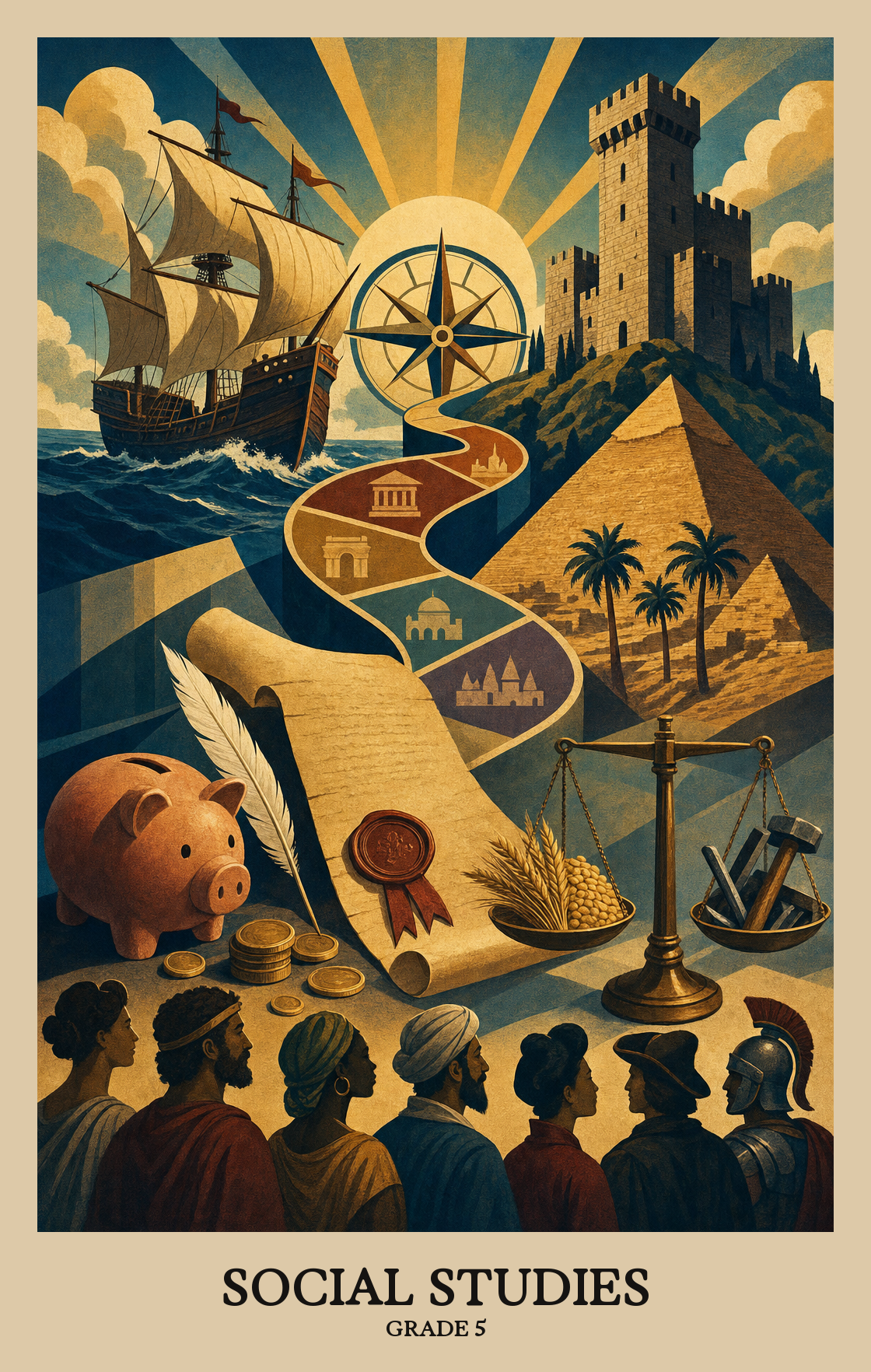
Students start the year with the story of how the country began. They read about the Declaration of Independence and the Constitution, and learn the basic ideas that shaped American government.
Students move through major chapters of the American story and look at the people and groups who changed it. Expect dinner-table mentions of presidents, inventors, and movements students find interesting.
Students travel back in time to ancient civilizations and follow the world through the Middle Ages, the Renaissance, and the age of exploration. They look at how trade, conflict, and travel spread ideas between cultures.
Students use maps and globes to find places and compare the size of regions. They look at how land and weather shape where people live and how moving and settling change a place over time.
Students learn why people cannot have everything they want and how that drives the choices families and businesses make. They also practice real-life money skills like saving, spending, and budgeting.
Students close the year by looking at how federal, state, and local governments work together. They learn the rights and responsibilities of citizens and the ways people take part through voting, speaking up, and service.
Students read the Declaration of Independence, the Constitution, and other founding documents to understand how the United States was created and what rules those documents set for how the government works.
Students place major events in American history in order and explain why each one mattered. This standard covers the big turning points a fifth grader is expected to know.
History doesn't just happen. Students look at how American life has stayed the same and how it has changed over time, and they examine what specific people and groups did to shape those shifts.
| Standard | Definition | Code |
|---|---|---|
| American Founding | Students read the Declaration of Independence, the Constitution, and other founding documents to understand how the United States was created and what rules those documents set for how the government works. | FL-SS.AH.5.1 |
| American Eras | Students place major events in American history in order and explain why each one mattered. This standard covers the big turning points a fifth grader is expected to know. | FL-SS.AH.5.2 |
| Continuity and Change | History doesn't just happen. Students look at how American life has stayed the same and how it has changed over time, and they examine what specific people and groups did to shape those shifts. | FL-SS.AH.5.3 |
Ancient civilizations like Greece, Rome, and Egypt shaped ideas we still use today. Students explore how those societies governed themselves, traded goods, and built cultures that influenced the modern world.
Students learn to place major chapters of world history in order, from the Middle Ages and the Renaissance through the age of exploration into the modern world.
Trade, war, migration, and shared ideas all changed how ancient civilizations grew and treated one another. Students study how those connections shaped cultures across the world.
| Standard | Definition | Code |
|---|---|---|
| Ancient and Classical Civilizations | Ancient civilizations like Greece, Rome, and Egypt shaped ideas we still use today. Students explore how those societies governed themselves, traded goods, and built cultures that influenced the modern world. | FL-SS.WH.5.1 |
| World Eras | Students learn to place major chapters of world history in order, from the Middle Ages and the Renaissance through the age of exploration into the modern world. | FL-SS.WH.5.2 |
| Global Interactions | Trade, war, migration, and shared ideas all changed how ancient civilizations grew and treated one another. Students study how those connections shaped cultures across the world. | FL-SS.WH.5.3 |
Students read maps and globes to pinpoint where places are and compare how big different regions are next to each other.
Students study what makes a place look and feel the way it does, from rivers and landforms to cities and farms, and track how those features shift as people and nature change them.
Students look at why people move to new places and how those arrivals change the area over time, from the languages spoken to the buildings built. Patterns of settlement and the spread of culture explain why places look and feel the way they do.
| Standard | Definition | Code |
|---|---|---|
| The World in Spatial Terms | Students read maps and globes to pinpoint where places are and compare how big different regions are next to each other. | FL-SS.GEO.5.1 |
| Places and Regions | Students study what makes a place look and feel the way it does, from rivers and landforms to cities and farms, and track how those features shift as people and nature change them. | FL-SS.GEO.5.2 |
| Human Systems | Students look at why people move to new places and how those arrivals change the area over time, from the languages spoken to the buildings built. Patterns of settlement and the spread of culture explain why places look and feel the way they do. | FL-SS.GEO.5.3 |
When there is not enough of something (time, money, or goods), people have to give something up to get what they want most. Students learn how those trade-offs shape the choices individuals, families, and businesses make every day.
Markets are places where buyers and sellers set prices and compete for goods. Students learn how that competition decides who gets what, and why prices rise or fall based on supply and demand.
Students practice the basics of managing money: deciding how much to save, how much to spend, and how borrowing money (credit) can cost more in the long run. Budgeting means making a plan so spending doesn't outpace income.
| Standard | Definition | Code |
|---|---|---|
| Economic Decision Making | When there is not enough of something (time, money, or goods), people have to give something up to get what they want most. Students learn how those trade-offs shape the choices individuals, families, and businesses make every day. | FL-SS.ECON.5.1 |
| Markets and the Economy | Markets are places where buyers and sellers set prices and compete for goods. Students learn how that competition decides who gets what, and why prices rise or fall based on supply and demand. | FL-SS.ECON.5.2 |
| Personal Financial Literacy | Students practice the basics of managing money: deciding how much to save, how much to spend, and how borrowing money (credit) can cost more in the long run. Budgeting means making a plan so spending doesn't outpace income. | FL-SS.ECON.5.3 |
Students read documents like the Constitution and the Declaration of Independence to understand why the United States set up its government the way it did. The focus is on the rules and ideas the founders used to limit government power and protect individual rights.
Citizens have rights (like free speech) and responsibilities (like following laws and voting). Students learn how people take part in their community and government.
Students learn how the U.S. government is divided into national, state, and local levels and what each level is responsible for. They also learn how those levels work together and when each one is in charge.
Students learn how people take part in democracy by voting, speaking up for causes, and volunteering in their communities. The focus is on real actions citizens take to shape government decisions.
| Standard | Definition | Code |
|---|---|---|
| Foundations of Government | Students read documents like the Constitution and the Declaration of Independence to understand why the United States set up its government the way it did. The focus is on the rules and ideas the founders used to limit government power and protect individual rights. | FL-SS.CIV.5.1 |
| Roles, Rights, and Responsibilities | Citizens have rights (like free speech) and responsibilities (like following laws and voting). Students learn how people take part in their community and government. | FL-SS.CIV.5.2 |
| Government Structures | Students learn how the U.S. government is divided into national, state, and local levels and what each level is responsible for. They also learn how those levels work together and when each one is in charge. | FL-SS.CIV.5.3 |
| Civic Engagement | Students learn how people take part in democracy by voting, speaking up for causes, and volunteering in their communities. The focus is on real actions citizens take to shape government decisions. | FL-SS.CIV.5.4 |
End-of-course exam in Civics, typically grade 7.
Students study the founding of the United States, major events in American history, and how the government works. They also learn about ancient civilizations, world history through exploration, geography, and basic economics like saving and budgeting.
Talk about news stories, family history, or places visited on trips. Watching a documentary together about the American Revolution or ancient Egypt and asking what surprised them goes a long way. Library trips for history books written for this age work well too.
Students should be able to explain why the Declaration of Independence and the Constitution were written, name a few key rights, and describe the three branches of government. They should also understand basic ideas like representation and the rule of law.
Most teachers move chronologically from colonization through the founding era, then into the early republic and beyond. Anchoring each unit in a few key documents and people helps students hold the timeline together rather than treating events as a list of facts.
Try connecting topics to real places and people. A visit to a local historic site, a family budget conversation, or a map of where relatives came from makes the content feel real. Historical fiction at this reading level also pulls many students in.
Students should practice making trade-offs, comparing prices, and thinking about saving versus spending. A weekly allowance with a savings goal, or planning a small purchase together, gives them real reps with the same ideas covered in class.
The branches of government and the difference between federal, state, and local roles tend to blur together. Students also mix up the order of events between colonization, the Revolution, and the early republic. Short review routines across the year help more than a single unit.
Students read maps, compare regions, and look at how landscape shapes where people settle. Pulling out a map during every history and world unit, instead of teaching geography as a separate block, keeps these skills sharp all year.
By spring, students should be able to explain the basic story of how the United States was founded, name the branches of government, read a map, and talk about a trade-off in their own words. If those feel solid, they are ready.
Class jobs, voting on small decisions, and discussing school rules give students daily practice with rights and responsibilities. Tying these routines back to the founding documents during units makes the connection stick.