Skip to content

What does a student learn in ?

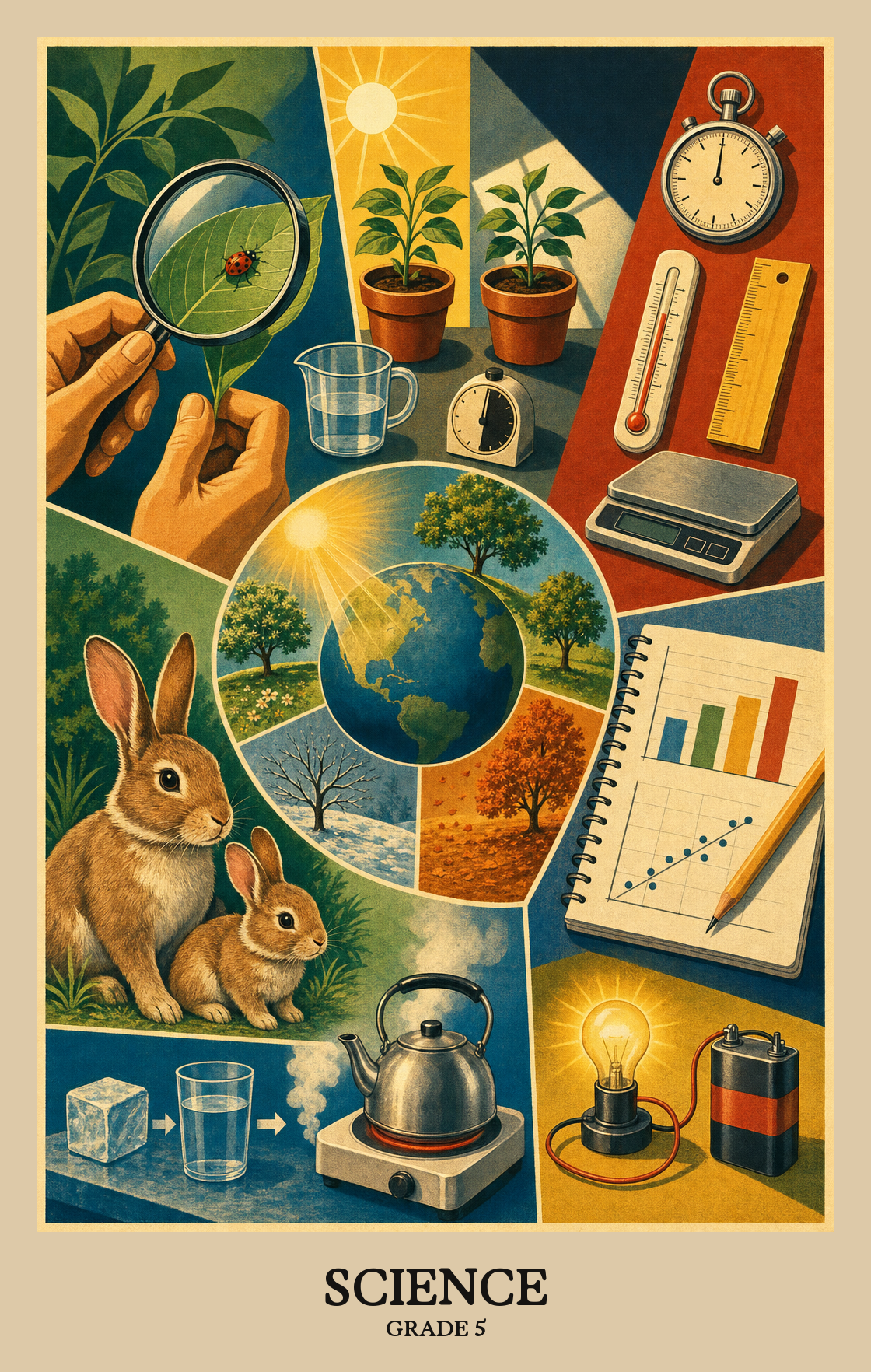
This is the year science shifts from observing to investigating. Students plan their own experiments, gather evidence, and explain what the results mean. They study how the Earth moves through day, night, and seasons, how plants and animals pass on traits, and how matter and energy change form. By spring, students can write a testable question, run a fair experiment, and explain what their data shows.

  • Scientific investigation
  • Earth and space
  • Weather and climate
  • Ecosystems
  • Matter and energy
  • Forces and motion
Source: Florida B.E.S.T. Standards
Year at a glance
How the year usually goes. Every school and district set their own curriculum, so treat this as a guide, not official pacing.
  1. 1

    Thinking like a scientist

    Students start the year learning how science actually works. They ask questions they can test, plan simple experiments, and figure out the difference between a guess, a model, and an idea that has held up to lots of evidence.

  2. 2

    Earth, sky, and weather

    Students look at Earth's place in space and what causes day, night, and the seasons. They also study weather and climate, including the land, water, and air that shape what happens outside the window.

  3. 3

    Matter, energy, and motion

    Students explore what things are made of and how matter can change, like ice melting or sugar dissolving. They also look at pushes, pulls, and different kinds of energy such as heat, light, and sound.

  4. 4

    Living things and ecosystems

    Students study how plants and animals are built, how they grow, and how traits pass from parents to offspring. They also trace how living things depend on each other and on sunlight, water, and air to survive.

Mastery Learning Standards
The required skills a student should display by the end of Grade 5.
Nature of Science
  • The Practice of Science

    Students form a question they can actually test, plan an experiment to answer it, then use what they find to explain what happened.

  • The Characteristics of Scientific Knowledge

    Science doesn't stay fixed. Students learn how scientists test ideas, share findings with other experts, and update what they know when new evidence changes the picture.

  • The Role of Theories, Laws, and Models

    Science uses different tools to explain the world. Students learn the difference between a hypothesis (an educated guess), a theory (a well-tested explanation), a law (a rule nature always follows), and a model (a diagram or stand-in that shows how something works).

Earth and Space Science
  • Earth in Space and Time

    Students learn why we have day and night, why seasons change, and where Earth sits in the solar system and beyond. The focus is on patterns they can observe, like shorter days in winter or the sun's path across the sky.

  • Earth's Structures

    Students learn how Earth is built in layers, from the rocky crust down to the core, and how water and air wrap around the planet. They explore how these systems interact through events like weather, erosion, and the water cycle.

  • Weather and Climate

    Students learn why some places are hot and rainy while others stay cool and dry, and how patterns in temperature and precipitation repeat season after season. They also look at what causes those patterns, like distance from the ocean or position on the globe.

Life Science
  • Organization and Development

    Cells are the tiny building blocks that make up every living thing. Students learn how cells group into tissues, tissues into organs, and organs into the systems that keep a plant or animal alive and growing.

  • Heredity and Reproduction

    Students learn how living things pass traits from parent to offspring, how offspring grow and develop, and why some traits run in families.

  • Diversity and Evolution

    Students learn why living things look and behave so differently from one another, and how those differences have shifted over millions of years as species adapted to survive.

  • Interdependence

    Plants, animals, and other organisms depend on each other to survive. Students learn how food, water, and nutrients move through an ecosystem in a cycle that keeps the whole system running.

Physical Science
  • Properties of Matter

    Matter is anything that takes up space and has mass, like water, air, or a rock. Students learn how matter can change form, what makes different materials behave differently, and what happens when substances are mixed or heated.

  • Forms of Energy

    Students learn that energy comes in different forms (light, heat, sound, motion) and can move from one object to another. No energy disappears in the process; it just changes form or location.

  • Forces and Motion

    Students learn how pushes and pulls move objects and how the size of a force affects how fast or far something moves. They practice predicting what happens when forces act on everyday objects.

Assessments
The state tests students at this grade and subject take.
State Summative

Statewide Science Assessment (Grade 5)

Florida Statewide Science Assessment given annually in grade 5 covering NGSSS Science.

When given:
spring
Frequency:
annual
Official source
Common Questions
  • What does fifth grade science cover this year?

    Students study four big areas: how scientists work, Earth and space, living things, and matter and energy. They run experiments, look at the water cycle and weather, learn how plants and animals depend on each other, and explore forces like gravity and pushes and pulls.

  • How can I help my child with science at home?

    Ask testable questions during everyday moments. Why did the puddle disappear? What makes the ball roll faster? Then try a small test together. Cooking, gardening, and watching the weather all count, and 10 minutes of curiosity beats a worksheet.

  • Do students need to memorize a lot of science vocabulary?

    Some words matter, like cell, force, energy, and atmosphere. But the goal is understanding, not memorizing. If students can explain an idea in their own words and give an example, the vocabulary will stick.

  • How should I sequence the four strands across the year?

    Most teachers anchor the year in Nature of Science and weave it through every unit. A common order is Earth and space in the fall, life science in the winter, and physical science in the spring, so outdoor weather and ecosystem work lands when it fits the season.

  • Which topics usually need the most reteaching?

    Cells and ecosystems give students trouble because the scale is hard to picture. The difference between weight and mass, and between heat and temperature, also needs more time than the pacing guide suggests. Plan extra hands-on practice for these.

  • What does mastery look like by the end of the year?

    Students can plan a simple experiment, collect data, and explain what the results mean. They can describe how energy moves through a food web, what causes day and night, and how matter changes state. They tell the difference between a hypothesis, a theory, and a model.

  • My child says science is boring. What can I do?

    Trade the textbook feeling for a real question. Sink or float in the bathtub, shadows across the yard at different times of day, or what happens to a banana left out for a week. Let students predict first, then check. Being wrong is part of the fun.

  • How do I know my child is ready for middle school science?

    Look for a student who asks why, suggests a way to find out, and can read a simple chart or graph without panic. They should be able to write a few sentences explaining what happened in an experiment and why. Confidence with measurement and units matters too.

  • How much of the year should be hands-on investigation?

    Aim for at least one investigation per unit where students plan part of the work themselves, not just follow steps. Short, frequent labs build stronger habits than rare big projects. Even a 15-minute observation with a notebook counts as real science work.