Moving and exploring space
Students start the year learning how their bodies move. They try fast and slow, high and low, and find ways to travel across a room without bumping into friends.
This is the year students discover that their bodies can tell stories. Students try out big and small movements, fast and slow, and start to notice how a dance can show a feeling or an idea. They watch others dance and share what they see, then practice a short movement to show a friend or family member. By spring, they can make up a simple dance about something they know, like a rainstorm or a busy bee, and perform it for the class.
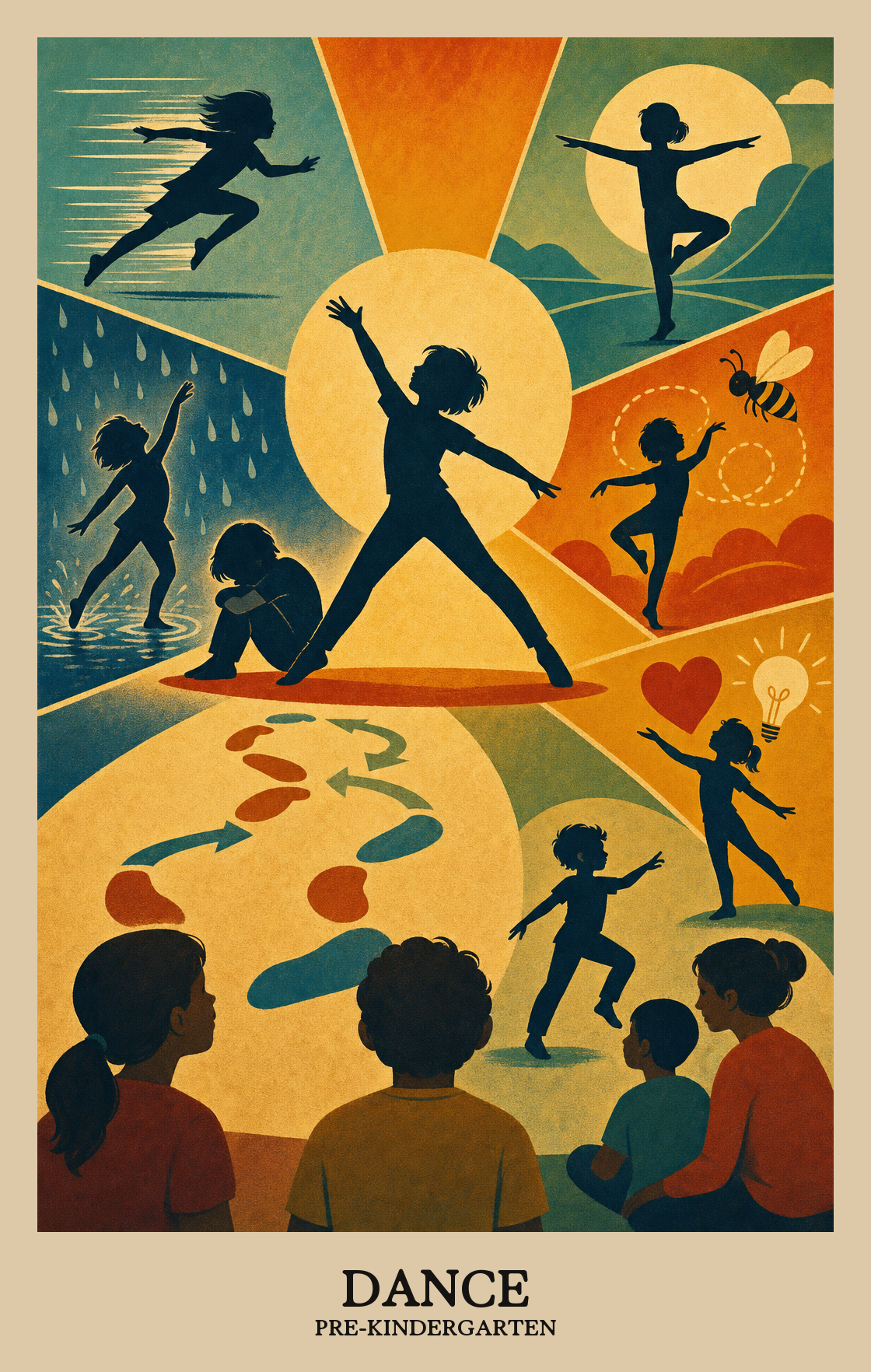
Students start the year learning how their bodies move. They try fast and slow, high and low, and find ways to travel across a room without bumping into friends.
Students begin inventing their own movements based on things they know, like animals, weather, or a favorite story. Parents may notice more dancing at home and made-up moves with a reason behind them.
Students string movements into short sequences and practice them more than once. They start to remember what comes next and clean up a move so it looks the way they want.
Students perform short dances for classmates and watch others dance. They talk about what they noticed, what a dance reminded them of, and which parts they liked.
Students connect something from their own life to a dance they make or watch, like moving like an animal they know or showing how they felt on a special day.
Dance connects to life outside the studio. Students begin noticing how the dances they learn reflect where people come from and what they celebrate.
| Standard | Definition | Code |
|---|---|---|
| Synthesize and relate knowledge and personal experiences to make art | Students connect something from their own life to a dance they make or watch, like moving like an animal they know or showing how they felt on a special day. | DA:Cn10.pk |
| Relate artistic ideas and works with societal, cultural | Dance connects to life outside the studio. Students begin noticing how the dances they learn reflect where people come from and what they celebrate. | DA:Cn11.pk |
Students come up with their own ideas for movement and dance, deciding what their body might do before they start moving.
Students pick a movement idea and practice turning it into a short dance. They make simple choices about how to move, like going fast or slow, and try it out.
Students pick a movement they like and practice it until it feels just right. They learn that making something means trying it more than once.
| Standard | Definition | Code |
|---|---|---|
| Generate and conceptualize artistic ideas and work | Students come up with their own ideas for movement and dance, deciding what their body might do before they start moving. | DA:Cr1.pk |
| Organize and develop artistic ideas and work | Students pick a movement idea and practice turning it into a short dance. They make simple choices about how to move, like going fast or slow, and try it out. | DA:Cr2.pk |
| Refine and complete artistic work | Students pick a movement they like and practice it until it feels just right. They learn that making something means trying it more than once. | DA:Cr3.pk |
Students pick a movement or short dance to show others, thinking about how it looks and feels to perform it.
Students practice a dance move again and again to get it ready to show someone else.
Students share a dance or movement with others to express a feeling or tell a simple story. The movement itself carries the message.
| Standard | Definition | Code |
|---|---|---|
| Analyze, interpret, and select artistic work for presentation | Students pick a movement or short dance to show others, thinking about how it looks and feels to perform it. | DA:Pr4.pk |
| Develop and refine artistic techniques and work for presentation | Students practice a dance move again and again to get it ready to show someone else. | DA:Pr5.pk |
| Convey meaning through the presentation of artistic work | Students share a dance or movement with others to express a feeling or tell a simple story. The movement itself carries the message. | DA:Pr6.pk |
Students watch a dance and talk about what they notice, like how the dancer moves fast or slow, jumps, or uses their arms.
Students look at a dance and share what they think it means or how it makes them feel. They start to understand that movement can tell a story or show an emotion.
Students look at a dance and say what they liked and why. They start to notice what makes movement interesting or not.
| Standard | Definition | Code |
|---|---|---|
| Perceive and analyze artistic work | Students watch a dance and talk about what they notice, like how the dancer moves fast or slow, jumps, or uses their arms. | DA:Re7.pk |
| Interpret intent and meaning in artistic work | Students look at a dance and share what they think it means or how it makes them feel. They start to understand that movement can tell a story or show an emotion. | DA:Re8.pk |
| Apply criteria to evaluate artistic work | Students look at a dance and say what they liked and why. They start to notice what makes movement interesting or not. | DA:Re9.pk |
At this age, dance is mostly moving on purpose to music or a story. Students learn to wiggle, stomp, tiptoe, spin, and freeze on cue. They start noticing how their bodies move through space and how a fast song feels different from a slow one.
Put on different kinds of music and move together for five or ten minutes. Ask simple questions like how does this song make you want to move, or can you move like a bear, then like a butterfly. That kind of play builds everything the classroom is working on.
No. Formal classes are not expected or needed. What helps most is regular chances to move freely at home, copy simple motions, and talk about what their body is doing.
Start with body awareness and basic moves like walk, jump, and freeze. Move into using space, levels, and speed. End the year with short made-up dances students can share, plus simple words for talking about what they saw.
Students can copy a short movement pattern, make up a few moves of their own, and perform them for a small audience. They can also watch a classmate dance and say one thing they noticed using plain words like fast, slow, high, or low.
Start with group dances where no one is alone in front. Let students share with a partner before a small group, and a small group before the class. Performing on a carpet square or with a scarf as a prop also lowers the pressure.
Look for a child who joins in when music plays, can follow a few movement directions in a row, and is willing to show a move to a parent or sibling. Talking about how a song or dance made them feel is another good sign.