Talking about daily life
Students start the year holding short conversations about themselves, their families, and their routines. They ask and answer questions, swap opinions, and keep a chat going past a single sentence.
This is the year students stop translating word by word and start holding real conversations. Students follow a short article, video, or chat in the new language and respond with their own opinions and questions. They compare how people live, eat, and celebrate in another culture with what happens at home. By spring, students can talk or write about a familiar topic for several sentences without falling back on English.
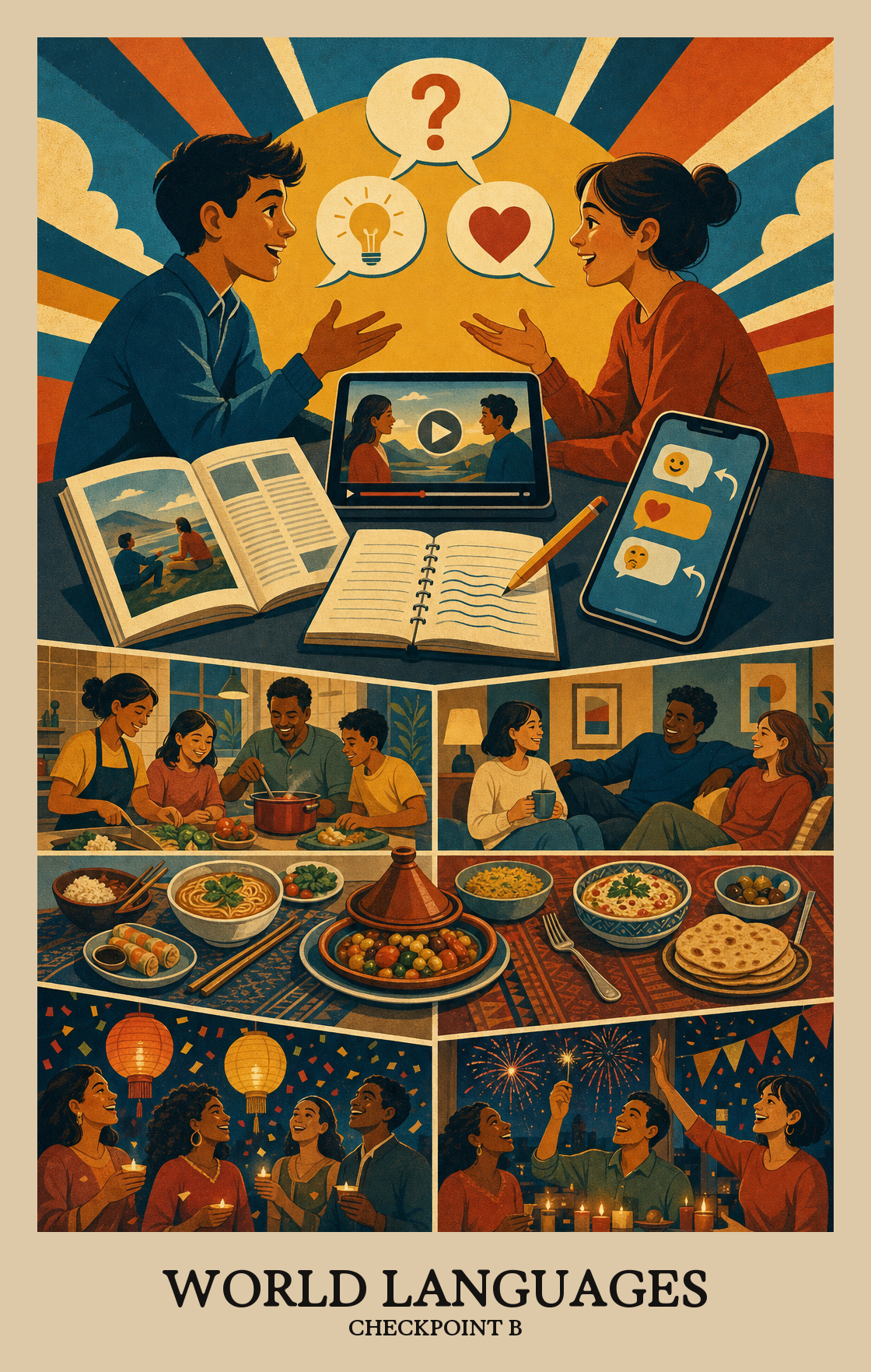
Students start the year holding short conversations about themselves, their families, and their routines. They ask and answer questions, swap opinions, and keep a chat going past a single sentence.
Students work through stories, short articles, videos, and audio clips in the new language. They pull out the main idea, catch important details, and figure out new words from context.
Students dig into how people in the cultures they study eat, celebrate, work, and spend time together. They compare those habits with their own and explain why the differences make sense.
Students give short talks, record videos, and write paragraphs to inform, persuade, or tell a story. They adjust their tone for the audience and use the language they have built up all year.
Students use the language outside the classroom through pen pals, community events, online sources, or research for other subjects. They set personal goals and track how their skills are growing.
Students listen to, read, or watch material in the language they are learning and work out the meaning on their own. At this level, they handle a wider range of topics and explain what the speaker or writer actually meant.
Students hold back-and-forth conversations in another language, asking questions, sharing opinions, and adjusting what they say until both people understand each other.
Students prepare and deliver presentations in the world language they're studying, choosing words and style to fit the audience, whether speaking, writing, or creating media.
| Standard | Definition | Code |
|---|---|---|
| Learners understand, interpret Checkpoint B | Students listen to, read, or watch material in the language they are learning and work out the meaning on their own. At this level, they handle a wider range of topics and explain what the speaker or writer actually meant. | DE-WL.1.1.wl-checkpoint-b |
| Learners interact and negotiate meaning in spoken, signed Checkpoint B | Students hold back-and-forth conversations in another language, asking questions, sharing opinions, and adjusting what they say until both people understand each other. | DE-WL.1.2.wl-checkpoint-b |
| Learners present information, concepts Checkpoint B | Students prepare and deliver presentations in the world language they're studying, choosing words and style to fit the audience, whether speaking, writing, or creating media. | DE-WL.1.3.wl-checkpoint-b |
Students investigate why people in another culture do what they do, then explain in the target language how those habits and customs connect to the values behind them.
Students explain how everyday objects, foods, art, or traditions from a culture connect to the values and beliefs behind them, using the language they are studying to do it.
| Standard | Definition | Code |
|---|---|---|
| Learners use the language to investigate, explain Checkpoint B | Students investigate why people in another culture do what they do, then explain in the target language how those habits and customs connect to the values behind them. | DE-WL.2.1.wl-checkpoint-b |
| Learners use the language to investigate, explain Checkpoint B | Students explain how everyday objects, foods, art, or traditions from a culture connect to the values and beliefs behind them, using the language they are studying to do it. | DE-WL.2.2.wl-checkpoint-b |
Students use the language they're learning to think through real problems and ideas from other subjects, like history, science, or math. The second language becomes a tool for thinking, not just a subject on its own.
Students read, listen to, or watch real content in another language, then judge whether the information or viewpoint is reliable or useful. This builds the habit of seeing the world through more than one cultural lens.
| Standard | Definition | Code |
|---|---|---|
| Learners build, reinforce Checkpoint B | Students use the language they're learning to think through real problems and ideas from other subjects, like history, science, or math. The second language becomes a tool for thinking, not just a subject on its own. | DE-WL.3.1.wl-checkpoint-b |
| Learners access and evaluate information and diverse perspectives that are… Checkpoint B | Students read, listen to, or watch real content in another language, then judge whether the information or viewpoint is reliable or useful. This builds the habit of seeing the world through more than one cultural lens. | DE-WL.3.2.wl-checkpoint-b |
Students notice how the language they're learning works differently from their own. They compare grammar, words, or sounds to explain what's similar, what's different, and what that reveals about how language itself works.
Students look at everyday life in another culture (meals, greetings, celebrations) and compare what they find to their own culture. Then they put what they noticed into words in the language they are learning.
| Standard | Definition | Code |
|---|---|---|
| Learners use the language to investigate, explain Checkpoint B | Students notice how the language they're learning works differently from their own. They compare grammar, words, or sounds to explain what's similar, what's different, and what that reveals about how language itself works. | DE-WL.4.1.wl-checkpoint-b |
| Learners use the language to investigate, explain Checkpoint B | Students look at everyday life in another culture (meals, greetings, celebrations) and compare what they find to their own culture. Then they put what they noticed into words in the language they are learning. | DE-WL.4.2.wl-checkpoint-b |
Students use the language they're learning to talk, work, and connect with people outside of class, from neighbors to people in other countries.
Students pick a goal for using the language outside class, then look back at how far they've come. That might mean tracking progress with a song, a show, or a conversation they couldn't have had before.
| Standard | Definition | Code |
|---|---|---|
| Learners use the language both within and beyond the classroom to interact and… Checkpoint B | Students use the language they're learning to talk, work, and connect with people outside of class, from neighbors to people in other countries. | DE-WL.5.1.wl-checkpoint-b |
| Learners set goals and reflect on their progress in using languages for… Checkpoint B | Students pick a goal for using the language outside class, then look back at how far they've come. That might mean tracking progress with a song, a show, or a conversation they couldn't have had before. | DE-WL.5.2.wl-checkpoint-b |
Students move from short memorized phrases to holding real conversations about familiar topics like family, school, food, travel, and weekend plans. They read short stories and articles, write paragraphs, and give short talks. The goal is using the language, not just knowing about it.
Ask students to teach a few new words at dinner or label things around the house. Watch a show or listen to music in the language together with subtitles on. Even ten minutes a day of hearing and using the language matters more than long study sessions.
Yes. Real speakers talk fast and use slang. Students at this stage catch the gist, not every word, and that is the right goal. Steady exposure to songs, short videos, and podcasts builds the ear over time.
Build outward from the student. Start with self, family, and daily routines, then move to school and community, then to travel, food, and current events in the cultures studied. Recycle vocabulary and grammar in each new unit so students keep using what they learned earlier.
Past tense forms, gendered nouns, and question-asking tend to slide between units. Build a short warm-up routine that revisits these every week instead of teaching them once and moving on. Mixing old structures into new topics keeps them alive.
Lean toward use. Students learn grammar faster when they need it to say something they care about. A short grammar focus tied to a speaking or writing task usually sticks better than a full grammar lesson with isolated drills.
Short, frequent practice beats long cram sessions. Ten new words a few times a week, used in real sentences, holds better than fifty words crammed before a quiz. Flashcard apps help, but talking and writing with the words is what makes them stick.
Language and culture are tied together. Knowing how people greet each other, eat, celebrate, or disagree helps students understand what words actually mean in context. Culture work also gives shy students something concrete to talk and write about.
By the end of the year, students should hold a short conversation on familiar topics, read a simple article and explain it, and write a paragraph with some past and future references. Pronunciation will not be perfect, but a patient native speaker should understand them.
Suggest one habit and stick with it: a podcast on the bus, a show with subtitles, a pen pal app, or a weekly chat with a relative or neighbor who speaks the language. The students who keep growing are the ones who use the language for something they already enjoy.