Coming up with musical ideas
Students start the year by writing their own short musical ideas. They try out melodies and rhythms, then pick the ones worth keeping and explain why those choices fit the mood they want.
This is the year music shifts from playing the notes to making real choices as a musician. Students plan their own pieces, then revise them based on feedback before performing. They learn to explain why a song sounds the way it does and how it connects to the time and place it came from. By spring, students can perform a piece they helped shape and talk about the choices behind it.
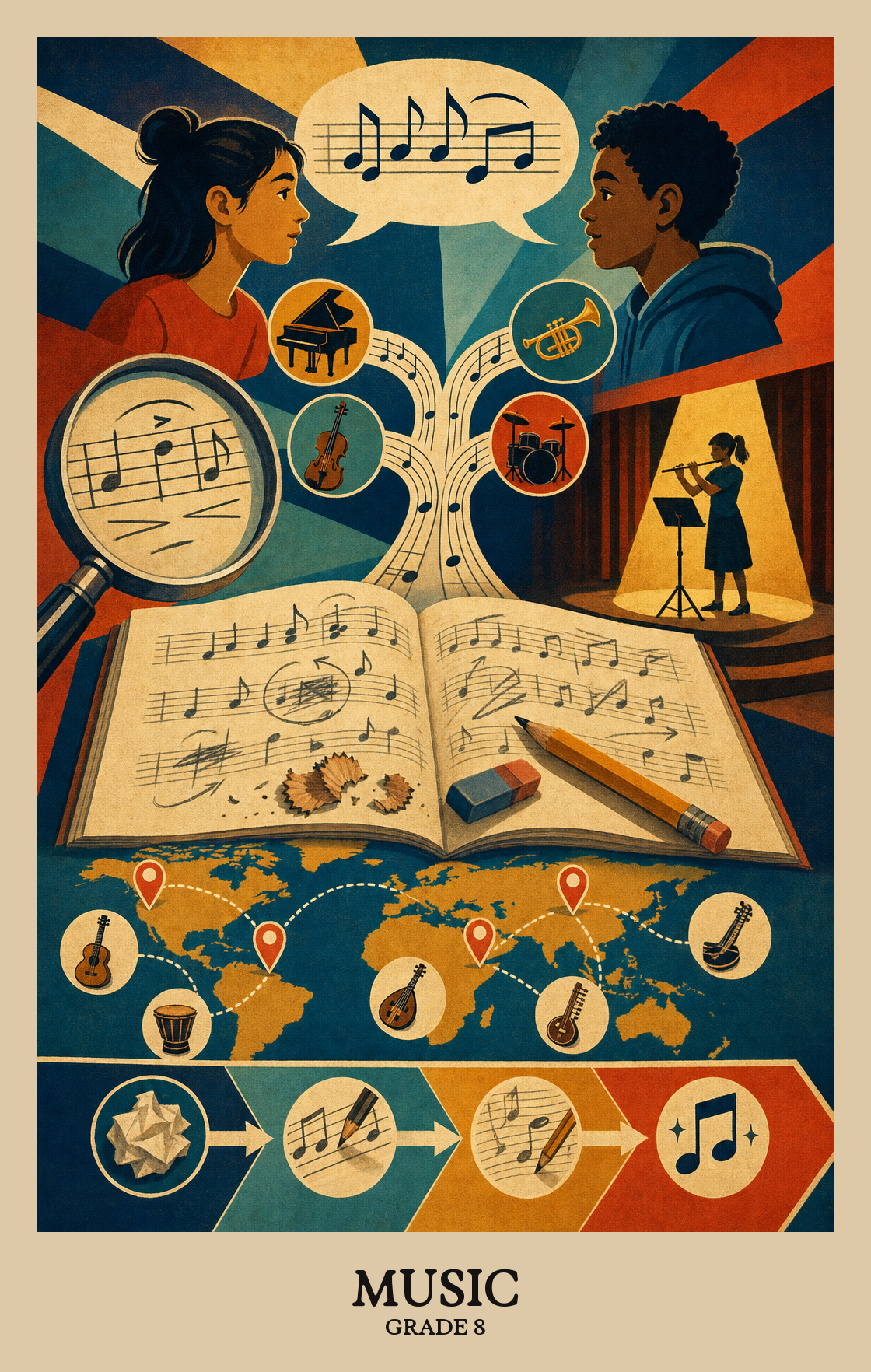
Students start the year by writing their own short musical ideas. They try out melodies and rhythms, then pick the ones worth keeping and explain why those choices fit the mood they want.
Students take a rough idea and build it into a real piece. They organize sections, revise weak spots, and keep working until the music holds together from beginning to end.
Students choose music to perform and work on the parts that need the most practice. They focus on tone, timing, and expression so the performance carries the meaning they want listeners to hear.
Students listen closely to music from different times and places. They describe what they hear, figure out what the composer or performer was going for, and back up their opinions with specific reasons.
Students connect music to history, culture, and their own lives. They look at how a song fits its time and place, and how their own experiences shape the music they make and the music they like.
Students connect what they already know and have lived through to the music they create or perform. Personal experience shapes the choices they make in their work.
Students look at a piece of music alongside the time period and culture it came from, then explain how that context changes what the music means.
| Standard | Definition | Code |
|---|---|---|
| Synthesize and relate knowledge and personal experiences to make art | Students connect what they already know and have lived through to the music they create or perform. Personal experience shapes the choices they make in their work. | MU:Cn10.8 |
| Relate artistic ideas and works with societal, cultural | Students look at a piece of music alongside the time period and culture it came from, then explain how that context changes what the music means. | MU:Cn11.8 |
Students brainstorm musical ideas and shape them into a piece they're working to create. That might mean experimenting with melody, rhythm, or song structure to find what works.
Students take a musical idea they've started and shape it into something more complete, deciding how the parts fit together and refining the work until it holds up as a whole piece.
Students review their own compositions, revise what isn't working, and bring a piece to a finished state they're ready to share.
| Standard | Definition | Code |
|---|---|---|
| Generate and conceptualize artistic ideas and work | Students brainstorm musical ideas and shape them into a piece they're working to create. That might mean experimenting with melody, rhythm, or song structure to find what works. | MU:Cr1.8 |
| Organize and develop artistic ideas and work | Students take a musical idea they've started and shape it into something more complete, deciding how the parts fit together and refining the work until it holds up as a whole piece. | MU:Cr2.8 |
| Refine and complete artistic work | Students review their own compositions, revise what isn't working, and bring a piece to a finished state they're ready to share. | MU:Cr3.8 |
Students choose a piece of music to perform and explain why it suits the occasion, the audience, and their own skill level.
Students rehearse and improve a piece of music before performing it, adjusting technique, timing, or tone until the work is ready to share with an audience.
Students perform a piece of music with clear intention, making choices about dynamics, tempo, and expression so the audience feels what the music is meant to communicate.
| Standard | Definition | Code |
|---|---|---|
| Analyze, interpret, and select artistic work for presentation | Students choose a piece of music to perform and explain why it suits the occasion, the audience, and their own skill level. | MU:Pr4.8 |
| Develop and refine artistic techniques and work for presentation | Students rehearse and improve a piece of music before performing it, adjusting technique, timing, or tone until the work is ready to share with an audience. | MU:Pr5.8 |
| Convey meaning through the presentation of artistic work | Students perform a piece of music with clear intention, making choices about dynamics, tempo, and expression so the audience feels what the music is meant to communicate. | MU:Pr6.8 |
Students listen to a piece of music and break down what they hear, noticing how melody, rhythm, or structure shape the overall effect.
Students explain what a piece of music means and what the composer or performer was trying to express, using specific details from the music itself to support their thinking.
Students choose a piece of music and judge its quality using a clear set of criteria, explaining what works, what doesn't, and why.
| Standard | Definition | Code |
|---|---|---|
| Perceive and analyze artistic work | Students listen to a piece of music and break down what they hear, noticing how melody, rhythm, or structure shape the overall effect. | MU:Re7.8 |
| Interpret intent and meaning in artistic work | Students explain what a piece of music means and what the composer or performer was trying to express, using specific details from the music itself to support their thinking. | MU:Re8.8 |
| Apply criteria to evaluate artistic work | Students choose a piece of music and judge its quality using a clear set of criteria, explaining what works, what doesn't, and why. | MU:Re9.8 |
Students create their own short pieces, rehearse and perform music for an audience, and listen to a wide range of songs to talk about how they work. They also connect music to history, culture, and their own lives. Expect a mix of playing, singing, writing, and discussing.
Listen to songs together and ask simple questions like what mood it creates, what instruments stand out, or how the ending differs from the start. Five minutes of curious conversation about a favorite song builds the same listening skills used in class. Background noise does not count, so put it on and actually pay attention.
Most teachers anchor the year in two or three performance pieces and weave creating and responding around them. Use early units to set listening vocabulary and revision habits, then layer in original composition once students can analyze a model. Save the biggest creative project for after winter break, when routines are solid.
No. Singing, clapping rhythms, using classroom instruments, and working with simple music apps all count. What matters is that students can make musical choices, explain them, and improve a piece after feedback.
Refining and revising a piece is the hardest part. Students will draft something and call it done, so they need repeated practice with using feedback to make a second and third version. Applying criteria to evaluate music, rather than just saying they liked it, also takes steady work all year.
Students should be able to create a short original piece, rehearse and perform a song with care, and explain why a piece of music works using musical reasons. They should also be able to connect a song to its time period, culture, or personal meaning.
Look for students who can take a draft through real revision, give feedback grounded in musical criteria rather than taste, and rehearse with a goal in mind. They should also be able to write or speak about a piece using specific evidence from what they heard.
Ask what choices the performer made and why those choices fit the song. Questions about tempo, volume, mood, and the story the music tells push students past liked it or didn't like it. Ten minutes in the car works well for this.
Pair each major listening or performance unit with a short context piece: where the music came from, who made it, and why it mattered to them. Keep the context tied to a specific piece students are actually working with, not a separate history lecture. This is where personal connection and analysis come together.