Building movement ideas
Students start the year exploring where dance ideas come from. They pull from their own experiences, music, and images to come up with movement they can shape into something bigger later.
This is the year dance shifts from learning steps to shaping ideas. Students draw on their own experiences and on history to build short dances with real meaning. They sharpen technique, rehearse with purpose, and make choices about what an audience should feel. By spring, students can perform a piece they helped create and explain why it moves the way it does.
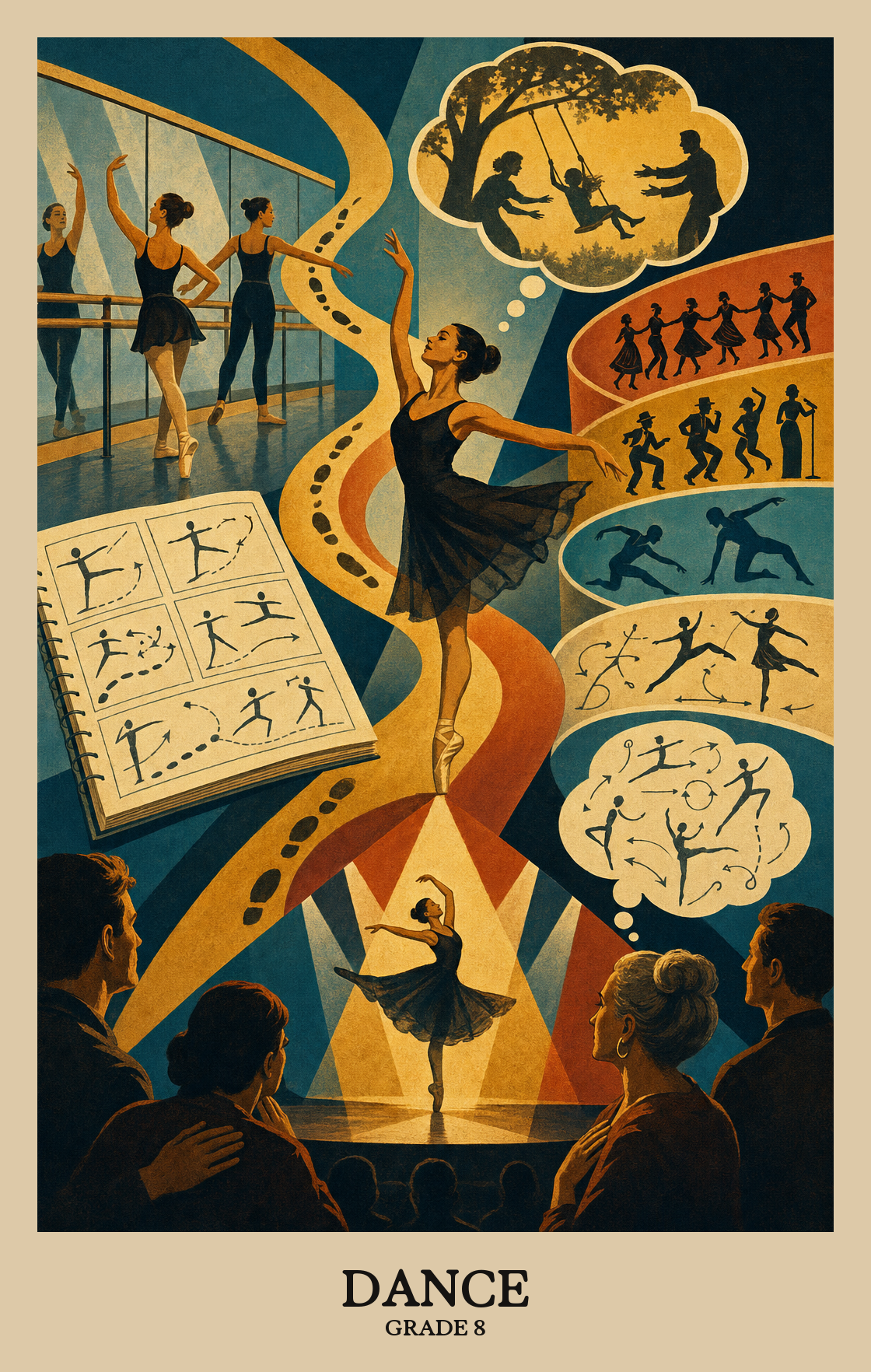
Students start the year exploring where dance ideas come from. They pull from their own experiences, music, and images to come up with movement they can shape into something bigger later.
Students take their raw ideas and organize them into real dance pieces. They work on structure, timing, and choices that make a dance hold together instead of feeling random.
The focus shifts to how students actually move. They work on control, balance, and clean execution so the dance they perform matches what they pictured in their head.
Students rehearse and present pieces for an audience. They think about what they want the audience to feel and make performance choices that get that message across.
Students learn to watch dance with a critical eye. They describe what they see, figure out what the choreographer might have meant, and use clear reasons to judge whether a piece works.
Students connect dance to history, culture, and the world around them. They look at how dances from different times and places carry meaning and how their own work fits into a larger story.
Students connect what they know from other subjects and their own life experiences to the choices they make when creating a dance.
Students look at a dance piece and explain how it connects to the time, place, or culture it came from. Understanding where a dance comes from changes how you see it.
| Standard | Definition | Code |
|---|---|---|
| Synthesize and relate knowledge and personal experiences to make art | Students connect what they know from other subjects and their own life experiences to the choices they make when creating a dance. | DA:Cn10.8 |
| Relate artistic ideas and works with societal, cultural | Students look at a dance piece and explain how it connects to the time, place, or culture it came from. Understanding where a dance comes from changes how you see it. | DA:Cn11.8 |
Students brainstorm and develop original ideas for a dance, deciding what movement, theme, or emotion the piece will explore before choreography begins.
Students refine their dance ideas by experimenting with movement, then shape those ideas into a structured piece that reflects clear artistic choices.
Students revisit a dance they've been building, fix what isn't working, and bring the piece to a finished, polished form.
| Standard | Definition | Code |
|---|---|---|
| Generate and conceptualize artistic ideas and work | Students brainstorm and develop original ideas for a dance, deciding what movement, theme, or emotion the piece will explore before choreography begins. | DA:Cr1.8 |
| Organize and develop artistic ideas and work | Students refine their dance ideas by experimenting with movement, then shape those ideas into a structured piece that reflects clear artistic choices. | DA:Cr2.8 |
| Refine and complete artistic work | Students revisit a dance they've been building, fix what isn't working, and bring the piece to a finished, polished form. | DA:Cr3.8 |
Students choose dances to perform and explain why each piece suits the audience, the setting, or the story they want to tell.
Students practice and improve their dance performance until it is ready to show an audience. That means fixing technique, sharpening timing, and making deliberate choices about how the piece looks and feels.
Students perform a dance they've shaped with intention, making choices about movement, timing, and space so that what they present actually communicates something to an audience.
| Standard | Definition | Code |
|---|---|---|
| Analyze, interpret, and select artistic work for presentation | Students choose dances to perform and explain why each piece suits the audience, the setting, or the story they want to tell. | DA:Pr4.8 |
| Develop and refine artistic techniques and work for presentation | Students practice and improve their dance performance until it is ready to show an audience. That means fixing technique, sharpening timing, and making deliberate choices about how the piece looks and feels. | DA:Pr5.8 |
| Convey meaning through the presentation of artistic work | Students perform a dance they've shaped with intention, making choices about movement, timing, and space so that what they present actually communicates something to an audience. | DA:Pr6.8 |
Students watch a dance performance and break down what they see: how the choreographer uses movement, timing, and space to build meaning. The goal is to go beyond "I liked it" and explain how the piece actually works.
Students explain what a dance means and what the choreographer was trying to say. They look at movement choices, such as pace or gesture, and describe the idea or feeling those choices express.
Students watch a dance and judge it using a set of criteria, explaining in specific terms why a choice works or falls short.
| Standard | Definition | Code |
|---|---|---|
| Perceive and analyze artistic work | Students watch a dance performance and break down what they see: how the choreographer uses movement, timing, and space to build meaning. The goal is to go beyond "I liked it" and explain how the piece actually works. | DA:Re7.8 |
| Interpret intent and meaning in artistic work | Students explain what a dance means and what the choreographer was trying to say. They look at movement choices, such as pace or gesture, and describe the idea or feeling those choices express. | DA:Re8.8 |
| Apply criteria to evaluate artistic work | Students watch a dance and judge it using a set of criteria, explaining in specific terms why a choice works or falls short. | DA:Re9.8 |
Students create short dance pieces, rehearse them, perform for an audience, and watch other dancers with a critical eye. They also connect dance to history and culture, looking at where movement styles come from and what they mean.
Give students space to move and time to play music they like. Ask them to make up a short dance about a memory, a feeling, or a story, then show it to you. Watching dance together on video and talking about what stood out also counts as practice.
No. The focus is on making and refining short movement pieces, not on prior training. Curiosity and willingness to try matter more than technique, and skills build quickly with regular class time.
A common arc starts with generating movement ideas, moves into shaping and refining short pieces, then builds toward performance and reflection. Save cultural and historical context for moments when it deepens a piece students are already working on, so the connection feels earned.
Refining work is the hardest part. Students often want to call a first draft finished, so plan repeated cycles of perform, get feedback, revise. Building shared language for giving and using feedback pays off all year.
Ask what they noticed first, what the dancers seemed to be feeling, and which moment stuck with them. Push past good or bad and into specific choices, like a sudden stop or a repeated shape. That kind of talk is exactly what students practice in class.
By the end of the year, students should be able to take an idea, shape it into a short dance with intention, rehearse it, and perform it for others. They should also be able to give specific feedback on a peer's piece using shared criteria.
Usually no. Comfortable clothes that allow full movement and bare feet or socks are standard. Check with the teacher before buying anything specific.