Finding ideas worth making
Students start the year by gathering ideas from their own lives, things they notice, and art they have seen. They keep a sketchbook and learn that good art usually starts with a lot of small starts.
This is the year art class shifts from following directions to making real choices. Students start with their own ideas, sketch out a plan, and improve the work before calling it done. They also learn to talk about art, explaining what a piece means and why it works. By spring, students can finish a personal art project and explain the choices they made along the way.
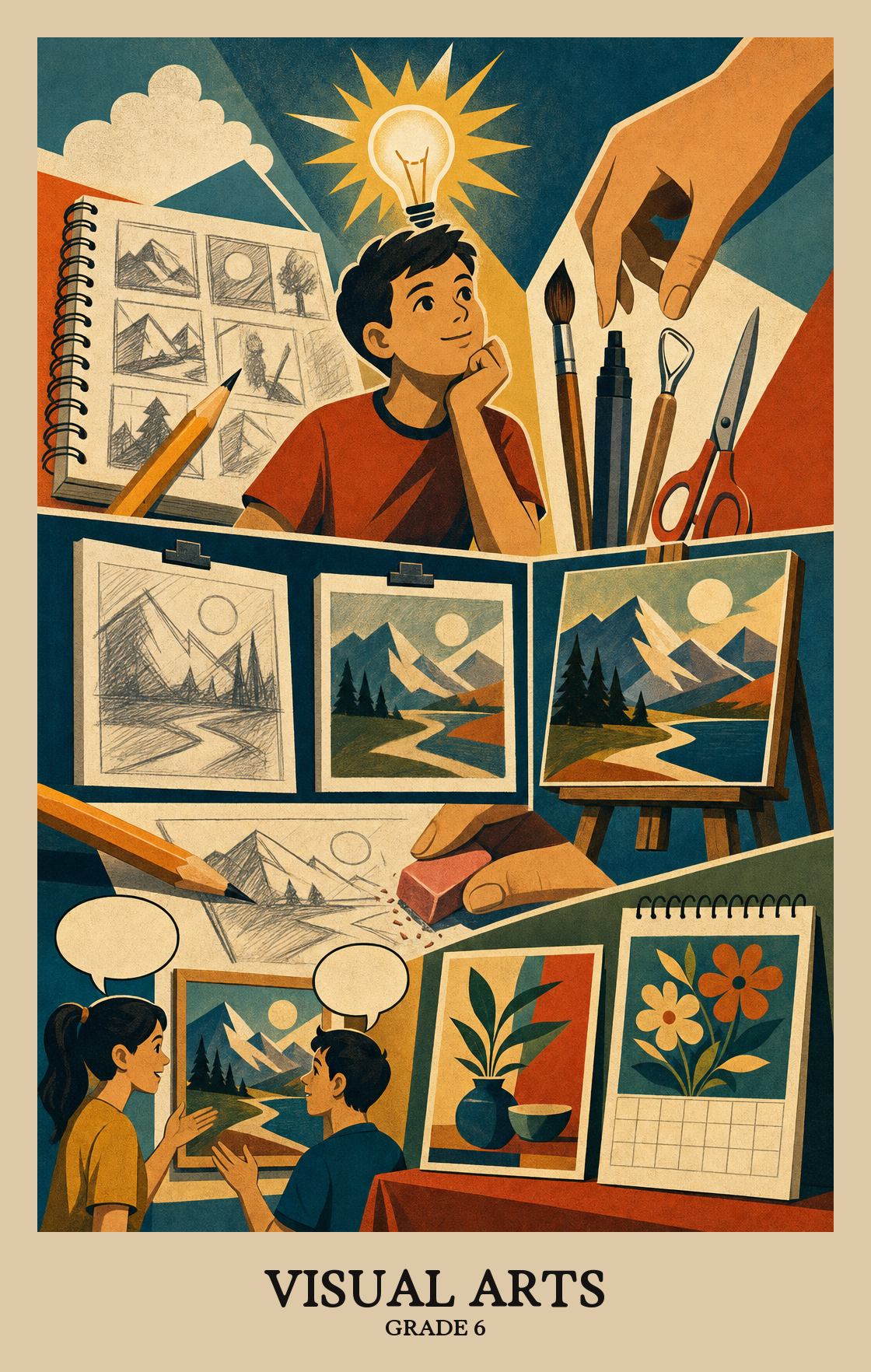
Students start the year by gathering ideas from their own lives, things they notice, and art they have seen. They keep a sketchbook and learn that good art usually starts with a lot of small starts.
Students practice with materials like pencil, paint, clay, and digital tools. They learn how to plan a piece, try a few versions, and pick the approach that works best before committing.
Students slow down and study artwork from different times and places. They talk about what they see, what the artist might have meant, and how the time and place around the artist shaped the piece.
Students take a piece from rough draft to finished work. They revise based on feedback, fix what is not working, and use a clear set of criteria to judge whether the piece is ready.
Students choose pieces to display and think about how presentation changes meaning. They decide what to share, how to arrange it, and what they want a viewer to take away.
Students pull from what they know and what they've lived through to make creative choices in their artwork. Personal experience becomes part of the work itself.
Students look at a piece of art and ask where it came from: what was happening in the world, who made it, and why. That context changes what the work means.
| Standard | Definition | Code |
|---|---|---|
| Synthesize and relate knowledge and personal experiences to make art | Students pull from what they know and what they've lived through to make creative choices in their artwork. Personal experience becomes part of the work itself. | VA:Cn10.6 |
| Relate artistic ideas and works with societal, cultural | Students look at a piece of art and ask where it came from: what was happening in the world, who made it, and why. That context changes what the work means. | VA:Cn11.6 |
Students brainstorm and develop original ideas before starting an art project, sketching out concepts and thinking through choices about subject, materials, and composition.
Students take a rough idea and work it into a finished piece, making decisions about composition, materials, and visual choices along the way.
Students review their own artwork, make deliberate changes, and bring a piece to a finished state. The focus is on decision-making: what to keep, what to fix, and when the work is done.
| Standard | Definition | Code |
|---|---|---|
| Generate and conceptualize artistic ideas and work | Students brainstorm and develop original ideas before starting an art project, sketching out concepts and thinking through choices about subject, materials, and composition. | VA:Cr1.6 |
| Organize and develop artistic ideas and work | Students take a rough idea and work it into a finished piece, making decisions about composition, materials, and visual choices along the way. | VA:Cr2.6 |
| Refine and complete artistic work | Students review their own artwork, make deliberate changes, and bring a piece to a finished state. The focus is on decision-making: what to keep, what to fix, and when the work is done. | VA:Cr3.6 |
Students look at several pieces of their own artwork, decide which ones are strong enough to show others, and explain why those pieces belong in a presentation or display.
Students practice and revise their artwork before it goes on display, making deliberate choices about how the finished piece will look to an audience.
Students choose how to display or share their artwork so the viewer understands what the piece is about. The presentation itself becomes part of the meaning.
| Standard | Definition | Code |
|---|---|---|
| Analyze, interpret, and select artistic work for presentation | Students look at several pieces of their own artwork, decide which ones are strong enough to show others, and explain why those pieces belong in a presentation or display. | VA:Pr4.6 |
| Develop and refine artistic techniques and work for presentation | Students practice and revise their artwork before it goes on display, making deliberate choices about how the finished piece will look to an audience. | VA:Pr5.6 |
| Convey meaning through the presentation of artistic work | Students choose how to display or share their artwork so the viewer understands what the piece is about. The presentation itself becomes part of the meaning. | VA:Pr6.6 |
Students look closely at a piece of art and describe what they notice, then explain how the artist's choices, like color, line, or composition, shape what the work means or how it feels.
Students look at a piece of art and explain what they think the artist was trying to say, using details from the work itself to back up their thinking.
Students look at a piece of art and judge it using a specific set of criteria, explaining why it works or falls short based on those reasons rather than just personal taste.
| Standard | Definition | Code |
|---|---|---|
| Perceive and analyze artistic work | Students look closely at a piece of art and describe what they notice, then explain how the artist's choices, like color, line, or composition, shape what the work means or how it feels. | VA:Re7.6 |
| Interpret intent and meaning in artistic work | Students look at a piece of art and explain what they think the artist was trying to say, using details from the work itself to back up their thinking. | VA:Re8.6 |
| Apply criteria to evaluate artistic work | Students look at a piece of art and judge it using a specific set of criteria, explaining why it works or falls short based on those reasons rather than just personal taste. | VA:Re9.6 |
Students make art on purpose. They come up with their own ideas, plan them, and finish the work instead of stopping at a rough sketch. They also look closely at art made by other people and talk about what it means.
Skill matters less than finishing. Keep a cheap sketchbook on the kitchen table and ask for one drawing a week, no grade attached. Ask what they were trying to show, not whether it looks real.
Younger students mostly follow a project the teacher sets up. Sixth graders are expected to start the idea themselves, change it as they work, and explain why they made the choices they did.
Front-load idea generation and sketchbook habits in the first quarter. Spend the middle of the year on technique with shorter projects. Save longer, student-driven pieces for the back half, when students can plan and revise without stalling out.
Revision. Students at this age often want to call a piece done the moment it looks okay. Plan extra time around refining work and giving feedback before a project is presented.
Drawing from life beats copying from a screen. Have them sketch a shoe, a houseplant, or the dog for ten minutes. Visiting a museum website and picking one piece to talk about over dinner also counts.
Look for a sketchbook with ideas that change over time, at least one finished piece they can explain, and the ability to say something specific about another artist's work beyond liking it or not.
Grade the process, not the picture. Use a short rubric that covers idea development, revision, craft, and how well students explain their choices. That keeps grading fair across very different finished pieces.
Connections matter this year. Tie at least a few projects to something students are reading about or living through, so they see art as a way people respond to their world, not just a craft activity.