Make-believe and pretend play
Students step into pretend play with their bodies and voices. They try on characters, act out simple stories, and get used to being someone else for a few minutes at a time.
This is the year pretend play becomes the first step into theatre. Students invent characters and short scenes drawn from their own lives and the stories they hear. They practice using their voice, face, and body to show how a character feels, then share that work with classmates. By spring, students can act out a simple story and talk about what a character was feeling and why.
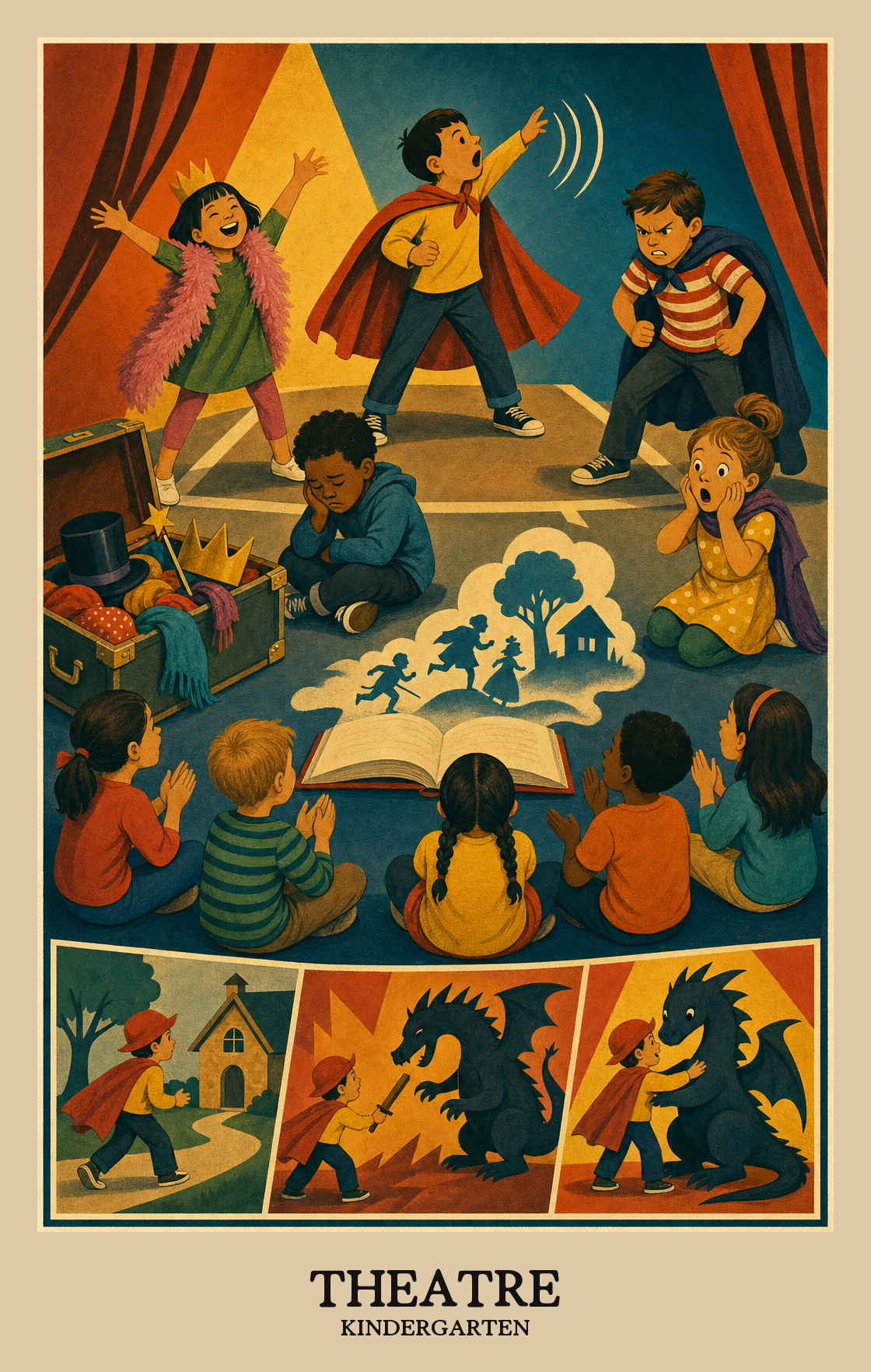
Students step into pretend play with their bodies and voices. They try on characters, act out simple stories, and get used to being someone else for a few minutes at a time.
Students start shaping their own short scenes. They come up with a who, a where, and a what happens, often pulling from books they know or moments from their own day.
Students become a thoughtful audience. They watch classmates perform and talk about what they saw, how a character felt, and what the story might mean.
Students rehearse a small piece and share it with the class or with families. They practice speaking clearly, taking a turn, and showing a feeling so the audience understands.
Students use things they know from everyday life, like a favorite place or a feeling, to make up characters and stories in pretend play.
Stories and plays come from real places and times. Students connect what happens in a play to their own life, family, or community to understand why stories matter.
| Standard | Definition | Code |
|---|---|---|
| Synthesize and relate knowledge and personal experiences to make art | Students use things they know from everyday life, like a favorite place or a feeling, to make up characters and stories in pretend play. | TH:Cn10.k |
| Relate artistic ideas and works with societal, cultural | Stories and plays come from real places and times. Students connect what happens in a play to their own life, family, or community to understand why stories matter. | TH:Cn11.k |
Students come up with ideas for a character or a short scene. They imagine who the character is, what the character wants, and what might happen next.
Students act out a story or idea by choosing what to say, where to move, and what to pretend. They put the pieces together to make a short scene or moment of play.
Students pick their favorite idea from a drama activity and practice it until it feels ready to share with the class.
| Standard | Definition | Code |
|---|---|---|
| Generate and conceptualize artistic ideas and work | Students come up with ideas for a character or a short scene. They imagine who the character is, what the character wants, and what might happen next. | TH:Cr1.k |
| Organize and develop artistic ideas and work | Students act out a story or idea by choosing what to say, where to move, and what to pretend. They put the pieces together to make a short scene or moment of play. | TH:Cr2.k |
| Refine and complete artistic work | Students pick their favorite idea from a drama activity and practice it until it feels ready to share with the class. | TH:Cr3.k |
Students choose which character or story to act out and explain why it feels right to perform.
Students practice how to speak, move, and show feelings onstage so a performance gets better with each try.
Students use movement, voice, and expression to share a story or feeling with an audience. The performance itself is how they communicate meaning.
| Standard | Definition | Code |
|---|---|---|
| Analyze, interpret, and select artistic work for presentation | Students choose which character or story to act out and explain why it feels right to perform. | TH:Pr4.k |
| Develop and refine artistic techniques and work for presentation | Students practice how to speak, move, and show feelings onstage so a performance gets better with each try. | TH:Pr5.k |
| Convey meaning through the presentation of artistic work | Students use movement, voice, and expression to share a story or feeling with an audience. The performance itself is how they communicate meaning. | TH:Pr6.k |
Students look at a short performance or puppet show and say what they noticed, like a character's movement or a surprising moment in the story.
Students look at a short play or puppet show and explain what they think it means or how it makes them feel.
Students look at a scene or performance and say what they liked, what worked, and why. They practice having a reason for their opinion, not just a feeling.
| Standard | Definition | Code |
|---|---|---|
| Perceive and analyze artistic work | Students look at a short performance or puppet show and say what they noticed, like a character's movement or a surprising moment in the story. | TH:Re7.k |
| Interpret intent and meaning in artistic work | Students look at a short play or puppet show and explain what they think it means or how it makes them feel. | TH:Re8.k |
| Apply criteria to evaluate artistic work | Students look at a scene or performance and say what they liked, what worked, and why. They practice having a reason for their opinion, not just a feeling. | TH:Re9.k |
Most of the work is pretend play with a purpose. Students act out short stories, pretend to be animals or characters, use their voices and bodies to show feelings, and watch each other perform. There are no scripts to memorize at this age.
Play pretend together. Act out a favorite picture book, take turns being different characters, or use stuffed animals as puppets. Ten minutes of make-believe after a bedtime story builds the same skills practiced in class.
No. At this age the focus is on imagining, trying out characters, and showing feelings through voice and movement. Any sharing is short and informal, often just for classmates.
Start with imagination and body awareness games, then move into character work using familiar stories. By spring, students can plan a short scene with a partner, perform it for the class, and talk about what worked.
Students can take on a character, use their voice and body to show who that character is, and stay in the scene for a short stretch. They can also watch a classmate perform and say one thing they noticed.
Start with puppets or stuffed animals so the puppet does the talking, not the student. Acting out a story behind a couch or under a blanket fort also lowers the pressure. Confidence builds with repetition, not with pushing.
Pick stories from a range of cultures and let students act them out. Ask simple questions afterward, like who the characters were and how they felt. The connection happens through the playing, not through explanation.
Watch for a child who can pretend to be someone else for a few minutes, follow a simple story from start to finish, and say something they liked about another student's pretend play. That readiness shows up most clearly during free play at home.