Exploring sound and voice
Students start the year by listening closely to music and noticing loud and quiet, fast and slow. They use their singing voices, speaking voices, and simple instruments to make sounds on purpose.
This is the year music shifts from background noise to something students can make on purpose. Students explore how their voices, bodies, and simple instruments create different sounds, and they start matching a sound to a feeling or idea. They also listen to songs and share what they notice. By spring, they can sing a short song, keep a steady beat, and tell a parent what a piece of music made them think about.
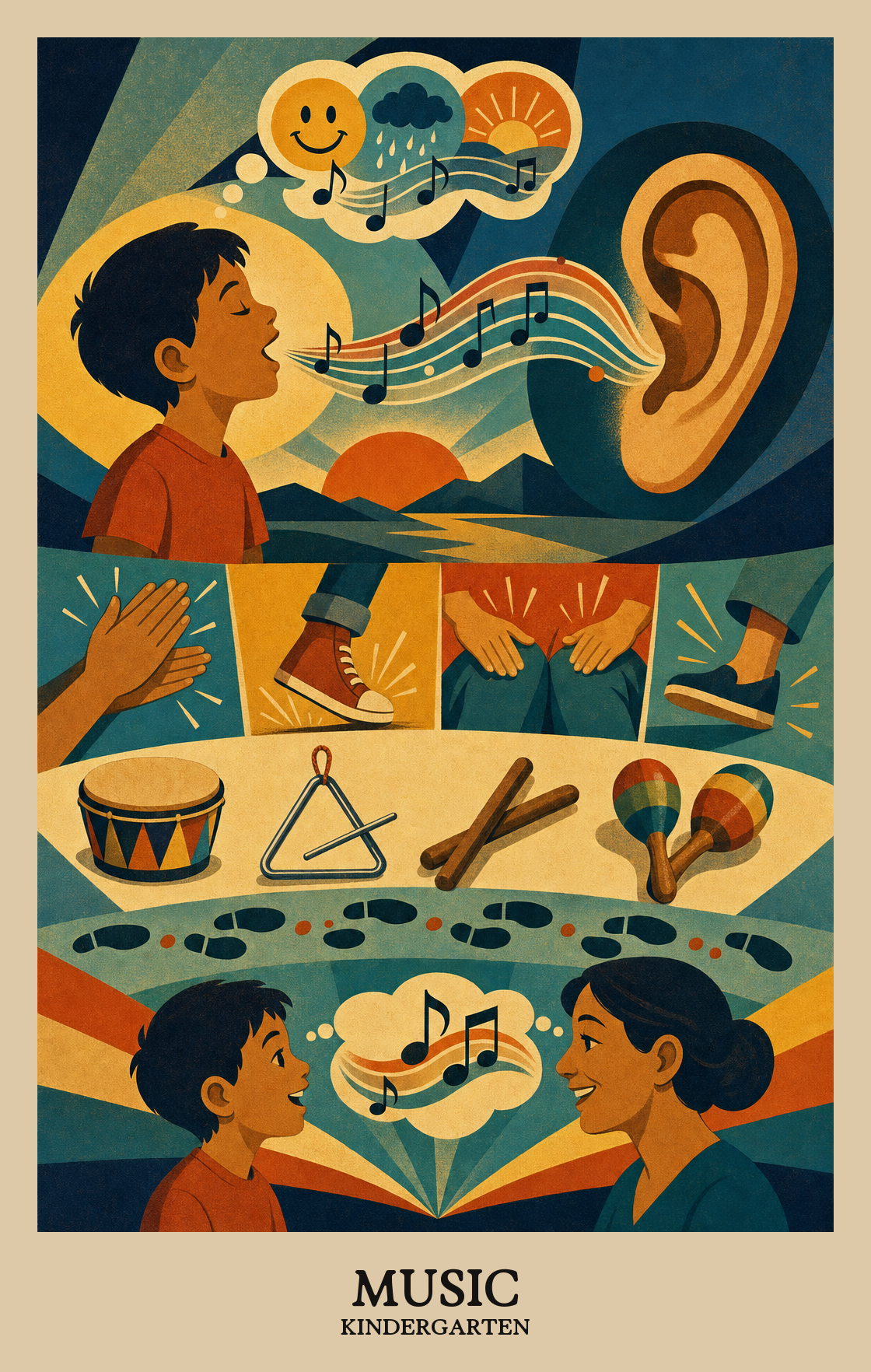
Students start the year by listening closely to music and noticing loud and quiet, fast and slow. They use their singing voices, speaking voices, and simple instruments to make sounds on purpose.
Students invent short patterns of sound and rhythm. They might tap a steady beat, echo a clap, or make up a tune about something from their day.
Students practice a song or rhythm and perform it for the class. They learn what it feels like to get ready, start together, and finish together.
Students hear songs from different families, holidays, and places. They talk about what a piece of music reminds them of and what they liked or would change.
Students connect what they already know and what they've lived through to the music they make and the songs they sing.
Songs and musical ideas come from somewhere. Students begin to notice how music connects to the people, places, and times that created it.
| Standard | Definition | Code |
|---|---|---|
| Synthesize and relate knowledge and personal experiences to make art | Students connect what they already know and what they've lived through to the music they make and the songs they sing. | MU:Cn10.k |
| Relate artistic ideas and works with societal, cultural | Songs and musical ideas come from somewhere. Students begin to notice how music connects to the people, places, and times that created it. | MU:Cn11.k |
Students come up with their own musical ideas, like making up a simple rhythm or deciding what sounds to use in a song.
Students pick a simple song idea and decide how it should sound, choosing things like fast or slow, loud or soft. They shape their music before sharing it.
Students revisit a song or rhythm they made up and decide if it sounds the way they want. They practice until it feels finished and ready to share.
| Standard | Definition | Code |
|---|---|---|
| Generate and conceptualize artistic ideas and work | Students come up with their own musical ideas, like making up a simple rhythm or deciding what sounds to use in a song. | MU:Cr1.k |
| Organize and develop artistic ideas and work | Students pick a simple song idea and decide how it should sound, choosing things like fast or slow, loud or soft. They shape their music before sharing it. | MU:Cr2.k |
| Refine and complete artistic work | Students revisit a song or rhythm they made up and decide if it sounds the way they want. They practice until it feels finished and ready to share. | MU:Cr3.k |
Students choose a song or piece of music to perform and talk about why they picked it.
Students practice a song or rhythm until they can perform it clearly for others. The focus is on improving how they play, sing, or move before sharing with an audience.
Students perform a song or rhythm for others and put feeling into it. The goal is to make the audience feel something, not just hear the notes.
| Standard | Definition | Code |
|---|---|---|
| Analyze, interpret, and select artistic work for presentation | Students choose a song or piece of music to perform and talk about why they picked it. | MU:Pr4.k |
| Develop and refine artistic techniques and work for presentation | Students practice a song or rhythm until they can perform it clearly for others. The focus is on improving how they play, sing, or move before sharing with an audience. | MU:Pr5.k |
| Convey meaning through the presentation of artistic work | Students perform a song or rhythm for others and put feeling into it. The goal is to make the audience feel something, not just hear the notes. | MU:Pr6.k |
Students listen to a short piece of music and share what they notice, like whether it feels fast or slow, loud or quiet.
Students listen to a short piece of music and say what they think it feels like or what it makes them picture. There are no wrong answers.
Students listen to a song or piece of music and say what they like about it and why. They begin learning that opinions about music can be backed up with a reason.
| Standard | Definition | Code |
|---|---|---|
| Perceive and analyze artistic work | Students listen to a short piece of music and share what they notice, like whether it feels fast or slow, loud or quiet. | MU:Re7.k |
| Interpret intent and meaning in artistic work | Students listen to a short piece of music and say what they think it feels like or what it makes them picture. There are no wrong answers. | MU:Re8.k |
| Apply criteria to evaluate artistic work | Students listen to a song or piece of music and say what they like about it and why. They begin learning that opinions about music can be backed up with a reason. | MU:Re9.k |
Students sing songs, move to a steady beat, play simple instruments like shakers and drums, and listen to short pieces of music. They also make up their own sounds and rhythms and talk about what they hear. Most of the learning happens through play.
Sing together in the car, clap along to songs, and play music while cooking or cleaning. Ask which parts sound fast or slow, loud or quiet, happy or sad. Five minutes of singing or dancing a day does more than any worksheet.
Not yet. The focus is on listening, singing in tune, keeping a steady beat, and noticing high and low sounds. Reading notes on a staff comes in later grades once students can hear and feel the music first.
Start with steady beat, call-and-response songs, and exploring sound through voice and body. Move into high and low, loud and soft, and fast and slow as separate ideas. Save short performances and making up original sound patterns for later in the year, once students are comfortable singing as a group.
That is normal at this age. Let quiet students join through movement, playing an instrument, or singing softly in a group before asking for solos. Most warm up to performing once they trust the room.
By spring, students should keep a steady beat with a song, match pitch well enough to sing with the group, and tell the difference between fast and slow or loud and quiet. They should also be able to share an opinion about a piece of music using simple words.
Students sing songs from different places and times and talk about where the songs come from or when families might sing them. It can be as simple as a lullaby, a birthday song, or a holiday song. The goal is noticing that music belongs to people and events.