Skip to content

What does a student learn in ?

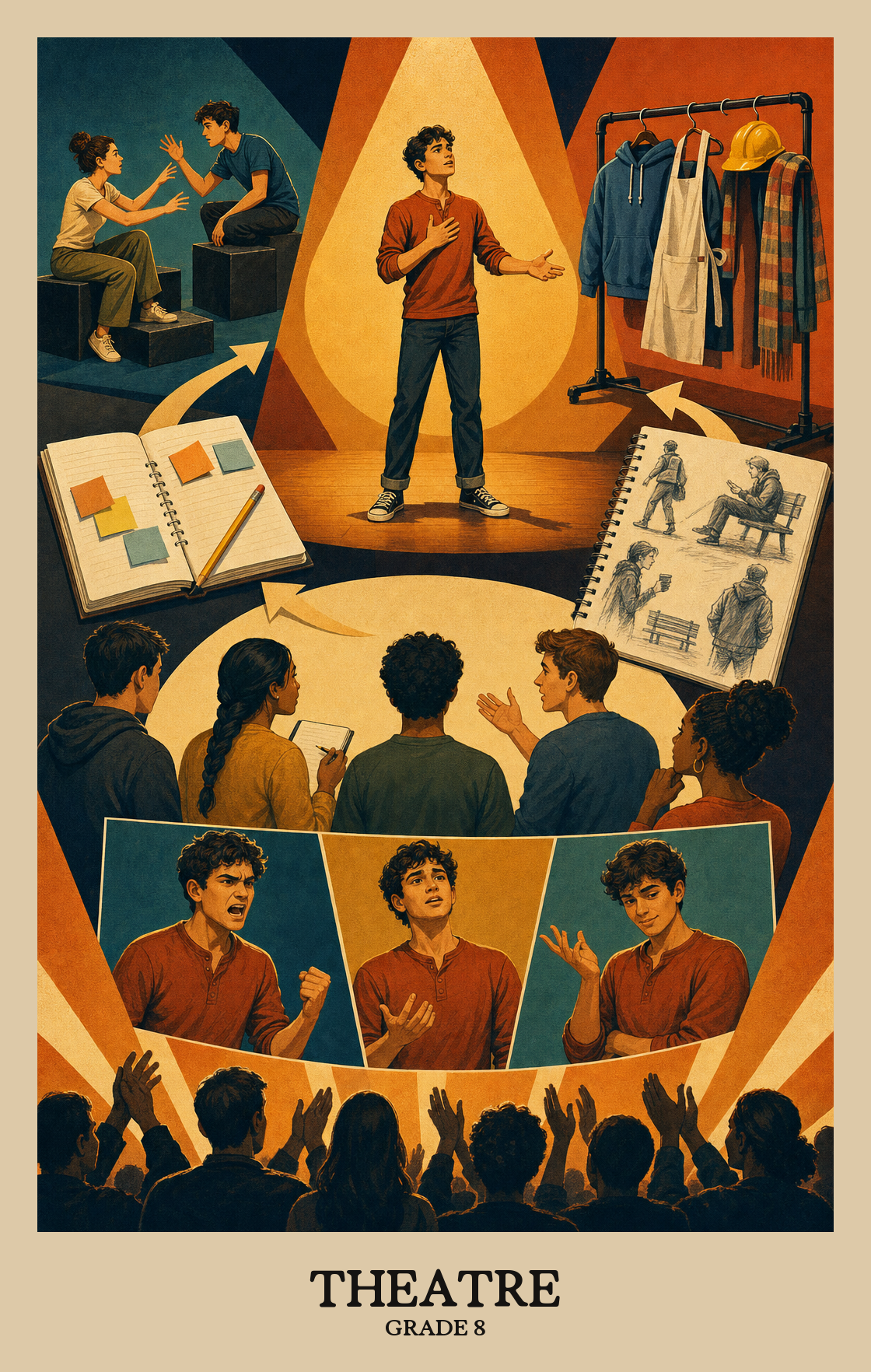
This is the year theatre work starts to carry real meaning. Students build characters and scenes from their own experiences and from what they notice in the world around them. They rehearse, take notes from others, and rework their choices to make a scene land. By spring, students can perform a polished scene and explain why they made the choices they did.

  • Character work
  • Scene building
  • Rehearsal and revision
  • Performing for an audience
  • Giving and using feedback
  • Theatre and culture
Source: Connecticut Connecticut Core Standards
Year at a glance
How the year usually goes. Every school and district set their own curriculum, so treat this as a guide, not official pacing.
  1. 1

    Finding ideas and building characters

    Students start the year by inventing characters and story ideas from their own lives and observations. They try out voices, imagine settings, and play with what a scene could be before anything gets written down.

  2. 2

    Shaping scenes and scripts

    Students organize their early ideas into actual scenes. They draft dialogue, decide what happens first and next, and rework rough pieces until a scene holds together and makes sense to an audience.

  3. 3

    Rehearsing and refining technique

    Students pick scenes to perform and practice the craft of acting. They work on voice, movement, and timing, and learn how small choices in rehearsal change what an audience sees and feels.

  4. 4

    Performing for an audience

    Students present finished work to classmates or families. They focus on conveying meaning, not just remembering lines, and pay attention to how the audience responds during the performance.

  5. 5

    Responding to theatre and its world

    Students watch plays and peer performances and learn to talk about them with real criteria. They connect what they see to history, culture, and their own experience, and explain what the work might mean.

Mastery Learning Standards
The required skills a student should display by the end of Grade 8.
Connecting
  • Synthesize and relate knowledge and personal experiences to make art

    Students connect their own memories and life experiences to the scenes and characters they create, using what they know to make their theatre work feel real and specific.

  • Relate artistic ideas and works with societal, cultural

    Students look at a play or performance and connect it to the time, place, or culture it came from. That context helps them understand why the story was told and what it meant to the people who first saw it.

Creating
  • Generate and conceptualize artistic ideas and work

    Students brainstorm original ideas for a scene or performance, then shape those ideas into a concrete plan for bringing a character or story to life.

  • Organize and develop artistic ideas and work

    Students take a scene idea from early notes or improvisation and shape it into a draft script or performance plan, making deliberate choices about character, dialogue, and staging.

  • Refine and complete artistic work

    Students revise a scene or script based on feedback, making specific changes until the piece is ready to share or perform.

Performing/Presenting/Producing
  • Analyze, interpret, and select artistic work for presentation

    Students pick a scene or monologue to perform and explain why it suits them, the audience, and the purpose of the presentation.

  • Develop and refine artistic techniques and work for presentation

    Students rehearse and improve a scene or performance before showing it to an audience, making specific choices about voice, movement, and timing to get the work ready.

  • Convey meaning through the presentation of artistic work

    Students perform a scene or character and make deliberate choices, from how they move to how they speak, so the audience understands what the work is really about.

Responding
  • Perceive and analyze artistic work

    Students watch or read a scene and explain what specific choices, like blocking, dialogue, or costume, are doing and why they work (or don't).

  • Interpret intent and meaning in artistic work

    Students analyze a scene or performance to explain what choices the playwright or actor made and why those choices shape what the audience feels or understands.

  • Apply criteria to evaluate artistic work

    Students use a set of criteria, like a rubric or a checklist, to judge whether a piece of theatre is working and explain why, using specific details from the performance itself.

Common Questions
  • What does eighth grade theatre actually cover?

    Students build scenes and short plays from their own ideas, then rehearse and perform them for an audience. They also watch plays and other students' work and learn to talk about what was effective and why. By spring, most can take a scene from a rough idea to a polished performance.

  • My child is shy. Does that mean theatre will be hard for them?

    Not really. A lot of the work is offstage: writing scenes, building characters, designing sets, running tech, and giving feedback. Performing is part of the year, but it usually starts small with partner work before any full audience.

  • How can I help with theatre at home?

    Read a scene out loud together and ask what the character wants. Watch a show or film and ask why a moment worked or fell flat. Ten minutes of this kind of talk does more than drilling lines.

  • How should the year be sequenced?

    Most teachers start with ensemble and improv to build trust, then move into scene work and character study, then a longer devised or scripted project in the second half of the year. Response and critique skills get woven in from week one so students have language to talk about the work.

  • What does mastery look like by June?

    A student who is ready for high school theatre can take a script or a prompt, make clear choices about character and meaning, rehearse with a group, and perform with focus. They can also watch another performance and give specific feedback tied to the choices the actors made.

  • Which skills usually need the most reteaching?

    Specific feedback and revision. Students can say a scene was good or bad, but naming what worked and changing it in the next rehearsal takes practice. Building a short critique routine after every showing pays off all year.

  • Does my child need to memorize lines?

    Yes, for some assignments. Short monologues and scene work are usually memorized so students can focus on character and movement instead of the page. Running lines in the car or at dinner is a real help.

  • How is theatre work graded?

    Grades come from the whole process, not just the final performance. Rehearsal habits, scripts and scene drafts, feedback given to classmates, and reflection on the work all count. A strong performance with no preparation behind it usually does not earn a top grade.