Holding real conversations
Students start the year speaking and writing the language for real reasons. They share opinions, ask follow-up questions, and keep a conversation going about everyday topics without falling back into English.
This is the year the new language stops feeling like a class and starts feeling like a tool. Students hold real conversations, read articles and stories without leaning on a dictionary for every word, and write paragraphs that explain or persuade. They dig into how people in other countries actually live and compare it honestly to life at home. By spring, students can watch a news clip or read a short article in the language and discuss what it means with a classmate.
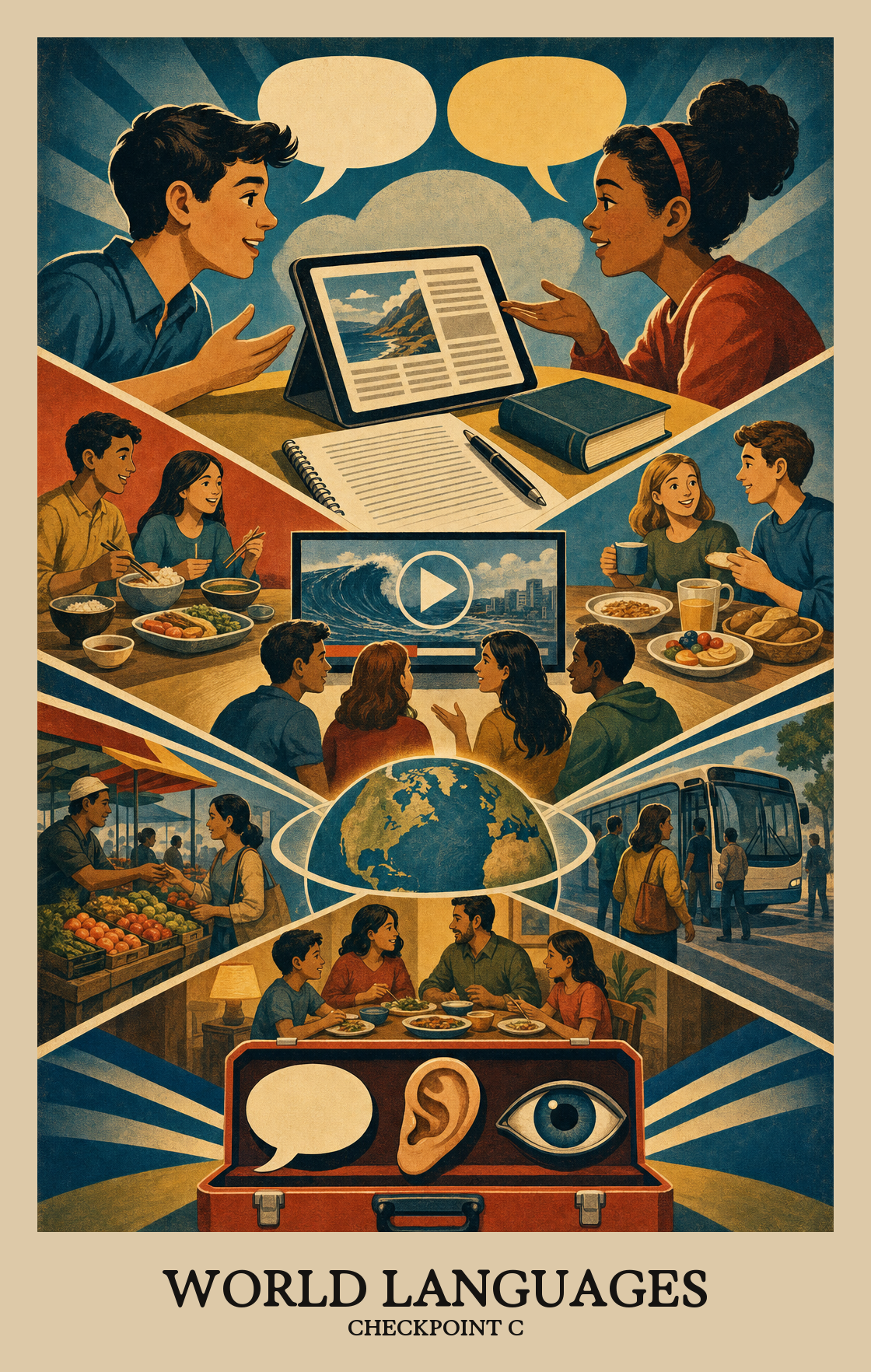
Students start the year speaking and writing the language for real reasons. They share opinions, ask follow-up questions, and keep a conversation going about everyday topics without falling back into English.
Students work with articles, videos, and stories made for native speakers. They pick out the main idea, notice the tone, and explain what the writer or speaker is really getting at.
Students look at how people in other countries live, eat, celebrate, and treat each other. They explain why a tradition or everyday habit makes sense to the people who grew up with it.
Students read and discuss topics from science, history, or current events in the new language. They compare sources, weigh different points of view, and notice how the language shapes the message.
Students put longer pieces together, such as a short talk, a written story, or a video. They adjust their words for the audience, whether that is a classmate, a younger student, or a pen pal abroad.
Students use the language outside the classroom through online exchanges, community events, or media they choose themselves. They set personal goals and track how their speaking and reading have grown over the year.
Students read, listen to, and watch material on many topics in the target language, then pull out meaning and explain what the content says or implies.
Students hold back-and-forth conversations in a second language, adjusting what they say based on how the other person responds. They share facts, opinions, and reactions, not just rehearsed phrases.
Students give prepared speeches, write essays, or create videos to share information or make an argument on topics they've studied. They adjust their language and format based on who they're presenting to.
| Standard | Definition | Code |
|---|---|---|
| Learners understand, interpret Checkpoint C | Students read, listen to, and watch material on many topics in the target language, then pull out meaning and explain what the content says or implies. | DE-WL.1.1.wl-checkpoint-c |
| Learners interact and negotiate meaning in spoken, signed Checkpoint C | Students hold back-and-forth conversations in a second language, adjusting what they say based on how the other person responds. They share facts, opinions, and reactions, not just rehearsed phrases. | DE-WL.1.2.wl-checkpoint-c |
| Learners present information, concepts Checkpoint C | Students give prepared speeches, write essays, or create videos to share information or make an argument on topics they've studied. They adjust their language and format based on who they're presenting to. | DE-WL.1.3.wl-checkpoint-c |
Students explain why people in another culture do things the way they do, connecting everyday habits and traditions to the values and beliefs behind them.
Students examine everyday objects, art, or traditions from the culture they're studying and explain what those things reveal about how people in that culture see the world. They use the target language to do it.
| Standard | Definition | Code |
|---|---|---|
| Learners use the language to investigate, explain Checkpoint C | Students explain why people in another culture do things the way they do, connecting everyday habits and traditions to the values and beliefs behind them. | DE-WL.2.1.wl-checkpoint-c |
| Learners use the language to investigate, explain Checkpoint C | Students examine everyday objects, art, or traditions from the culture they're studying and explain what those things reveal about how people in that culture see the world. They use the target language to do it. | DE-WL.2.2.wl-checkpoint-c |
Students use the language they are learning to explore topics from other subjects, like science or history, and work through real problems. Studying two things at once deepens both.
Students read, listen to, or watch content in the target language to gather information and compare viewpoints they could not easily find in English alone.
| Standard | Definition | Code |
|---|---|---|
| Learners build, reinforce Checkpoint C | Students use the language they are learning to explore topics from other subjects, like science or history, and work through real problems. Studying two things at once deepens both. | DE-WL.3.1.wl-checkpoint-c |
| Learners access and evaluate information and diverse perspectives that are… Checkpoint C | Students read, listen to, or watch content in the target language to gather information and compare viewpoints they could not easily find in English alone. | DE-WL.3.2.wl-checkpoint-c |
Students study how the new language they are learning works differently from their own, noticing patterns in grammar, word order, or meaning that reveal how languages are built.
Students compare their own culture with the cultures tied to the language they are learning, then explain what those differences and similarities reveal about how people live and see the world.
| Standard | Definition | Code |
|---|---|---|
| Learners use the language to investigate, explain Checkpoint C | Students study how the new language they are learning works differently from their own, noticing patterns in grammar, word order, or meaning that reveal how languages are built. | DE-WL.4.1.wl-checkpoint-c |
| Learners use the language to investigate, explain Checkpoint C | Students compare their own culture with the cultures tied to the language they are learning, then explain what those differences and similarities reveal about how people live and see the world. | DE-WL.4.2.wl-checkpoint-c |
Students use the language they are learning to have real conversations and work with others, both inside school and out in the wider world.
Students set personal goals for using a second language and look back at how far they've come. The focus is on using the language in real life, whether for a hobby, a job, or just for fun.
| Standard | Definition | Code |
|---|---|---|
| Learners use the language both within and beyond the classroom to interact and… Checkpoint C | Students use the language they are learning to have real conversations and work with others, both inside school and out in the wider world. | DE-WL.5.1.wl-checkpoint-c |
| Learners set goals and reflect on their progress in using languages for… Checkpoint C | Students set personal goals for using a second language and look back at how far they've come. The focus is on using the language in real life, whether for a hobby, a job, or just for fun. | DE-WL.5.2.wl-checkpoint-c |
Students hold real conversations, read articles or short stories, and give presentations on topics they care about. They can handle most everyday situations in the language and start discussing opinions, current events, and culture with more depth.
Ask students to tell about their day in the language, even if you only catch a few words. Watch a show or listen to music in the language together and ask what a line meant. Ten minutes of regular exposure beats an hour once a week.
By the end, students can talk and write about familiar and some unfamiliar topics in connected paragraphs. They can read a news article or short story and pull out the main ideas, and they can compare how something works in the other culture versus their own.
Pick a few themes for the year, such as identity, food, or social issues, and pull communication, culture, and community work into each one. Build each unit around a real task students will do at the end, like an interview, a recorded talk, or a short article. The grammar and vocabulary come in to serve that task.
Some memorizing helps, but students gain more from using new words in conversation, writing, and reading. Encourage students to keep a small notebook of phrases they actually want to say and to reuse them in the next conversation.
Past tense control, connecting words like because, although, and however, and listening to unscripted speech are the common sticking points. Build short listening warm-ups from real audio and ask for written paragraphs often so weak spots show up early.
Most of the period. Aim for students to be the ones producing the language, with the teacher setting up tasks and stepping in to coach. Pair and small-group work usually gets more talk time than whole-class question and answer.
Listen for whether students can keep a conversation going when something unexpected comes up, not just when the topic is rehearsed. If they can read a short article and summarize it in the language, and write a paragraph with a clear point, they are ready to move up.
Suggest a pen pal, a language exchange app, a podcast on a topic they already like, or volunteering where the language is spoken. Even ordering food or following a recipe in the language counts. The point is regular, low-pressure use.