Pretending and playing together
Students step into make-believe play with classmates. They try on simple roles like a parent, a puppy, or a firefighter, and use their bodies and voices to bring the character to life.
This is the year students discover that pretending is a kind of thinking. Through dress-up, puppets, and acting out favorite stories, students learn to step into a character and show how that character feels. They start to notice what makes a story interesting and share their own ideas for what should happen next. By spring, students can take on a role in a simple classroom play and tell you who they were and why.
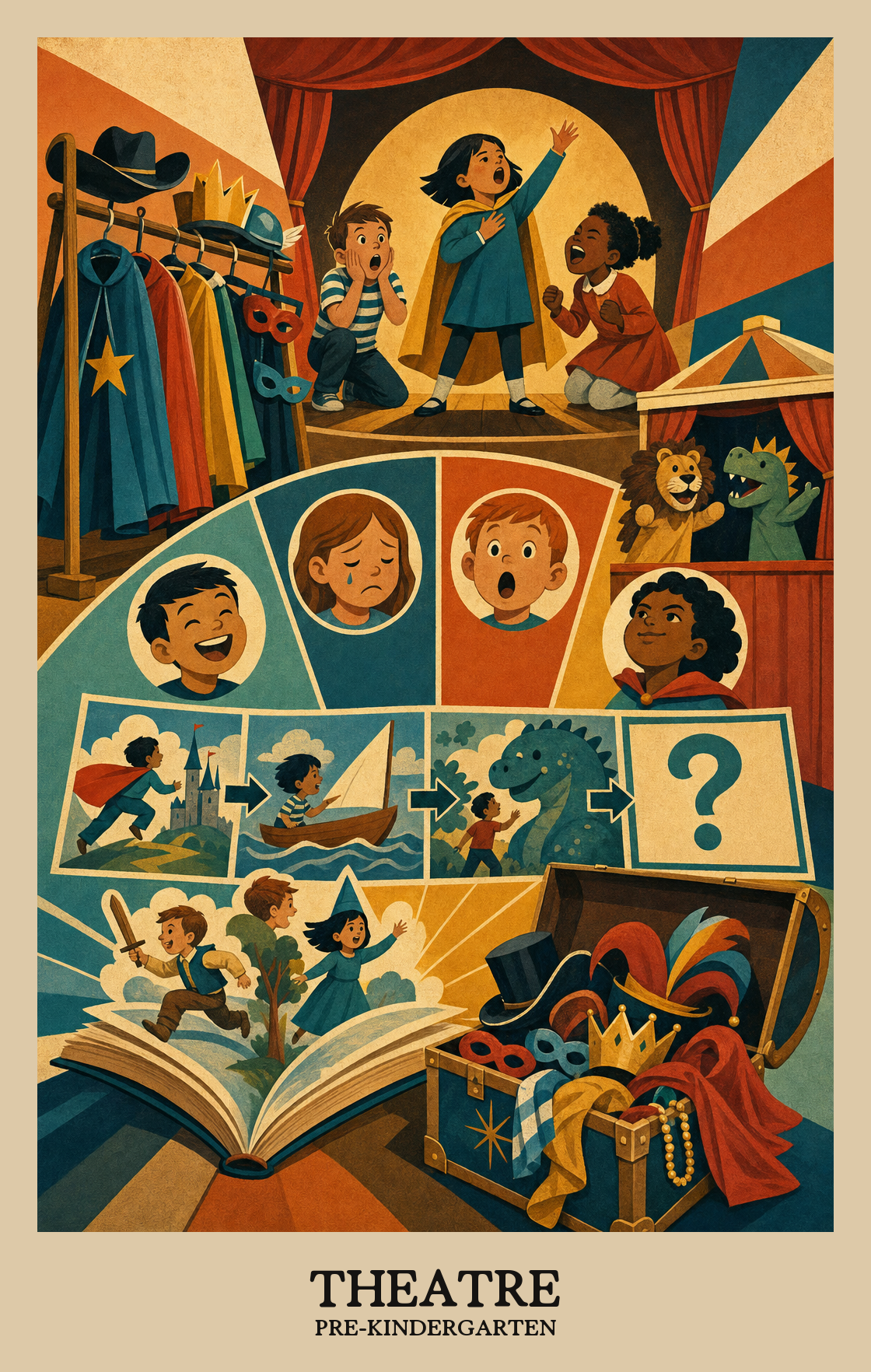
Students step into make-believe play with classmates. They try on simple roles like a parent, a puppy, or a firefighter, and use their bodies and voices to bring the character to life.
Students start turning ideas into little stories. They borrow from favorite books and from their own lives, then act out what happens first, next, and at the end.
Students practice a short scene or song to show to others. They work on speaking so the audience can hear and moving so the audience can see.
Students watch classmates perform and notice what the story was about. They share what they liked and what the characters were feeling.
Students connect their own life experiences to simple pretend play and storytelling. A memory, a feeling, or something they've seen at home can become part of what they act out.
Students connect a play, story, or character to their own life and the world around them, noticing how art reflects where people come from and how they live.
| Standard | Definition | Code |
|---|---|---|
| Synthesize and relate knowledge and personal experiences to make art | Students connect their own life experiences to simple pretend play and storytelling. A memory, a feeling, or something they've seen at home can become part of what they act out. | TH:Cn10.pk |
| Relate artistic ideas and works with societal, cultural | Students connect a play, story, or character to their own life and the world around them, noticing how art reflects where people come from and how they live. | TH:Cn11.pk |
Students invent characters and make-believe situations by playing pretend, drawing on their own ideas and imagination to create short scenes or stories.
Students use pretend play to try out an idea, then change or build on it. They might act out a story, add a new character, or find a different way to end it.
Students practice a short scene or puppet show more than once, making small changes until it feels ready to share.
| Standard | Definition | Code |
|---|---|---|
| Generate and conceptualize artistic ideas and work | Students invent characters and make-believe situations by playing pretend, drawing on their own ideas and imagination to create short scenes or stories. | TH:Cr1.pk |
| Organize and develop artistic ideas and work | Students use pretend play to try out an idea, then change or build on it. They might act out a story, add a new character, or find a different way to end it. | TH:Cr2.pk |
| Refine and complete artistic work | Students practice a short scene or puppet show more than once, making small changes until it feels ready to share. | TH:Cr3.pk |
Students pick a character or action to act out and practice showing it to others.
Students practice a short performance, like a song, a story, or a simple scene, and keep working on it until they feel ready to share it with others.
Students act out a story or feeling in front of others, using their face, body, and voice to show what something means.
| Standard | Definition | Code |
|---|---|---|
| Analyze, interpret, and select artistic work for presentation | Students pick a character or action to act out and practice showing it to others. | TH:Pr4.pk |
| Develop and refine artistic techniques and work for presentation | Students practice a short performance, like a song, a story, or a simple scene, and keep working on it until they feel ready to share it with others. | TH:Pr5.pk |
| Convey meaning through the presentation of artistic work | Students act out a story or feeling in front of others, using their face, body, and voice to show what something means. | TH:Pr6.pk |
Students look at a short play or puppet show and talk about what they noticed, what happened, and how it made them feel.
Students look at a puppet show or drawing and talk about what they think is happening and how it makes them feel.
Students look at a drawing or a performance and say what they like about it and why. They start to notice what makes something good.
| Standard | Definition | Code |
|---|---|---|
| Perceive and analyze artistic work | Students look at a short play or puppet show and talk about what they noticed, what happened, and how it made them feel. | TH:Re7.pk |
| Interpret intent and meaning in artistic work | Students look at a puppet show or drawing and talk about what they think is happening and how it makes them feel. | TH:Re8.pk |
| Apply criteria to evaluate artistic work | Students look at a drawing or a performance and say what they like about it and why. They start to notice what makes something good. | TH:Re9.pk |
Most of it is pretend play. Students act out stories, take on roles like a doctor or a dragon, and use their bodies and voices to show feelings. Watching a short puppet show and talking about it counts too.
Play pretend together for ten minutes a day. Use a blanket as a cape, a spoon as a microphone, or stuffed animals as characters. Ask what is happening in the story and who each character is.
No. At this age, acting out a story for a parent or a small group of classmates is plenty. The goal is comfort with pretending and sharing ideas, not a polished show.
Start with solo pretend play and simple role-taking in the fall. Move into acting out familiar stories with a partner by winter. By spring, small groups can plan a short scene together and share it with the class.
Acting out a picture book deepens story comprehension. Pretend play in the dramatic play corner builds vocabulary and turn-taking. A short movement game can warm up bodies before circle time.
Let them watch first. Many shy students join in once they see the routine and feel safe. Offering a small role, like holding a prop or making a sound effect, often works better than asking them to speak.
Students should pretend to be a character, use voice and body to show a feeling, act out a short story with classmates, and say what they liked about a scene. Some will share opinions about why a character acted a certain way.