Listening and finding the beat
Students start the year by listening closely to short songs and finding the steady beat. They learn to tell loud from soft and fast from slow, and to clap along in time.
This is the year music shifts from simple play to making real choices about sound. Students invent short tunes and rhythms, then practice them until they are ready to share. They sing and play in front of others, listening for what works and trying it again. By spring, they can perform a short song with steady rhythm and talk about how a piece of music made them feel.
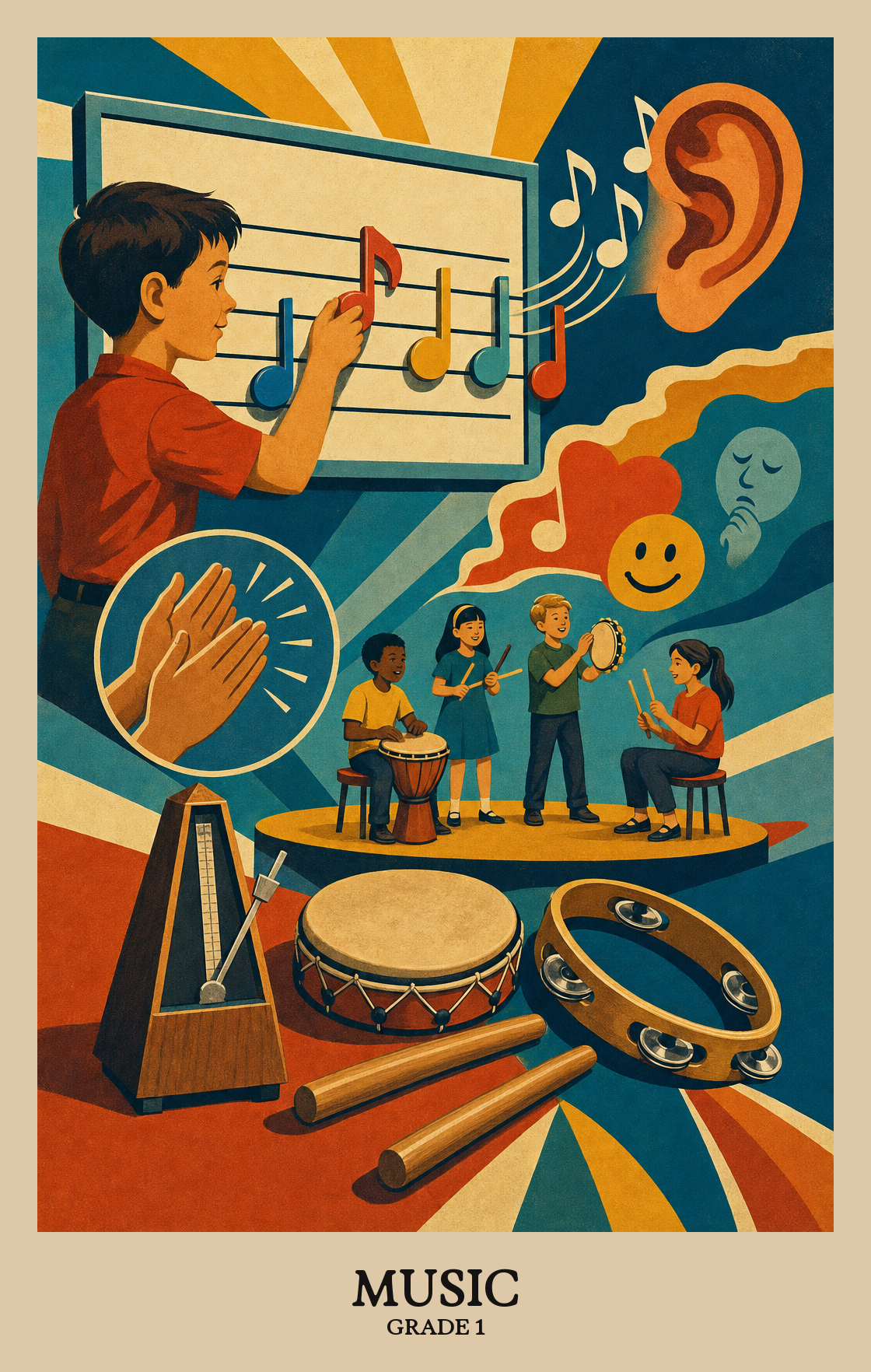
Students start the year by listening closely to short songs and finding the steady beat. They learn to tell loud from soft and fast from slow, and to clap along in time.
Students sing simple songs as a group and try out classroom instruments like drums, shakers, and bells. They practice matching pitch and taking turns so the music holds together.
Students invent short patterns by clapping rhythms or picking a few notes. They try ideas, keep what sounds good, and build a tiny piece of their own to share.
Students perform songs for classmates and learn pieces from different cultures and times. They talk about what a song might mean and how it makes them feel.
Students connect what they already know and feel to the music they make and listen to. A song might remind them of home, a season, or a memory, and that connection shapes how they perform or respond to it.
Music connects to the world outside the classroom. Students begin to see how a song, rhythm, or instrument ties to a place, a time, or a community.
| Standard | Definition | Code |
|---|---|---|
| Synthesize and relate knowledge and personal experiences to make art | Students connect what they already know and feel to the music they make and listen to. A song might remind them of home, a season, or a memory, and that connection shapes how they perform or respond to it. | MU:Cn10.1 |
| Relate artistic ideas and works with societal, cultural | Music connects to the world outside the classroom. Students begin to see how a song, rhythm, or instrument ties to a place, a time, or a community. | MU:Cn11.1 |
Students come up with their own musical ideas, like inventing a rhythm to clap or choosing sounds that go together. This is where a song or beat starts.
Students arrange sounds and musical ideas into a short piece or pattern. They experiment with what comes first, what comes next, and how the whole thing fits together.
Students listen back to their own music, decide what to change, and practice until the piece sounds the way they want it to.
| Standard | Definition | Code |
|---|---|---|
| Generate and conceptualize artistic ideas and work | Students come up with their own musical ideas, like inventing a rhythm to clap or choosing sounds that go together. This is where a song or beat starts. | MU:Cr1.1 |
| Organize and develop artistic ideas and work | Students arrange sounds and musical ideas into a short piece or pattern. They experiment with what comes first, what comes next, and how the whole thing fits together. | MU:Cr2.1 |
| Refine and complete artistic work | Students listen back to their own music, decide what to change, and practice until the piece sounds the way they want it to. | MU:Cr3.1 |
Students choose a song or piece to perform and think about how they want it to sound before they play or sing it.
Students practice a song or rhythm until it sounds the way they want it to, then share it with an audience. The focus is on getting better through repetition, not just performing once.
Students perform a song or rhythm for an audience and make deliberate choices, like tempo or dynamics, to express a feeling or idea.
| Standard | Definition | Code |
|---|---|---|
| Analyze, interpret, and select artistic work for presentation | Students choose a song or piece to perform and think about how they want it to sound before they play or sing it. | MU:Pr4.1 |
| Develop and refine artistic techniques and work for presentation | Students practice a song or rhythm until it sounds the way they want it to, then share it with an audience. The focus is on getting better through repetition, not just performing once. | MU:Pr5.1 |
| Convey meaning through the presentation of artistic work | Students perform a song or rhythm for an audience and make deliberate choices, like tempo or dynamics, to express a feeling or idea. | MU:Pr6.1 |
Students listen to a short piece of music and describe what they notice, such as whether it feels fast or slow, loud or quiet, or happy or sad.
Students listen to a short piece of music and explain in their own words what they think the composer or performer was trying to say or show.
Students listen to a piece of music and decide what they think is good or not so good about it, using simple reasons like "the beat is steady" or "the singing is too quiet."
| Standard | Definition | Code |
|---|---|---|
| Perceive and analyze artistic work | Students listen to a short piece of music and describe what they notice, such as whether it feels fast or slow, loud or quiet, or happy or sad. | MU:Re7.1 |
| Interpret intent and meaning in artistic work | Students listen to a short piece of music and explain in their own words what they think the composer or performer was trying to say or show. | MU:Re8.1 |
| Apply criteria to evaluate artistic work | Students listen to a piece of music and decide what they think is good or not so good about it, using simple reasons like "the beat is steady" or "the singing is too quiet." | MU:Re9.1 |
Students sing simple songs, clap and tap steady beats, and try out instruments like shakers and drums. They learn to tell loud from soft, fast from slow, and high from low. By spring, most can keep a beat with a group and make up short musical patterns of their own.
Sing along to the radio, clap the beat of a favorite song, or march around the kitchen to music. Ask which part sounded happy or sad and why. Five minutes of this a few times a week builds the same ear that music class is building.
No. Many students at this age are still finding their singing voice and prefer to listen or hum first. Keep singing together at home in a low-pressure way, like in the car or at bath time, and confidence usually grows by the end of the year.
Most can match a simple tune with their voice, keep a steady beat, and play a short pattern on a classroom instrument. They can also say what they liked about a piece of music and give a simple reason, like the drums were loud or the song felt slow.
Start with steady beat, echo singing, and listening routines in the fall. Move into high and low, loud and soft, and basic rhythm patterns by winter. In spring, layer in short composing tasks and small group performances so students apply what they know.
Keeping a steady beat with a partner or group is the one that needs the most return visits. Distinguishing beat from rhythm also tends to slip. Short daily warm-ups with body percussion and echo patterns hold up better than one long lesson per week.
Use quick check-ins during normal class activities: who can echo this pattern, who can keep the beat while we sing, who can pick the louder of two examples. Notes on a class roster across a few weeks give a clearer picture than any single performance task.
They can sing a short song in tune with the group, keep a beat through a whole song, and play a simple rhythm on a classroom instrument. They can also listen to a short piece and say one thing about it, such as the tempo or the mood.